Coimbra’s sights are stacked vertically. The university sits on top of the hill, the churches step down the slope beneath it, the lower town is on the flat by the river, and the left bank is across the water. That geography is also the itinerary: start at the top, and every subsequent decision is downhill.
The city was inscribed on the UNESCO World Heritage List in 2013 as “Universidade de Coimbra – Alta e Sofia”, and it is worth noting what that covers: 32 buildings across the upper town and Rua da Sofia, not just the photogenic courtyard. Most guides treat “UNESCO Coimbra” as one square.
Three significant sights are closed right now, all three without a published reopening date, and we put them in the at-a-glance box rather than hiding them at the bottom. Read that part first if you are deciding whether to come at all — the honest verdict page takes the question head-on.
The university complex
One ticket, several buildings, and the thing most people come to Portugal’s centre to see.
Biblioteca Joanina, finished 1728, roughly 60,000 volumes printed between the fifteenth and eighteenth centuries, three halls in black, red and green under painted ceilings, and King John V looking down from a Domenico Duprà portrait. Walls 2.11 metres thick hold the interior stable without machinery; oak shelving repels insects; two colonies of bats eat what gets through. It is still a working library — an average of 750 works are requested from it each year. Entry is fifty people every twenty minutes at a fixed time, and photography on the Noble Floor is prohibited.
Prisão Académica is not an optional extra. It is the way in. Medieval in origin and the oldest preserved prison in Portugal: two narrow cells and a winding staircase from the primitive structure, plus communal cells, a visiting room, a prayer room and latrines added in 1782. On the Middle Floor the arch stones still carry each mason’s chisel signature, used to count his work so he could be paid.
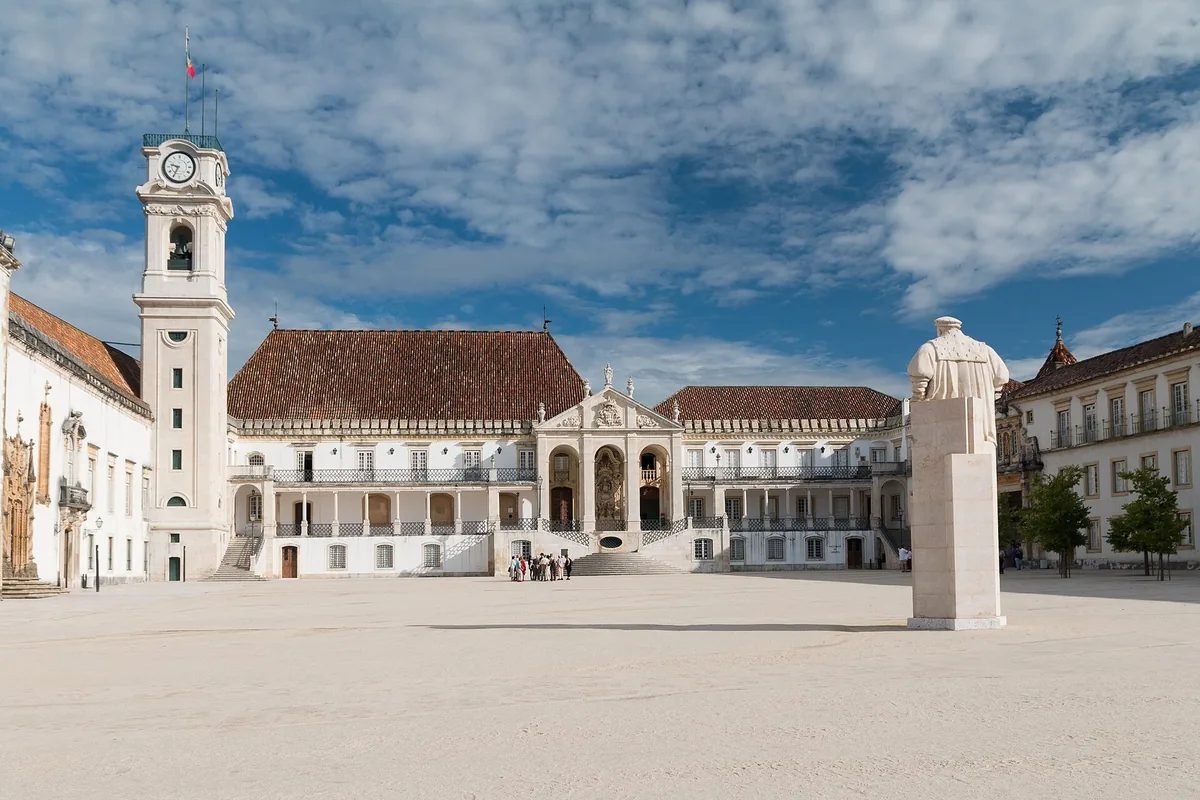
Paço das Escolas began as a tenth-century fortress under Islamic rule, became the first Portuguese royal household in 1131, and passed permanently to the University in 1544. Inside it, the Sala dos Capelos: 172 grotesque ceiling panels, portraits of every Portuguese king from Afonso Henriques to Manuel II with the Philippine dynasty of 1580–1640 deliberately missing, and the room where John I was proclaimed in 1385.
Capela de São Miguel, tiles of 1613, eighteenth-century gilt altarpiece, and a stone plaque recording the oath of 1646 after which Portuguese monarchs stopped wearing a crown. Closed every Sunday 11:45–14:00 for mass.
Torre da Universidade is closed. The university states it flatly, with no reason and no date. The 184-step climb and the under-6 age bar are on the record; the tower is not currently sold.
The ticket guide sets out all six programmes and the rules that govern them.
Two cathedrals and a pantheon
Coimbra has two cathedrals, three euros apart, and they are the best-value pair of buildings in central Portugal.
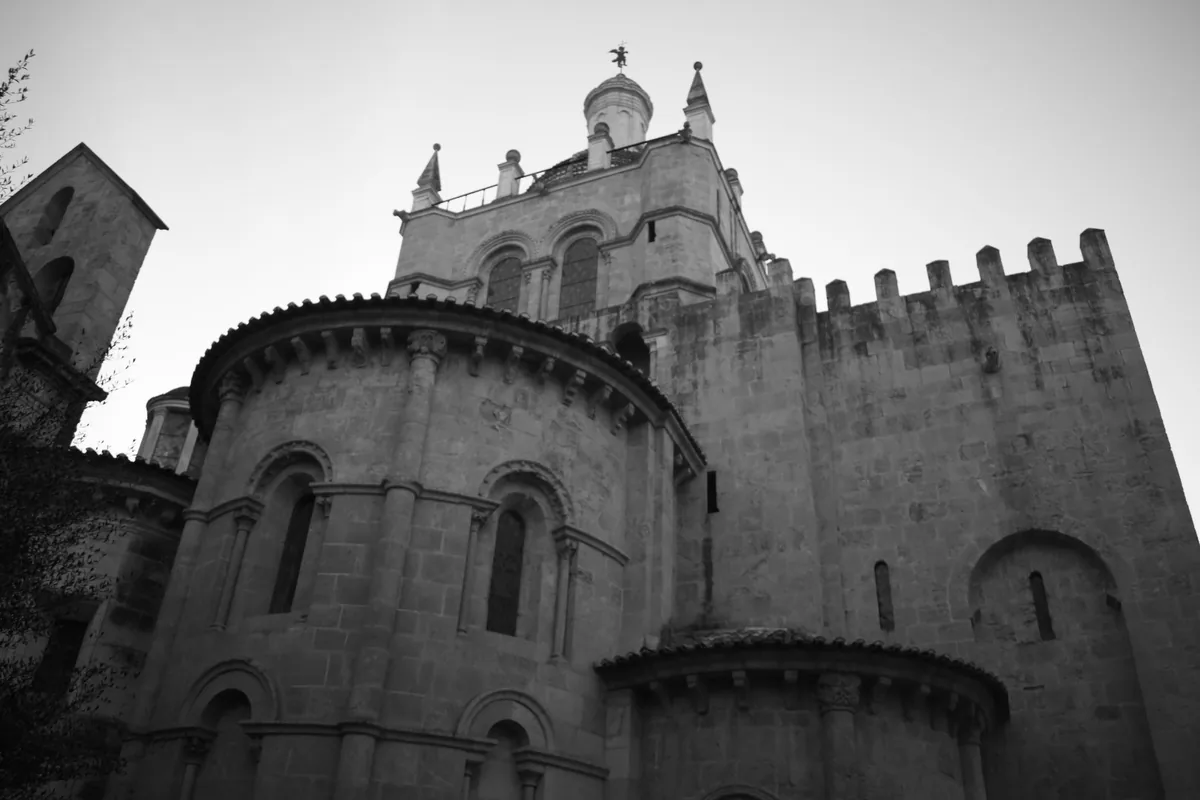
Sé Velha, 3.00 EUR. Begun in 1164, consecrated 1184, and the only Portuguese Romanesque cathedral of the Reconquest era to survive relatively intact. It looks like a fort because it was built like one.
Two corrections most guides need. It was not built by Afonso Henriques and he was not crowned in it — he was already dead. Construction began under Bishop Miguel Salomão, and in 1185 it was the second king, Sancho I, who was crowned there. The design is attributed to Master Robert, a Frenchman simultaneously running the Lisbon cathedral site.
The thing to look at is the carving. The parish calls the Romanesque capitals the richest iconographic programme of the Romanesque in Portugal — and they contain no human figures and no biblical scenes at all, probably because they were carved by Mozarabic artists settled in Coimbra. A cathedral whose sculpture refuses to depict people. The Gothic cloister was begun in 1218 and part of the hillside had to be cut away to fit it.
Sé Nova, 1.00 EUR, and it is the cheapest ticketed interior in the upper town. Begun in 1598 as the Jesuit College of the Eleven Thousand Virgins, inaugurated 1698 — a hundred years to build — and the Jesuits who built it were expelled sixty years later. It became the cathedral in 1772 for one reason: it was bigger. It holds the choir stalls and the Gothic-Manueline font carried up from the old cathedral. Open every day 09:00–18:00.
Mosteiro de Santa Cruz, 5.00 EUR, on Praça 8 de Maio in the lower town. Founded 1131, a National Pantheon, and the burial place of Portugal’s first two kings. The nave and the tombs are free. The 5.00 EUR buys the Claustro do Silêncio, the chapter house, the sacristy paintings, the museum of sacred art with the relics of St Teotónio, and the high choir stalls — the only place you get the view down the length of the church. Most visitors never buy it. Open Monday to Saturday 09:30–16:30, Sundays and religious holidays 13:00–17:00.
Igreja de São Tiago on Praça do Comércio is one of the city’s oldest buildings and the hardest to get information about: no official source publishes its hours, its admission or even its coordinates.
Across the Mondego
The left bank is a short walk across the bridge and it holds two monasteries, a miniature country and a garden with a murder in it.
Mosteiro de Santa Clara-a-Velha is closed, and has been since 20 October 2025, for a 1.54 million EUR requalification of its interpretation centre and surroundings. No reopening date is published. Watch for a trap while researching: a plausible-looking official page headed “Reabertura do Mosteiro de Santa Clara-a-Velha” is dated 22 June 2023 and refers to an earlier reopening entirely.
What you are missing is a fourteenth-century Gothic monastery that the Mondego drowned. The nuns endured three centuries of cyclical flooding before leaving permanently in 1677, and it was excavated out of the river silt in the 1990s. The official monument page notes that the most recent floods were in December 2019. The river has been trying to reclaim this building for 700 years and has not stopped.
Mosteiro de Santa Clara-a-Nova, 6.00 EUR — 3.00 EUR for groups of six or more and for ages 12–18, free under 12, formally described as a donation toward upkeep. It is where the nuns and the queen went. Open 08:30–17:00 in winter and 08:30–18:30 in summer, with no visits during services.
The reason to go is that the same queen is buried twice in the same building. In the main chapel’s retable sits the silver-and-crystal urn holding the incorrupt body of Queen Isabel. Go down to the coro baixo and you find her original Gothic stone tomb, carved by Mestre Pero in 1330, which the Poor Clares dragged up the hill with them when the floods drove them out. No flash photography inside.
Portugal dos Pequenitos, the 1940s miniature-Portugal park, is beside Santa Clara-a-Velha. Adult 14.95 EUR, ages 3–13 9.95 EUR, over-65s 11.95 EUR, and the park states a minimum visit of 90 minutes. Closed only on 25 December.
The gardens of Quinta das Lágrimas, where Inês de Castro was murdered in 1355, cost 3.50 EUR, close Mondays, and are covered on the Santa Clara neighbourhood page.
The museums, including the one that is shut
The Museu Nacional Machado de Castro is closed and has been since mid-February 2026, for conservation works under the national recovery plan, with storm damage over the winter on top. In February the director said it would be totally closed until June; by 12 June the reported plan was a phased reopening after the summer. As of today the official page still carries the closure notice, and no date is published.
What is behind those doors, when they open: one of Portugal’s most important collections of sculpture, sacred goldsmithing and painting, most of it drawn from the convents and monasteries politically extinguished in 1834, built over and around the Roman cryptoporticus of Aeminium — the mid-first-century vaulted substructure of the forum, which the museum describes as one of its most important attractions rather than a basement. The Gonçalo Byrne building won the Piranesi Prix de Rome in 2014.
The Museu da Ciência is bundled into the university tickets rather than sold alone: the Pombaline Chemistry Laboratory in a former Jesuit refectory, the Cabinet of Curiosities, the Mineral Gallery and the Physics Cabinet. Every day 10:00–19:00, last admission 18:45. The Natural History Gallery is closed, and twice every three months the Cabinet of Curiosities and Physics Cabinet shut for disinfestation — your ticket is usable on following days, without a refund.
The Museu Académico is included free in every standard university programme and almost nobody goes in. It covers the black capes, the burned ribbons and the student repúblicas — which is to say, the living tradition you will see in the streets outside.
The Museu Municipal is six buildings, not one: the Edifício Chiado, the Torre de Almedina’s walled-city display, the Torre de Anto’s Coimbra guitar and fado collection, the Sala da Cidade, an exhibition on the Jews of Coimbra in the old Inquisition building, and a mikveh — a Jewish ritual bath, which almost no English-language guide mentions. Most sites run Tuesday to Saturday, 10:00–13:00 and 14:00–18:00. No price list is published for any of them.
And the Botanical Garden is free: thirteen hectares, part of the 2013 inscription, 09:00–20:00 in summer and 09:00–17:30 in winter.
Free sights, arches and viewpoints
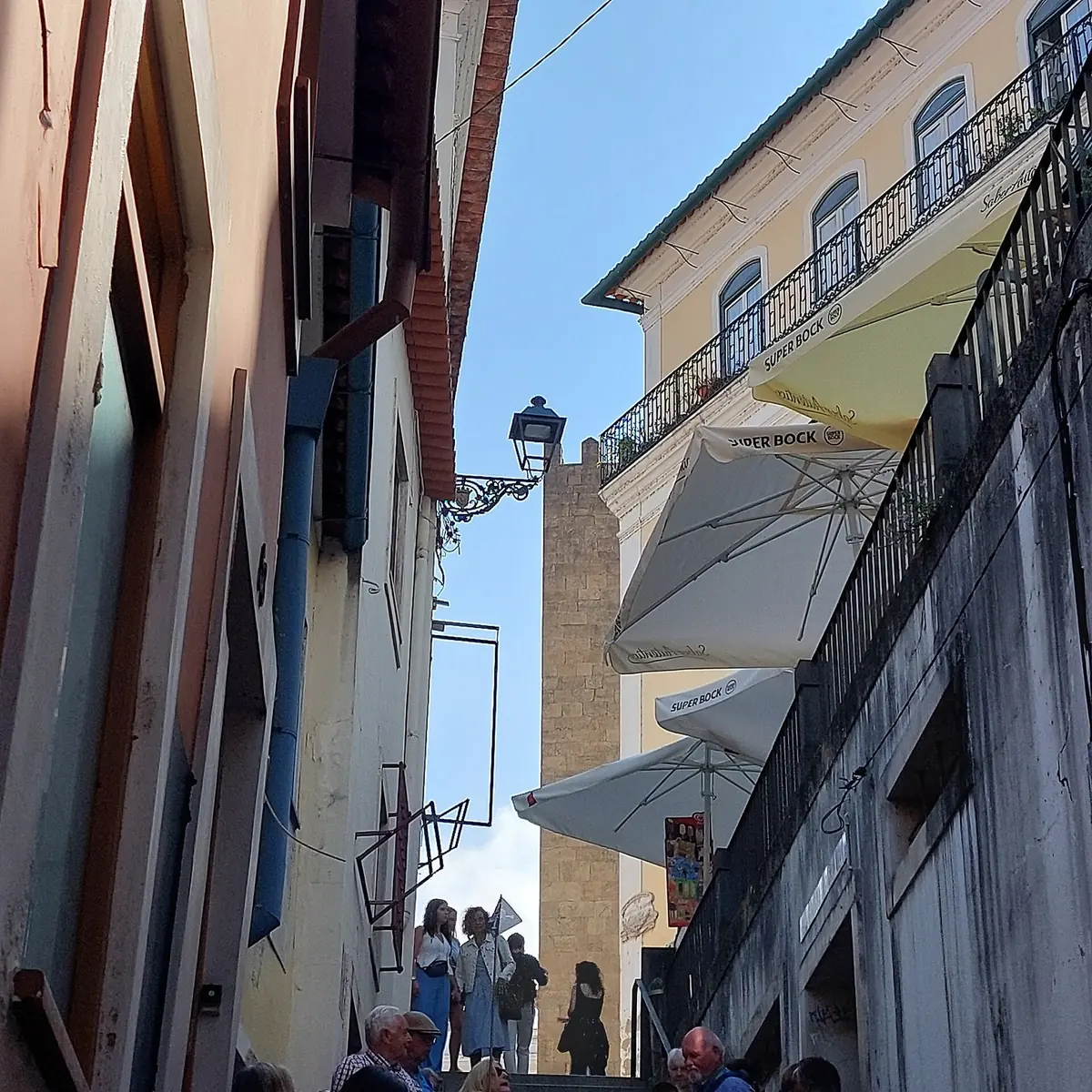
Arco de Almedina is the surviving main gate of Coimbra’s Moorish-founded walled town, on Rua Ferreira Borges at the foot of the climb. The arch is a public street: free, open, permanently walkable. The museum in the tower above it is the catch — Tuesday to Saturday only, 10:00–13:00 and 14:00–18:00, closed Sundays, Mondays and public holidays. Sunday is exactly when day-trippers have time, so a large share of visitors physically cannot get in.
Penedo da Saudade, the Crag of Longing, is a clifftop garden east of the centre whose rock faces and plaques carry verses left by generations of students. Free, unenclosed, and the quietest half-hour in Coimbra. No official page publishes hours — the municipal pages that used to now redirect to the tourism homepage — and we are not repeating the “open 24 hours” line from mapping apps, which is user-generated.
The Paço das Escolas courtyard is free to walk into and free to photograph: the library facade, the Via Latina colonnade and the closed clock tower within a few metres of each other. If the photograph is what you want, you do not need a ticket at all.
The gardens of Quinta das Lágrimas, across the river, are where Inês de Castro was murdered in 1355, and they come with a correction. Visitors expect a carved stone fountain; the foundation’s own text says the Fonte das Lágrimas is nothing of the kind — “não é uma fonte de pedra esculpida. Sai simplesmente da rocha”, it comes straight out of the rock — and the channel below it is lined with red algae that local tradition insists is Inês’s blood. The site also predates the legend: in a document of 26 June 1326, Queen Isabel asked the friars of Santa Cruz for the land around two springs, and the place was already called the Fonte dos Amores before Pedro and Inês ever met there.
The riverside, both banks and the Pedro e Inês footbridge, is the only place the whole hill town resolves into a single view. It is flat, it is free, and it is on the riverside walk.
The order to do all of this in is downhill, once, in a single line: the university at opening, the Sé Nova a minute away at 1.00 EUR, the Sé Velha fifteen minutes down the slope, through the Arco de Almedina into the lower town, and out at Santa Cruz on Praça 8 de Maio. That is the Alta to Baixa descent, and it is how the one-day itinerary is built.
The opening-hour traps
Coimbra’s sights do not keep convenient hours, and four specific patterns catch people out.
Sunday is the worst day. Santa Cruz does not open until 13:00. The Torre de Almedina museum does not open at all. St Michael’s Chapel closes 11:45–14:00 for mass. The Sé Velha opens at 11:00 rather than 09:30. If you have one day, do not make it a Sunday. The weekend itinerary is built backwards from what actually opens.
Mondays remove the left bank. The municipal museum sites close, and the Quinta das Lágrimas gardens close.
The two-hour lunch gap. Every municipal museum site except the Edifício Chiado shuts 13:00–14:00. That is the opposite of what people assume about city-centre landmarks, and it is the single most useful practical line about the Almedina tower.
The movable academic days. The entire university circuit closed on 24 May 2026 for Academic Week during the Queima das Fitas, and closes again on 4 October 2026 for the Latada. Santa Cruz closes on both parade days. A student festival shuts a World Heritage site and a national pantheon twice a year, and the dates move.
Seasonal changeovers. The Sé Velha runs summer hours June to September and winter hours October to May. The botanical garden changes on 1 April and 1 October. Portugal dos Pequenitos changes on 1 March and 16 October. Conímbriga closes on 24 July, which nobody expects.
The practical information page keeps the running list, and the when to visit guide maps the festivals against the closures.