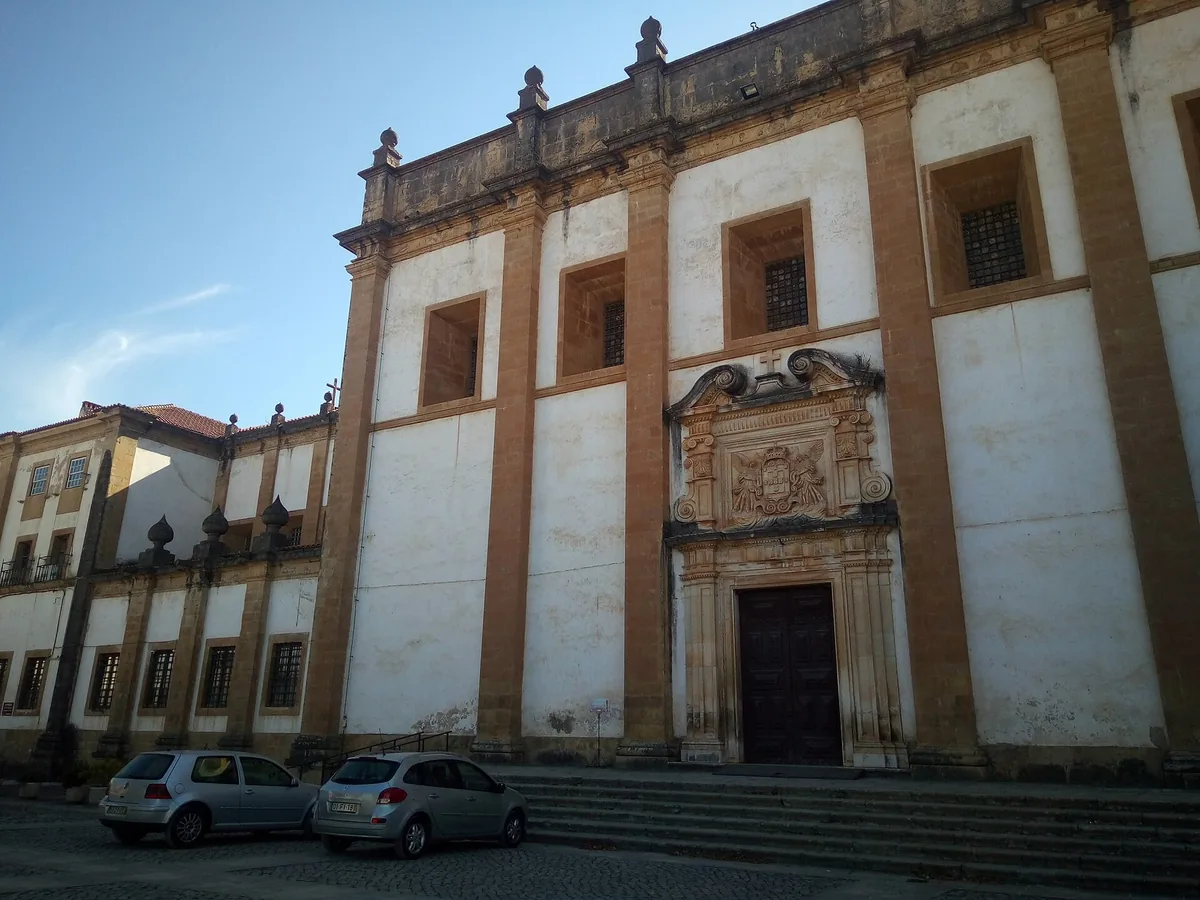

You climb the Calçada de Santa Isabel on the left bank and the building appears as a long, plain, pale wall along the ridge — more barracks than basilica, which is fair, because part of the complex still is an army barracks. Inside the church the proportions change completely: high, bright, baroque, and at the centre of the retable a silver-and-crystal urn holding the incorrupt body of Queen Isabel of Portugal.
Then go down to the coro baixo, the lower choir, and you find her again. Her original Gothic stone tomb, carved by Mestre Pero in 1330, is down there — the tomb the Poor Clares dragged up this hill with them when the Mondego finally drove them out of Santa Clara-a-Velha in 1677. Two tombs, one queen, one building, and almost nobody makes the climb.
Two tombs, one queen
Start upstairs, because that is what the church is built around. The silver-and-crystal urn sits in the retable of the main chapel, raised, lit and unmissable, holding the body of Queen Isabel.
It is a Baroque object doing a Baroque job: a relic made visible, expensive and central, in a church designed so that everyone in it is looking at the same point.
Then go down to the coro baixo. The lower choir is where the enclosed community sang, out of sight of the congregation, and it is where the first tomb ended up.
Mestre Pero carved it in 1330, in the queen’s own lifetime. Gothic, stone, austere, and completely unlike the silver upstairs.
Three hundred and forty-seven years separate the carving of that tomb from its arrival in this building. In between, the river drowned the monastery it was made for.
Think about the physical act. The Poor Clares abandoned Santa Clara-a-Velha permanently in 1677 and moved up the Monte da Esperança, and they brought the tomb with them. Not a relic in a box — a carved stone sarcophagus, up a hill.
That is what makes this the better of the two Clare monasteries to visit right now, and not only because the other one is closed. The whole story of the move is legible in one building, in two rooms, on two floors.
Take the stairs down deliberately rather than treating the lower choir as an optional extra. Most visitors photograph the urn and leave.
Photography is allowed, but no flash inside the monument, which is stated on the confraternity’s own page. In a lower choir with almost no daylight, that is a real constraint — brace against something.
One more reason to take your time: there is no interpretation in the building. No panels, no audioguide, no printed trail. Everything you understand here you will have brought with you or paid a guide for.
Give the church and both choirs about 45 minutes. That is the site’s own framing and it is right.
There is a theological logic to the doubling as well as a practical one. A Gothic tomb is a monument to a dead woman; a crystal urn is a display case for a body held to be incorrupt. The move from one to the other is the move from medieval commemoration to Counter-Reformation proof.
The community did not discard the first when it acquired the second. Both are here, on two floors, and the building lets you walk between two ways of venerating the same person.
If you see only one, see the stone. The silver is the spectacle, but the 1330 tomb is the object with the journey.
The queen who moved uphill
Isabel of Aragon married King Dinis of Portugal and became the queen Portugal calls the Rainha Santa, the Holy Queen. Coimbra is her city in a way that no amount of civic branding could manufacture: she founded a monastery here, was buried here, and is still the focus of a confraternity that runs this church.
Her foundation was on the flood plain. That decision looks careless now and was not — the left bank was where the land was, the water was, and the Franciscan tradition of poverty pointed away from the fortified hill opposite.
She also arranged the water. In a document dated 26 June 1326 she asked the friars of Santa Cruz, who owned the estate then called the Quinta do Pombal, for the land around two springs so she could pipe water 500 metres to her convent.
Those springs are now in the gardens of Quinta das Lágrimas, and they were already called the Fonte dos Amores before Pedro and Inês ever met there. The legend attached itself to a place the queen had used for plumbing.
So within two kilometres of each other on this bank you have her monastery, her water supply and her tomb, and the middle one has become a love story.
The move uphill in 1677 was her community’s decision, not hers — she had been dead for three and a half centuries. But it is why the Rainha Santa is now venerated on a ridge rather than beside a river.
Isabel’s reputation rests on charity rather than politics — hospitals, alms, the founding of religious houses — and the confraternity that runs this church is a direct continuation of that cult rather than a heritage body managing a monument.
The city still marks her. The Festas da Rainha Santa Isabel are Coimbra’s religious festival, and this church is their centre of gravity.
If you want the whole arc, do it in order: the closed monastery on the flats, the gardens with the springs, and then this hill. It is a morning, and it is the best thematic walk on the left bank.
A note on the name you will see everywhere. The church is signed as the Igreja da Rainha Santa Isabel as often as it is called Santa Clara-a-Nova, and both refer to the same building. Map apps use both.
A monastery and a barracks
The other thing to know before you arrive is that this is not a museum complex. Part of it is still an army barracks.
That explains the exterior: long, regular, institutional, with none of the sculptural display you would expect from a seventeenth-century monastic foundation of this size.
It also explains why the visit is tightly defined. You are seeing the church, the chapel and the choirs, in a building whose other functions are not open to you and never have been.
Do not treat that as a disappointment. Portugal is full of dissolved monasteries repurposed by the state after 1834, and most of them lost their religious function entirely. This one kept the church working.
The confraternity — the Confraria da Rainha Santa Isabel — runs the visits, and the framing is theirs: the admission is described formally as a donation toward the monastery’s upkeep rather than a museum ticket.
That distinction has a practical edge. There are no timed slots, no online booking flow and no audioguide app. You climb up, you pay at the door, and you are in a church.
It also means visits stop during services, which are Thursday at 18:00, Saturday at 16:30 and Sunday at 11:00. Those are the three windows to avoid.
And it means the experience is quieter than anything in the Alta. On a weekday morning you may be the only visitors in the building.
Which, given that the monument holds a queen in two tombs and a view back over the whole city, is a strange and welcome thing.
It is worth knowing how unusual that continuity is. In 1834 the Portuguese state extinguished the religious orders and took their property, which is where most of the sculpture in the Machado de Castro collection came from. Whole monastic complexes became barracks, hospitals and schools.
So the military presence here is not an oddity bolted on to a monument. It is the standard nineteenth-century outcome, and the survival of the church alongside it is the exception.
How to visit
Entry is 6.00 EUR each. Groups of six or more pay 3.00 EUR each, ages 12 to 18 pay 3.00 EUR, and under-12s are free.
A guided visit adds a flat 10.00 EUR on top of entry, regardless of how many people are in your group, and must be booked in advance on +351 239 441 674. For two people that is five euros each; for a family it is close to free.
Hours are generous by Coimbra standards: Monday to Sunday 08:30 to 17:00 in winter and 08:30 to 18:30 in summer. There is no closing day.
That 08:30 opening is the earliest of any ticketed site in the city, and it is the single best argument for doing this first and crossing back for the Alta afterwards.
No visits during services: Thursday 18:00, Saturday 16:30, Sunday 11:00. Sunday mid-morning is the one to plan around.
Photography without flash. Dress as for any working church.
Getting here is the real question, and the honest answer is that it is a climb from the river on the Calçada de Santa Isabel. If you are coming from the Baixa, cross the river and go up; allow more time than the map suggests.
Coimbra’s transport changed on 10 September 2026, when the Metrobus began running to Coimbra-B and Praça da República, so check the city’s own mobility hub rather than an older guide — details in getting around Coimbra.
Coming from the right bank on foot, allow twenty-five to thirty minutes from Praça 8 de Maio: down to the river, across, and then the climb. It is the climb that people underestimate, not the distance.
Prices at Portuguese sites are revised in January and mid-season. Re-check the confraternity’s page before you rely on a figure.
Bring cash, or at least do not assume otherwise. This is a confraternity door rather than a ticketing system, and the charge is framed as a donation toward upkeep.
For families the arithmetic is unusually kind: two adults at 6.00 EUR and two children under 12 free comes to 12 EUR for the whole visit, which is less than one adult ticket at Portugal dos Pequenitos down the hill.
What to look for
Beyond the two tombs, three things repay attention.
First, the sightlines. The church was designed so that the urn is visible from everywhere, and the effect is best from about two-thirds of the way back rather than from the front.
Second, the contrast in materials. Silver and crystal above, plain carved stone below. Two centuries with completely different ideas about how a holy body should be presented, in the same building, twenty steps apart.
Third, the lower choir as a room. Enclosed communities sang out of sight, and the architecture of that concealment — the grille, the separation, the acoustic relationship with the church above — is the part of monastic life that visitors almost never get to stand inside.
Outside, turn round. The ridge looks back over the Mondego to the Alta, with the university on the skyline, and it is one of the best free views in Coimbra — particularly useful this year, because the University Tower is closed.
From up here you can also see, on the flats below, the excavated outline of the monastery this community fled. The whole 1677 decision is visible in one glance.
The Alta from here reads as what it is: a fortified hill town with a university on top of it, stacked above a river, with the Baixa squeezed onto the flat strip between. No street-level view in Coimbra explains the city as economically as this one does.
Take five minutes for that view before you go in or after you come out. It costs nothing and it is the thing you will remember.
Fourth, if you have time: listen. An empty baroque church on a ridge is an acoustic object, and the reason Coimbra’s student singers care so much about stone staircases and stone squares is the same reason this room sounds the way it does.
What to combine
Santa Clara-a-Velha, down on the flats, is closed — since 20 October 2025, with no reopening date published. Read that page before you plan a detour, and ignore the 2023 “Reabertura” article that keeps surfacing in search results.
Portugal dos Pequenitos is on the Rossio de Santa Clara, open every day except Christmas Day, with a stated minimum visit of 90 minutes. Adults 14–64 pay 14.95 EUR.
Quinta das Lágrimas has the gardens, the springs Queen Isabel asked for in 1326, and the Fonte das Lágrimas — which is not a carved fountain but water coming straight out of the rock. Closed Mondays.
Then walk the river back. The Mondego riverside walk crosses the Pedro e Inês footbridge and puts the Alta in front of you the whole way.
For food afterwards, the left bank is thin on options and the Baixa is ten minutes back across the bridge, so plan lunch on the right bank rather than hoping something appears at the top of the hill.
On the other bank, Santa Cruz holds the first two kings and closes at 16:30, and the what to see in Coimbra guide sets the order for a day that works around this year’s closures.
If you would rather spend the afternoon on the water than the hill, the left bank is also where the Mondego kayaking and river cruise operators put you on the river the nuns lost their monastery to.