
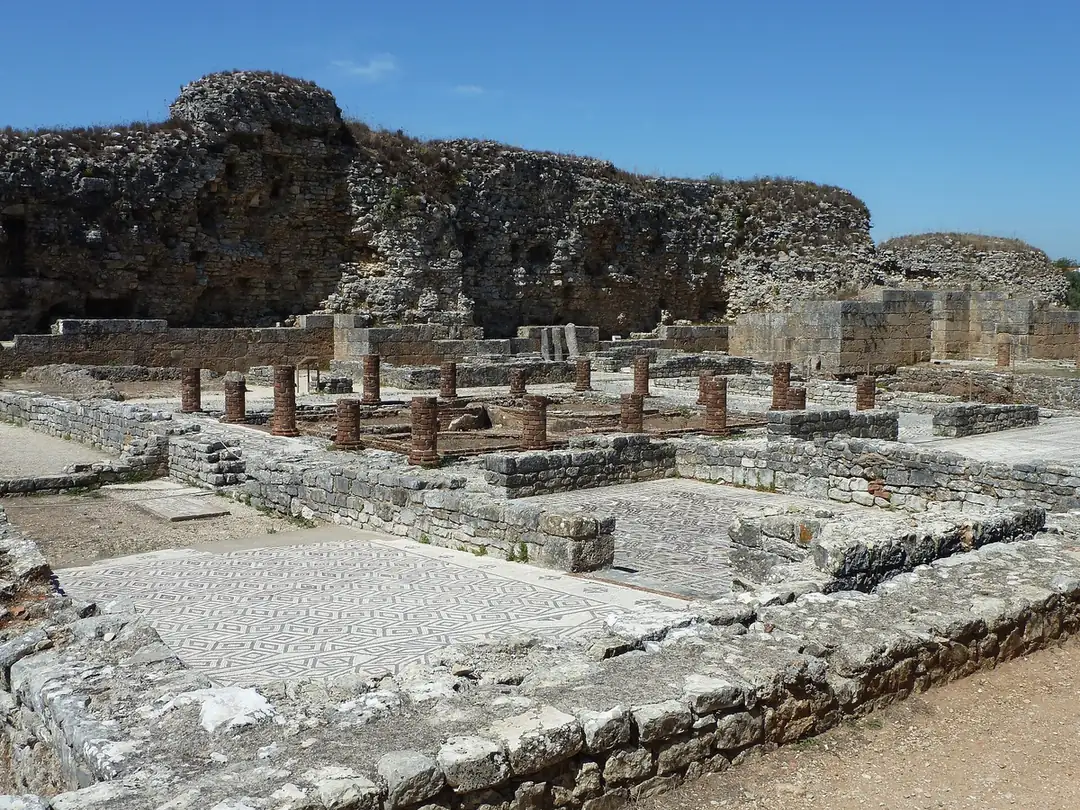
You walk in past the late wall the townspeople threw up in a hurry, and then the ground opens into floors. Not fragments behind glass — floors, in place, where they were laid, with a colonnaded garden in the middle of them and water still moving through it. Conímbriga is the best-preserved Roman town in Portugal and the mosaics are the reason.
It is also the reason the city you are staying in has its name. English Wiktionary derives Coimbra from Latin Conimbriga, noting the two are doublets — the same word, arrived twice. Roman Coimbra was called Aeminium; when Conímbriga declined, the name walked north with the bishopric. The parish history of the Sé Velha confirms it: Coimbra has been an episcopal seat since the fifth century, succeeding neighbouring Conímbriga.
The bus timetable, which is the whole trip
Start here, not with the ruins. Getting to Conímbriga is easy; getting back is the part that goes wrong.
The operator is SIT-RC — Sistema Intermunicipal de Transportes da Região de Coimbra — and the line is 209, from Coimbra (Portagem). It is not Transdev, whatever older guides say. Journey time about 37 minutes. On the timetable in force from 4 September 2026:
| Out from Coimbra | Back from Conímbriga | |
|---|---|---|
| Weekdays | 09:00 · 09:30 · 12:30 | 13:25 · 16:25 · 17:55 |
| Saturdays | 09:30 · 12:30 · 15:30 | 13:25 · 18:25 |
| Sundays & holidays | 09:30 · 12:30 · 15:00 | 13:55 · 18:25 |
Three buses a day each way, and only two back at weekends. Take the 09:00 on a weekday and the 17:55 home: you get the site nearly empty for the morning and hours in hand at the end. Miss the 17:55 and you are paying for a taxi across open country.
The Saturday 13:25 return gives you barely three hours on site including the walk from the stop, so the realistic weekend pattern is the 09:30 out and the 18:25 back — eight hours for a three-hour site. That gap is the strongest argument for a guided trip if your only free day is a Saturday.
The fare is not published. SIT publishes line timetables but not fares on the pages we could reach, so we do not print one. En route the bus also stops at Santa Clara-a-Velha, the Convento de São Francisco and the Condeixa-a-Nova bus terminal.
Hours, tickets and the closure dates
Open every day, 10:00–18:00. The ticket office closes at 17:15 and the shop at 17:30, which is the detail that catches people arriving on the 15:30 Saturday bus.
Admission is 10.00 EUR per adult, covering both the excavated town and the Museu Nacional de Conímbriga on the site. It is free for school groups booked in advance, and free for residents in Portugal under the Acesso 52 initiative.
Closure dates: 1 January, Easter Sunday, 1 May, 24 July, and 24 and 25 December. The 24 July closure is the one nobody expects — check it before building a July day around the site, and see the July guide for the rest of that month’s traps.
Allow two and a half to three hours for the ruins and the museum together. With the 09:00 bus that leaves a long, unhurried middle to the day, which is exactly what this site rewards.
What to look for on the ground
The Casa dos Repuxos is the set piece: the House of Fountains, whose water gardens still work. What you are standing in is not decoration around a courtyard but a hydraulic system with mosaics laid around it, and the two were designed together. Watch the water before you photograph the floors.
The mosaics in situ. The thing that distinguishes Conímbriga from a museum of Roman fragments is that the floors are where they were made. You are looking at rooms, with thresholds, in the order somebody walked them.
The museum. It is on the site and included in the ticket, and it is where the small finds and the interpretation live. Do it after the ruins rather than before, when you have questions.
For the material the region sent the other way, note that the Queijo Rabaçal DOP zone covers this same corner of the district — Penela, and parts of Condeixa-a-Nova and Soure. You are in the cheese country as well as the ruins.
Accessibility, stated plainly
Conímbriga publishes an unusually honest position, and it is worth repeating exactly.
The museum has no architectural barriers and is accessible to visitors with reduced mobility. There are adapted toilets by the shop and the ticket office, and a wheelchair is available to borrow.
The ruins are not accessible. The site’s own words are that they do not yet meet the conditions — “as Ruínas ainda não reúnem condições”. That is a straight answer to a question most heritage sites fudge, and it lets you plan honestly: the museum half of the visit works, the excavated town does not.
If that applies to you, the transport question changes too. A door-to-door guided trip removes the walk from the bus stop, though it cannot change the ground inside the site.
By car, and other ways in
The site publishes its road access: the A1 and IC2, taking the Condeixa-a-Nova exit signed for Conímbriga; the IC3 and IC8 toward Condeixa-a-Nova, with signed access near Condeixa-a-Velha; and the A13 from Tomar to Condeixa-a-Nova.
By train, the site directs you to the Linha do Norte to Coimbra-B, then bus or taxi via Condeixa-a-Nova. Note that the shuttle train from Coimbra-B into the city centre was permanently deactivated on 12 January 2025 — read the station guide, because your bus leaves from the Portagem in the city, not from the mainline station.
We do not publish a road distance. No official source states the Coimbra–Conímbriga kilometre figure, and the numbers circulating in guides are uncited. It is roughly sixteen kilometres in the sense that the etymology suggests a short walk for a name, and we will leave it there.
For how the site fits a longer stay, the two-day itinerary builds the whole second day around the 09:00 bus.