
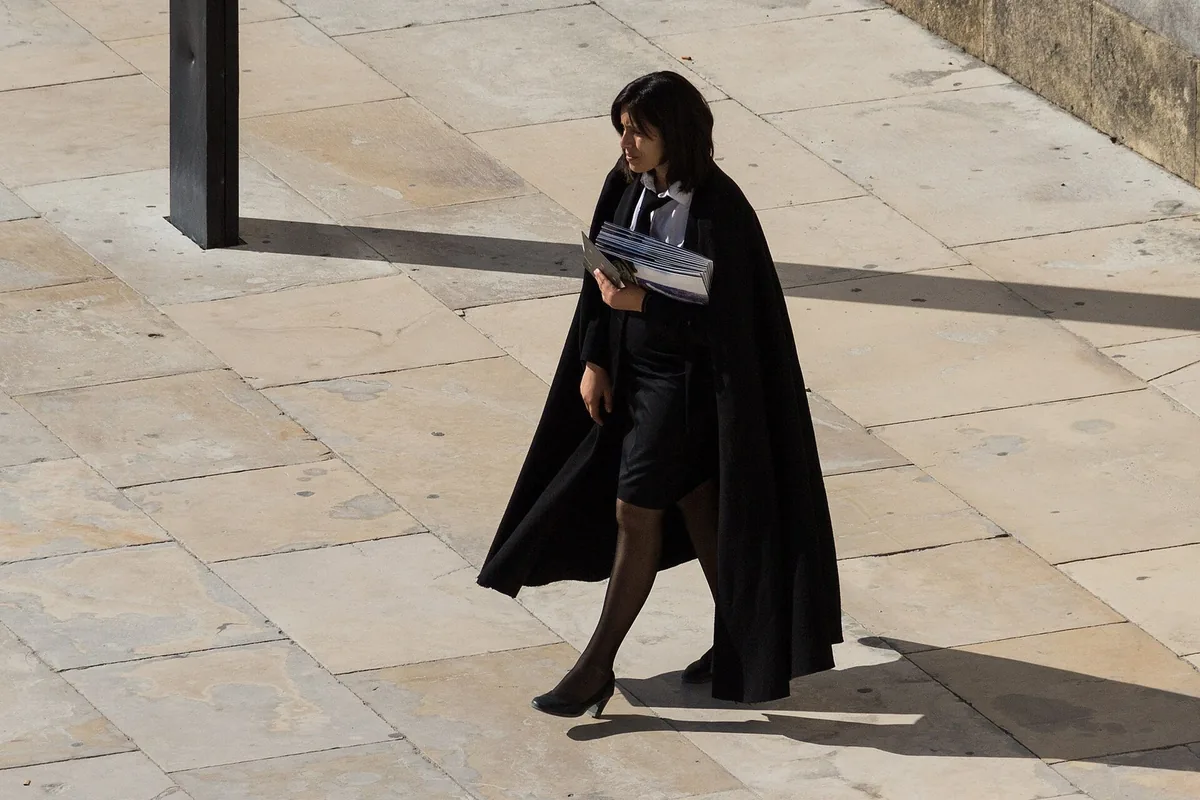
You will see them on the first evening, usually in twos and threes, coming down the hill toward the Baixa: black suit, black shoes, and a long black cape worn over one shoulder, sometimes deliberately frayed at the hem. It looks like a film set. It is not. It is the traje académico, the academic dress of the University of Coimbra, and nobody is wearing it for you.
What makes Coimbra different from every other old European university town is that the costume is not ceremonial-only. It goes to lectures. It goes to the pub. It gets rained on. And once a year it is the centre of an eight-day festival that the Câmara Municipal calls a maior festa Académica de toda a Europa — the largest student festival in all of Europe.
This page sets out what is documented about all of it, and is equally clear about what is not, because the black capes attract more confident folklore than almost anything else in Portugal.
A university that governed itself
Start with the institution, because the clothes make more sense once you know what they were worn inside.
The University of Coimbra held the Foro Académico: the privilege of governing itself and keeping its own legislation, which protected students, staff and professors from being tried and jailed alongside everybody else. A self-governing body needs the apparatus of governance, and Coimbra had it — including its own gaol.
That gaol still exists. The Prisão Académica is of medieval origin, is the oldest preserved prison in Portugal, and occupies the ground and middle floors of the Joanina Library building. You walk through it to reach the library, because it is the entrance. Two narrow cells and a winding staircase survive from the primitive structure; communal cells, a visiting room, a prayer room and latrines were added in 1782 under the Pombaline reforms.
The privilege was revoked in 1834. The cells outlasted it by nearly two centuries and are now a corridor for tourists.
The academic body that wore the capes, in other words, was a legal jurisdiction before it was a tradition. Its self-image as a distinct order of people with its own rules, rituals and hierarchy is not a student affectation grafted onto a modern university; it is a residue of a status the state formally recognised and then took away.
Hold that thought when you see a first-year in a cape being ordered around by a fourth-year. The structure being performed is older than the Republic.
The ribbons, and the colours
The festival is called Queima das Fitas — the Burning of the Ribbons — and the ribbons are the point.
Students carry fitas in the colour of their faculty. Burning them marks the end of the degree. The Câmara Municipal puts the meaning precisely, and the precision is the good part: “Para os finalistas é o adeus à Universidade e à vida de estudante, para os caloiros é a integração oficial na Academia” — for finalists it is goodbye to the university and to student life; for freshers it is formal initiation into the Academia. The same eight days mean opposite things depending on which end of the degree you are standing at.
The colours run through everything. The parade floats are decorated com as cores das Faculdades, and the university’s own building follows the same system: inside the Royal Palace the Yellow Room is yellow, in the university’s own words, in honour of the Faculty of Medicine, and the other rooms each carry a different colour for a different faculty.
Here is a gap we are not going to fill. Only Medicine equals yellow is confirmed from an official source. The full colour-to-faculty mapping circulates widely online — law red, letters dark blue, and so on — and we could not verify it against the University or the Associação Académica. If you want the complete list, ask at the Museu Académico, which exists precisely for this and is included free in every standard university ticket.
That museum is the single most under-visited thing in Coimbra. It covers the capes, the rituals, the repúblicas and the Queima, it is bundled into the 12.50 EUR and 16.50 EUR programmes, and almost nobody who buys those tickets walks into it.
Queima das Fitas, in order
Eight days in May, one for each of the university’s eight faculties. The 2026 edition ran 22–30 May, centred on Praça da Canção. The sequence is fixed and worth knowing even if you are only watching.
Serenata Monumental opens it, at the Largo da Sé Velha, and it begins after midnight strikes twelve — após soarem as 12 badaladas — when the guitars start and the students sing from the cathedral steps. In 2026 the city added a marked enclosure by the monument for access and safety. It is the one part of the festival that is genuinely solemn rather than loud.
Then, in 2026’s order: the “Queima” do Grelo at Largo da Sé Nova on 24 May at 10:00; the Cortejo dos Quartanistas, the parade, the same day, with carros alegóricos covered in paper flowers in faculty colours and carrying social satire and student demands; the Baile de Gala das Faculdades on 26 May; and Noites do Parque, nightly concerts at Praça da Canção. The Bênção das Pastas, the blessing of the folders, sat separately in June.
Eight days, eight faculties, and the list is the structure. The faculties usually given for the Coimbra edition are Humanities, Law, Medicine, Sciences and Technology, Pharmacy, Economics, Psychology and Education Sciences, and Sports Sciences and Physical Education — one day each, which is why the festival is eight days long rather than a round week. That list and the festival’s origin in the 1850s, its suspension in 1969 as academic mourning under the dictatorship and its resumption in 1980 all rest on a general reference source rather than on the university, so treat them as good rather than certain. The dates and the closures above are the parts we can source properly.
2027 dates are not published as of 15 September 2026. Do not assume it is always the third week of May, and do not plan flights around a guessed date. Our Queima das Fitas page will carry them when they exist.
The autumn twin, and the closures
The Queima has a mirror image at the other end of the academic year. The Latada, formally the Festa das Latas e Imposição de Insígnias, welcomes new students instead of sending finalists off, and it is deliberately, structurally undignified.
The Câmara Municipal’s own description: a serenade at Largo da Sé Nova by fado groups; a procession through the city in academic dress in which the caloiros parade in costumes devised for them by senior students, with tin cans tied to their ankles, making “um cortejo bastante ruidoso” — a distinctly noisy parade; and, at the end, the seniors baptising the freshers in the Mondego. The 2025 edition ran 29 September to 5 October, with the parade on the Sunday at 14:00.
Now the planning warning, which is the most useful thing on this page. Two institutions close for these festivals.
The University of Coimbra’s entire tourist circuit shut on 24 May 2026 for Academic Week and closes again on 4 October 2026 for the Latada. That means no Joanina Library, no Royal Palace, no Science Museum. And the Mosteiro de Santa Cruz lists closure on the day of the Queima Cortejo and on the day of the Latada Cortejo, both movable, alongside Christmas Day and New Year’s Day.
A UNESCO World Heritage site and a national pantheon both shut for a student parade. Check the university’s own information page before booking anything for late May or early October. The October guide and the May guide carry the rest of each month’s traps.
What we could not verify
Three claims come up constantly about the capes, and we are printing none of them as fact.
The frayed hems. You will be told the tears and cuts in the bottom of a cape are a record — one for each heartbreak, or each friendship, or each year survived. It is a lovely story and it may well be true; it is also exactly the kind of thing that gets invented for visitors and repeated until it hardens. No official or institutional source we could reach documents a fixed meaning. If somebody in a cape tells you what their own hem means, believe them about their own hem.
The film-costume connection. There is a very widely circulated claim linking the Coimbra traje to the robes in a well-known series of fantasy novels. We could not source it from the university, the Academia or any primary record, and it is repeated so often and so confidently online that its ubiquity is not evidence. We are not printing it as fact in either direction.
The origin story. Explanations for where the traje came from — monastic dress, sixteenth-century court dress, nineteenth-century invention — all circulate. What is documented and citable is the institutional history above: a university with its own law and its own prison until 1834, and a festival first organised by Coimbra students in the 1850s, suspended in 1969 as “academic mourning” in protest against the dictatorship, and resumed in 1980. Note that this last sequence rests on a general reference source rather than on the university, so treat the dates as good rather than certain.
If you want the tradition explained by people who own it, three places do it properly: the Museu Académico, a fado de Coimbra evening, where the music and the capes are the same culture, and the Torre de Anto, the municipal museum’s nucleus dedicated to the Coimbra guitar and its fado.