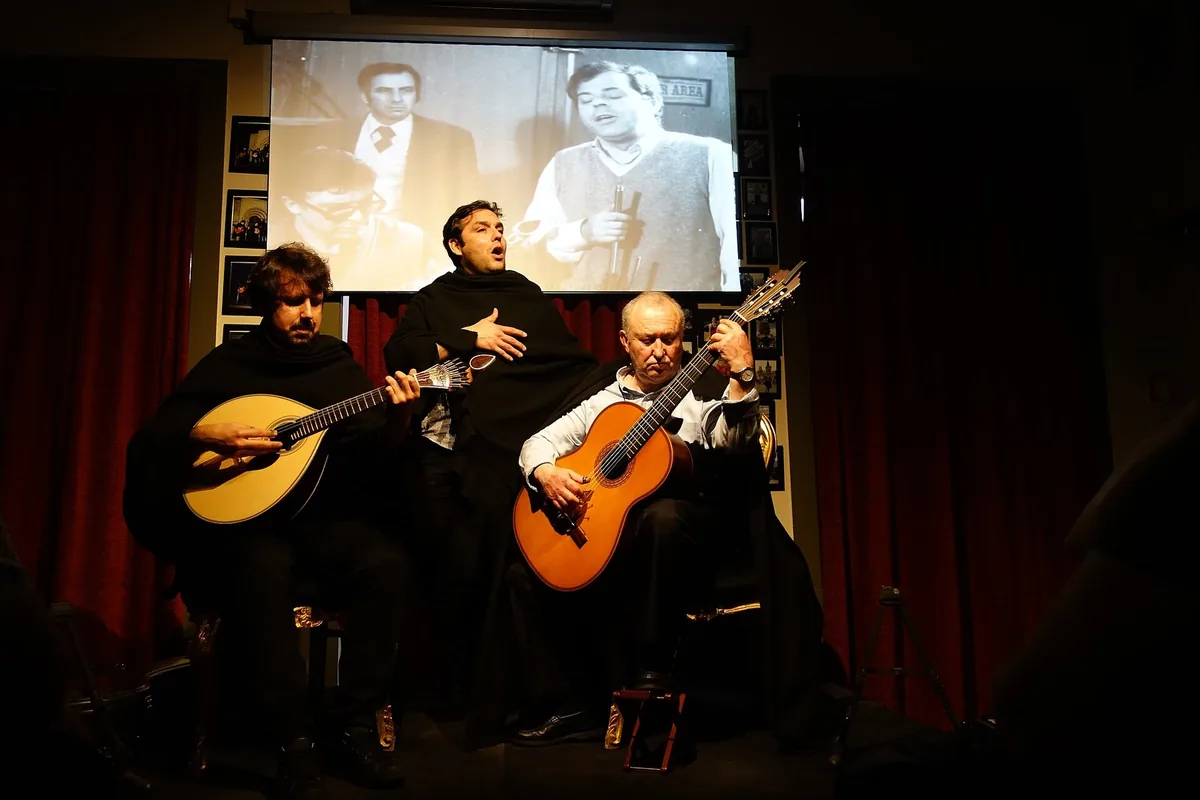
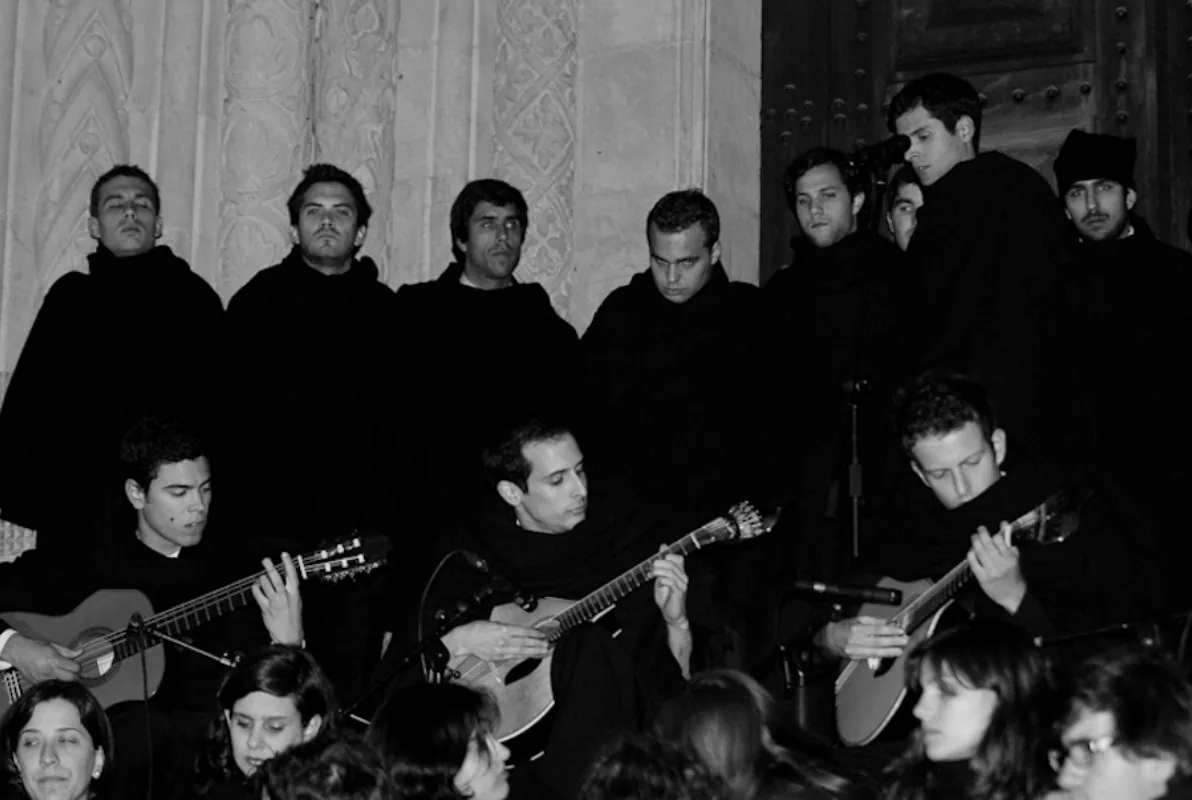
If you have heard fado in Lisbon, prepare to be wrong-footed. The instrument sounds lower. Nobody is sitting down. There is no woman in a shawl at the centre of it, and the men singing are wearing black capes because that is what they wear to lectures.
Turismo Centro de Portugal draws the line precisely: unlike Lisbon fado, which was traditionally performed by an underprivileged class, in Coimbra fado “o erudito e o popular partilhavam músicas, histórias e vivências” — the learned and the popular shared songs, stories and experience. For that reason it is defined as a fado of serenade, a fado of the street, with lyrics and music that are not only popular in origin but scholarly in character.
Students have been singing in these streets since the sixteenth century. What grew out of it is a music about longing for a woman, for the city, and for the university itself — and, over time, a broader form the Portuguese call the Canção de Coimbra, the Song of Coimbra.
How it differs from Lisbon fado
Four differences, all of them sourced to Turismo Centro de Portugal, and each one changes what you hear.
Class origin. Lisbon fado came out of the urban poor and the taverns. Coimbra fado came out of an academy, and from the start it mixed the learned with the popular rather than choosing between them. That is not a snobbery about which is better; it is a statement about where the words came from.
Form. Coimbra fado is a serenade and a street music — sung standing, outdoors, to somebody — rather than a seated tavern lament. Even indoors, in a ticketed room, the posture is a serenader’s. The performance is described as um acontecimento solene: a solemn event, not a floor show.
Lyrics. The poems come from “os mais ilustres poetas que passaram pela Academia de Coimbra” — the most illustrious poets who passed through the university. The subject is saudade, and its three objects are named: a woman, the city, and the Academia itself. A music with homesickness for an institution in it is a strange and specific thing.
Who performs it. It is sung by men, in the black traje académico. That follows from where it came from — a male student body serenading outside windows — and it is what you will see on any stage in Coimbra. We are describing the tradition as it is performed, not quoting a rule, because no official source we read states one.
And the tradition is older than the genre. Students singing in the streets of Coimbra is documented from the sixteenth century, which is to say the practice predates anything anybody would recognise as fado by three hundred years. What happened later was that a street habit acquired a repertoire, an instrumentation and a name — and then, over the twentieth century, grew outward into the broader Canção de Coimbra, the Song of Coimbra, which is where this music goes when it stops being fado.
Augusto Hilário, author of the Fado Hilário, is the figure named as having immortalised the form. If one name comes up on a stage in Coimbra, it will be his.
The guitar, tuned a tone lower
Here is the mechanism, and it is the thing that explains the sound before any of the history does.
The Guitarra Portuguesa de Coimbra is not the same instrument as the Lisbon guitarra. It is teardrop-shaped where the Lisbon instrument is scrolled, and — in the musicians’ own phrase, quoted by Turismo Centro — “é afinada num tom abaixo”: it is tuned one tone lower.
That is the answer to “why does this sound darker”. A whole tone down changes the register of every line the guitar plays, moves the resonance into the chest of the instrument rather than its top end, and puts the vocal line in a lower place relative to it. You do not need to read music to hear it; put a Lisbon recording and a Coimbra recording back to back and the difference arrives in about four seconds.
The people who made that sound modern are Artur Paredes and his son Carlos Paredes, named by Turismo Centro as the popularisers of the Coimbra guitar. Carlos Paredes is the reason the instrument travelled beyond the city.
Carlos Paredes is the name to search for afterwards. Turismo Centro names him and his father Artur as the musicians who popularised the Coimbra guitar, and the son is the reason the instrument left the city at all. A recording of his is the cheapest possible way to check, before you book anything, whether this music does something for you — and it will tell you more in four minutes than any description of a tuning can.
If you want to look at the instruments rather than only hear them, the municipal museum runs the Torre de Anto – Núcleo da Guitarra e do Fado de Coimbra on Rua de Sobre Ribas, dedicated to exactly this. It opens Tuesday to Saturday, 10:00–13:00 and 14:00–18:00, and closes Sundays, Mondays and public holidays. Admission is not published anywhere we could reach — the municipal museum publishes hours and addresses for all six of its sites and a price list for none of them. Almost no English-language guide mentions it at all.
Where you can actually hear it
Free first, because there is a free option and most guides skip past it to the ticketed one.
Café Santa Cruz, Praça 8 de Maio, inside the former Church of São João de Santa Cruz. Its own site lists Coimbra fado sessions at 18:00 and 22:00 daily, with no 22:00 session on Sundays, and admission free. You are in a 1530 church that was deconsecrated in 1834 and became a café in 1923, listening to fado, having bought a coffee. That is the best value in the city by a distance. What the café does not publish anywhere is its opening hours — not on its own English homepage — so do not plan a tight evening around it without checking at the door.
Fado ao Centro, Rua do Quebra Costas 7, is the ticketed show and the one most visitors end up at. Daily at 18:00, every day of the year without exception, running approximately 50 minutes. It was founded in Coimbra in 2010 by three musicians, all former University of Coimbra students, and it is built as much around explaining the tradition as performing it — which is the right format if this is your first encounter with it.
À Capella, Rua Corpo de Deus, performs in a chapel built in 1364. Turismo Centro lists it as daily at 21:30. Frommer’s reports it open 13:00–03:00 with fado at 21:30, 22:30 and 23:30 and a 5 EUR cover charge — but Frommer’s pages carry no date, so treat those times and that figure as needing confirmation at the door.
Quebra o Galho, Rua do Quebra Costas 12, runs fado nights 1 April to 15 November, daily except Saturdays, with booking compulsory. Its price is not published. Note the address: it and Fado ao Centro are a few doors apart on the same 120-metre stepped lane, the one officially named Back-Breaker Street.
Diligência Bar, Rua Nova 30, runs live music Monday to Saturday, 18:00–02:00. No ticket price is published.
Turismo Centro’s own booking warning applies to all of it: “aconselha-se a reserva antecipada, pois normalmente é difícil conseguir lugar no próprio dia” — book ahead, because it is usually hard to get a place on the day.
What it costs
One venue publishes a full ticket structure. Everybody else publishes nothing, and we are not filling that in for them.
Fado ao Centro, from its own ticket page: adults 16.00 EUR; youths 7–17, 9.00 EUR; children under 6 free, with the note that small children are welcome as long as absolute silence is maintained; family ticket 45.00 EUR for two adults and up to three youths. The ticket includes a glass of Port wine, and it guarantees a place in the concert hall but not a specific seat — entrance and seat selection are first-come, first-served.
And there is a free ticket, for exactly the right people. Fado ao Centro gives University of Coimbra bachelor’s and master’s students a free seat, on presentation of a current student card or proof of enrolment, capped at two per day. Postgraduates are not included. The music is about being a student in this city, and the venue lets students in for nothing. That is the best sentence on this page and it is on their own ticket page.
Everything else is a gap. À Capella’s cover charge comes from an undated third-party source. Quebra o Galho, Diligência and the Torre de Anto publish no prices at all. Café Santa Cruz is free but publishes no opening hours. If you want a figure for any of them, call.
On the online listings. The best-reviewed Coimbra product on GetYourGuide by volume is a fado show whose venue is given as Casa Fado ao Centro — a 50-minute show with a glass of Port, carrying a 4.7 rating across about 1,210 reviews when we checked on 15 September 2026. Prices and review counts on that platform moved between page loads on the same day, so we are not printing a figure. Our fado show page sets out what the booked version buys you over walking in.
When fado becomes a civic event
Twice a year the music leaves the venues and takes over a cathedral square, and if your dates line up this is the version to see.
The Serenata Monumental opens the Queima das Fitas in May. It happens at the Largo da Sé Velha, on the steps of the Old Cathedral, and it begins after the bell strikes twelve — “após soarem as 12 badaladas, quando se ouvem os primeiros acordes das guitarras e as vozes afinadas dos estudantes que se encontram na escadaria da Sé Velha”. Students sing the Canção de Coimbra from the cathedral staircase to a silent square. In 2026 the city added a marked enclosure by the monument for access and safety.
The 2026 Queima ran 22–30 May, with the Serenata on the night of the 21st into the 22nd. 2027 dates are not published as of 15 September 2026, and we will not extrapolate them.
The Latada is the autumn mirror image, welcoming new students rather than sending finalists off, and it has its own serenade — at Largo da Sé Nova, at midnight. In 2025 the festival ran 29 September to 5 October with the serenade on 1 October.
The planning warning attached to both: these festivals close things. The whole university visitor circuit shut on 24 May 2026 and closes again on 4 October 2026, and Santa Cruz closes on both parade days. A trip built around hearing the Serenata is a trip that will not see the Joanina Library that week.
What we could not verify
Two things, and we would rather say so than pass them on.
An audience convention that everybody repeats. There is a very widely circulated claim about how Coimbra audiences show approval at the end of a fado, and you will find it in almost every English-language article about this music. We could not find it in any official or institutional source we could reach. It may well be true. It is not something we are printing as fact, and if it matters to you, ask at the venue before the set starts — the staff at a fado house are used to the question and will tell you what their room does.
The general rule holds regardless: this is described by the regional tourism body as a solemn event, and rooms behave accordingly. Do not talk during a song. Do not photograph with flash. If you arrive late, wait at the back until a number ends.
Prices at four of the five venues. À Capella’s 5 EUR cover comes from a source with no publication date. Quebra o Galho, Diligência Bar, Café Santa Cruz’s wider programme and the Torre de Anto museum publish no admission figures we could source. Those are five phone calls we have not made, and we would rather tell you they are missing than fill them in.
What to do with all of this. If you have one evening, start with the free 18:00 session at Café Santa Cruz to hear whether the music does anything for you, then book Fado ao Centro for another night if it does. If you have one night only and want the explanation as well as the performance, book Fado ao Centro and skip the deliberation. And if you are here in late May, go and stand on the cathedral steps at midnight instead of doing either.
The music pairs with the rest of the student city: the Museu Académico covers the capes and the rituals and is already inside your university ticket, and the food guide is honest about which of the dishes on the menu beside your table actually come from Coimbra.