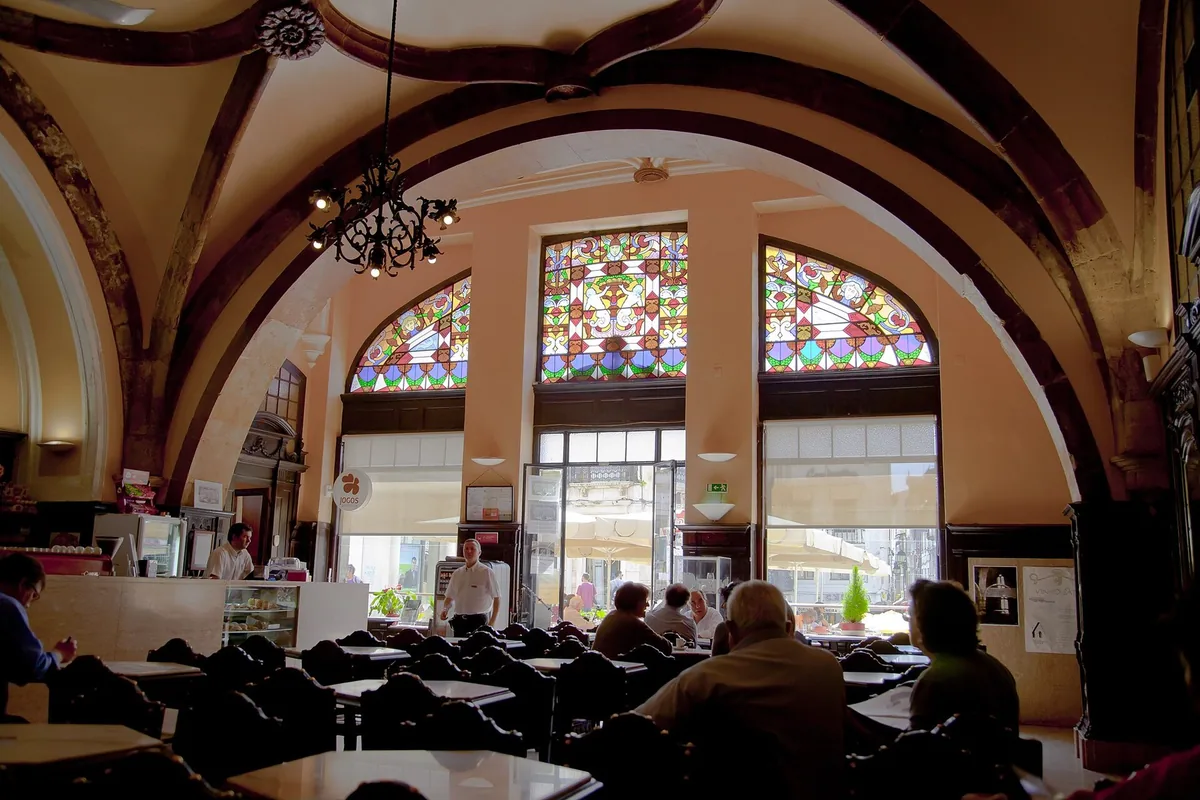

You order a coffee and then look up, and the ceiling is a vault. Not a decorative one — a real stone vault, forty feet above a room full of marble-topped tables, with stained glass at the end of it and wrought-iron chandeliers hanging down into the space where a congregation used to stand. Café Santa Cruz is inside a church. That sentence is true and it is also the least interesting version of the story.
The building is the former Church of São João de Santa Cruz, part of the monastery complex on Praça 8 de Maio. It was completed in 1530 under King John III and deconsecrated in 1834, when the religious orders were expelled after the Liberal Revolution. The café opened in 1923. Between those two dates the building spent nearly ninety years holding assorted commercial uses, which is the part every short write-up leaves out.
The eighty-nine-year gap
Here is the chronology as the Portuguese government’s own Comércio com História register sets it out, because it corrects a story that is told wrongly almost everywhere.
1131: the Monastery of Santa Cruz is founded under the Augustinian rule. 1530: the Church of São João is completed. 1834: deconsecration. Then a long stretch of ordinary commercial occupancy, lasting until 1920.
February 1921: the architect Jaime Inácio dos Santos presents renovation plans, with the building work carried out by Augusto Monteiro and his son José. October 1921: the whole complex is classified a National Monument. 1923: the café opens to the public.
So the popular shorthand — that the church became a café when the monks were expelled — is wrong by almost a century. The conversion was a deliberate 1920s project on a building that had already been through several other lives, and it happened in the same two years as the national classification. Somebody decided this room should be public and should stay standing, and then made it a café so that it would.
The later dates matter too. In 1974 Alexandre Marques took over management; in 1985 a company was formed with Marques, Marcelino Pestana and Arnaldo Gonçalves; a major requalification completed in 2001; a gold medal for business merit followed in 2013; and the café marked its centenary in 2023. Since 2015 it has been the headquarters of the Portuguese Association of Historical Cafes.
What to look at while you sit
Most of what is around you dates from the 1921–23 conversion rather than from the church, and knowing that makes it better rather than worse.
The stained glass is by the Almeida brothers and Afonso Pessoa. The wrought-iron chandeliers are by António Maria da Conceição. The original furnishings — marble tabletops and leather chairs — are documented as part of the same scheme.
What that adds up to is a complete 1920s interior inserted into a sixteenth-century shell, by named craftsmen, and largely intact a century later. It is a better example of early twentieth-century Portuguese design than of Manueline church architecture, and it is the rarer of the two.
Then look at the proportions. The room is far too tall for what it does. A café wants an intimate ceiling; this one has a nave. Every conversation in the place goes up into the vault and comes back slightly changed, which is also why the fado works here.
The free fado
This is the practical headline and the reason to plan around the address.
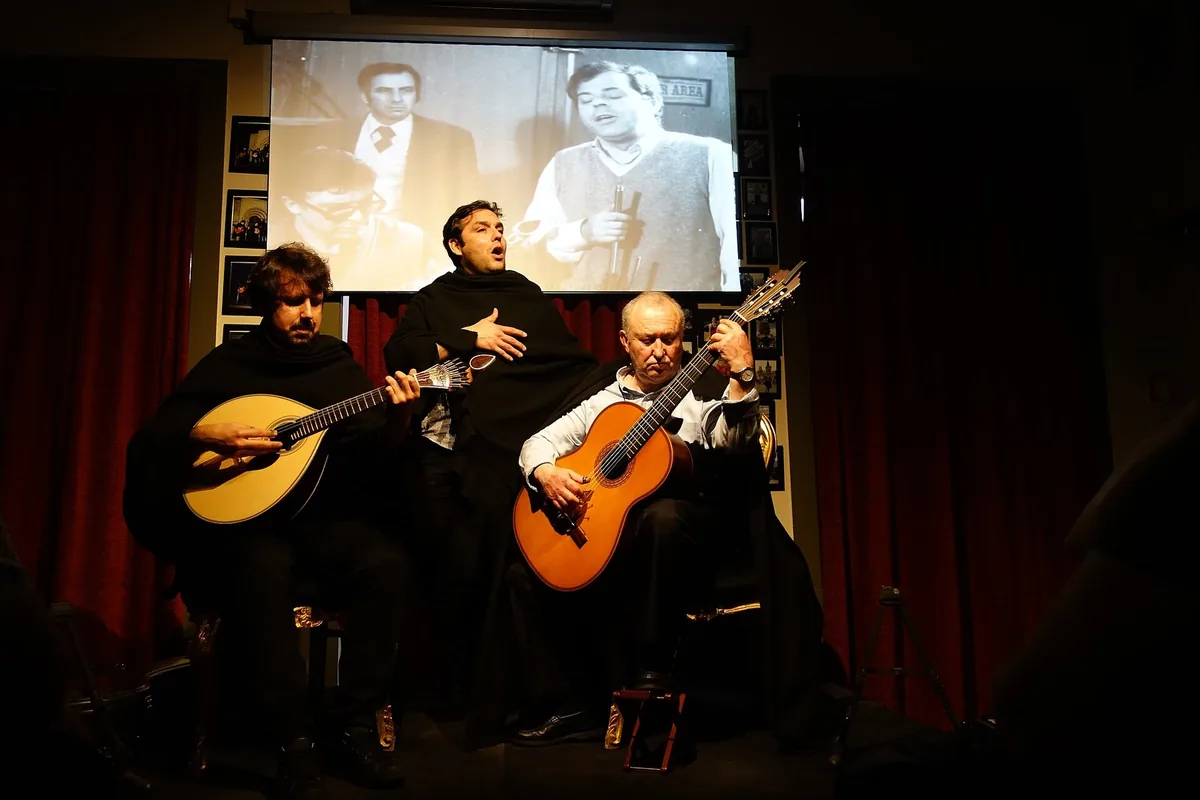
The café runs Coimbra fado sessions at 18:00 and 22:00, every day, with no 22:00 session on Sundays, and its own site states that admission is free. In a city where fado houses sell tickets, that is a remarkable arrangement and it is the cheapest serious music in Coimbra.
Coimbra fado is not Lisbon fado. It is sung by men, traditionally students and graduates of the university, in academic dress; the guitar is different, the repertoire is different, and and you will be told the audience applauds by coughing rather than clapping — a claim repeated everywhere and, as far as we can find, sourced nowhere. It grew out of the serenade tradition on the steps of the Sé Velha, and its biggest annual set-piece is the Serenata Monumental during the Queima das Fitas in May.
The café also hosts live music, documentary screenings and book launches. None of that is on a published schedule we could read, so ask at the counter or check the site for the week you are there.
For ticketed, room-scale fado with a guitar explained before it is played, Fado ao Centro is a few minutes uphill and À Capella is in a chapel built in 1364.
The hours problem
One thing this famous, well-documented business does not publish is when it is open.
We read the café’s own English site on 15 September 2026 and found no opening hours on it. Aggregator listings carry times, as they do for everything, and we are not reprinting them: an unverified timetable for a specific café on a specific day is exactly the kind of small confident error that sends people to a closed door.
What is published, and is therefore usable, is the fado schedule. If there is a session at 18:00 the café is open at 18:00. That is a floor rather than a timetable, but it is a reliable one, and it is enough to build an evening on.
The telephone number is +351 239 833 617. Ring it if you need certainty about a morning coffee.
No prices are published either — not for coffee, not for the house sweet, not for a glass of anything. Portuguese café prices rise when you sit at a table rather than standing at the counter, and a landmark room on a monument square is not the cheapest coffee in Coimbra. Neither is it expensive by the standards of anywhere you have flown from.
What to order, and what is next door
Order the Crúzio. It is the house sweet, made to a recipe of sweet egg and toasted almond, created in 2012 and presented by the café as a nod to the monastic heritage of the building — that link is the venue’s framing rather than a documented continuity, and it is a good pastry either way.
It belongs to a real tradition. Coimbra’s official tourism body lists a whole family of conventual sweets from the city’s convents: arrufadas, pastéis de Santa Clara, barrigas de freira, pudim das clarissas and the crúzios themselves. Two of those are genuinely Coimbra’s own, which is two more than most of the dishes sold here as local.
Then walk twenty metres. The Mosteiro de Santa Cruz next door holds the tombs of Afonso Henriques and Sancho I, the first two kings of Portugal, and the nave is free to enter; the cloister, sacristy and high choir cost 5.00 EUR. Coffee under the vault of the old church, then the royal tombs in the new one, is twenty minutes and the best-value hour in the Baixa.