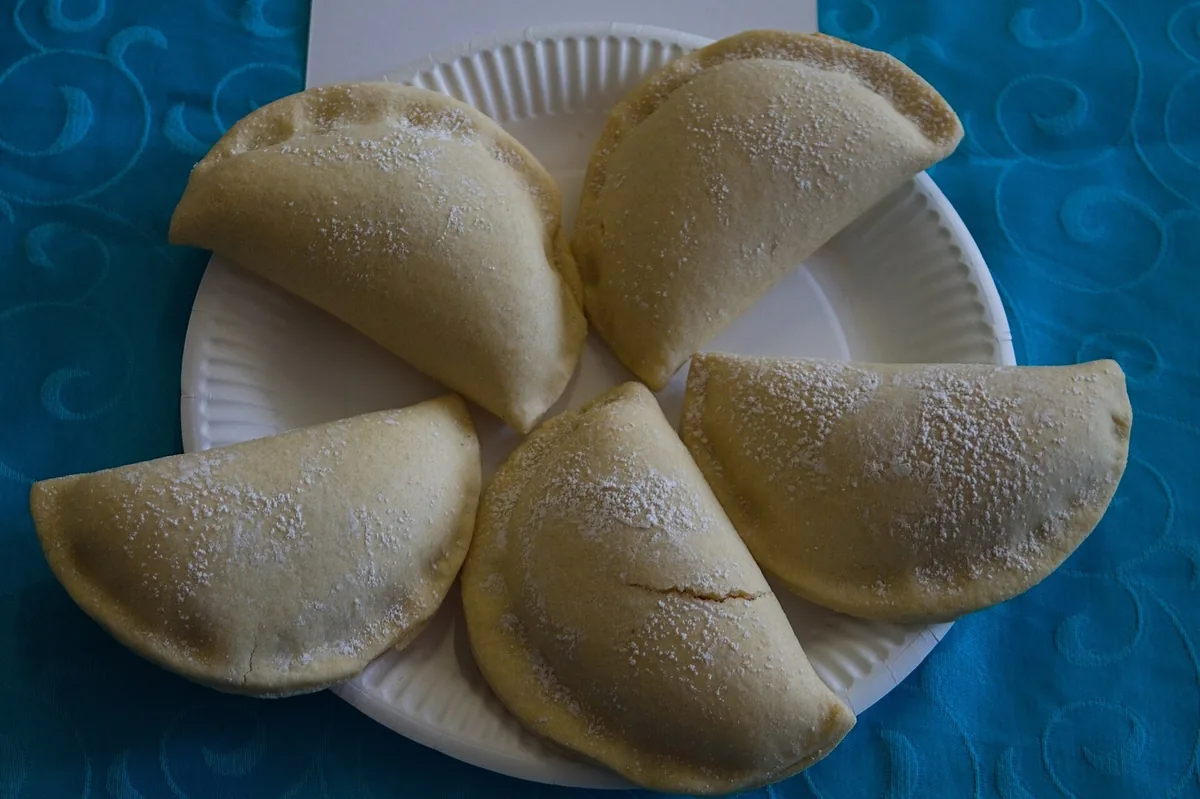

A half-moon, crimped along the curved edge, pale and matt rather than glossy, about the size of the palm of your hand. The crust is baked, not fried, and it gives rather than shatters. Inside is doce de ovos — egg yolks cooked with sugar into a dense, glowing paste — with ground almond worked through it, which cuts the sweetness and gives the filling something to hold onto.
And this one is really from here. The Portuguese agriculture ministry’s own traditional-products register, DGADR, states that pastéis de Santa Clara originate from the Convento de Santa Clara in Coimbra, and that the convent gave its name to some of the best-known conventual sweets of the Beira Litoral. In a city where most of the famous dishes belong to other towns, that is worth saying twice.
What it is, exactly
Two official descriptions exist and they differ slightly, which is useful rather than confusing.
DGADR describes half-moon pastries with a tender baked crust — explicitly not fried — filled with doce de ovos with ground almond worked in. Turismo de Coimbra describes thin, crisp pastry filled with egg and almond cream.
Tender versus crisp is the kind of difference that arises when a sweet is made by many hands over four centuries. Both are recognisably the same object, and what you actually get will depend on the pastry cook. What is constant is the shape, the baking rather than frying, and the egg-and-almond filling.
The distinction between baked and fried is the one to hold on to. It separates this from a whole family of fried Portuguese pastries and it is what gives the crust its particular yielding texture.
We are not publishing a recipe. No proportions, no oven temperature and no resting time are given in the sources we read, and a four-hundred-year-old convent sweet with invented measurements would be exactly the kind of quiet fabrication this guide exists to avoid.
The convent it came from
The name is an address. The Convento de Santa Clara stood on the left bank of the Mondego, and its two successive buildings are still the landmarks of the Santa Clara quarter.
Santa Clara-a-Velha, the original, was founded on the flood plain and lost a four-hundred-year argument with the river; the community abandoned it in the seventeenth century and moved uphill to Santa Clara-a-Nova, taking with them the body of Queen Isabel of Portugal, who is buried there twice — in a silver-and-crystal urn above the altar and in her original Gothic tomb in the lower choir.
That is the institution behind the pastry, and it explains the ingredients. Convents used egg whites in quantity for starching habits and clarifying wine, and were left with yolks. The docaria conventual of Portugal is what they did with the surplus, and almonds were the obvious partner.
Note for planning: Santa Clara-a-Velha has been closed since October 2025 with no reopening date, but Santa Clara-a-Nova on the ridge is open daily 08:30–17:00, extended to 18:30 in summer, at 6.00 EUR.
Where to eat them
One address is documented by name. Pastelaria Briosa, at Largo da Portagem at the river end of the Baixa, is listed by the travel writer Ola Daniela for pastéis de Santa Clara, alongside pastéis de Tentúgal, queijadas de Coimbra and its own Suspiro Briosa.
That is the only named source we have for a specific shop, and we are not adding others from guesswork. Its position is convenient in any case: Largo da Portagem is the hinge between the lower town and the bridge to Santa Clara, so you can buy the pastry and then walk to the convent that produced it in about fifteen minutes.
No opening hours or prices are published for the shop in any source we read, and we are not reprinting them from aggregators. Portuguese pastelarias generally open early and are at their best before noon.
Beyond Briosa, the answer is to ask. Any decent pastelaria in the city should have them or know who does, and the phrase is tem pastéis de Santa Clara?
How to eat them
With an espresso, standing at a counter, in the morning. That is the Portuguese default and it is correct here.
One is usually enough. A yolk-and-sugar filling is intensely rich and the almond only partly tempers it; two in a row is a decision you will feel for an hour. The customary counterweight is bitter coffee, and the pairing is not decorative — it is structural.
Price the order at the counter rather than a table. Portuguese cafés charge more for a seated service, and in a monument-adjacent square the difference is noticeable.
If you want an evening version, a small glass of something sweet works better than wine with the meal. And if you are assembling a Coimbra sweet tasting, the honest pairing is this and an arrufada — the two things in this city that are actually from it.
Why the provenance matters
Because Coimbra is surrounded by famous food that is not its own, and most guides do not distinguish.
Leitão da Bairrada is from Mealhada, about twenty kilometres north and largely in Aveiro district. Bairrada sparkling wine is from the same region. Chanfana and negalhos are from the hills around Miranda do Corvo and Lousã. Pastel de Tentúgal is from Tentúgal in Montemor-o-Velho, twenty kilometres west. Queijo Rabaçal’s DOP zone excludes Coimbra city entirely.
All of them are sold here and all of them are worth eating. But the two that the city can actually claim are this pastry and the arrufada, and if you want to eat something from Coimbra rather than from its catchment area, those are the two.
The full sorting is in what to eat in Coimbra, which sets out each dish, where it comes from, and what the documented evidence for that is.