
Every guide to this city prints the same list. Leitão. Chanfana. Pastel de Tentúgal. Queijo Rabaçal. Bairrada sparkling wine. They are all delicious, they are all on menus here, and not one of them is a Coimbra dish.
They come from Mealhada, from the hills around Miranda do Corvo and Lousã, from a village in Montemor-o-Velho, and from a protected zone that stops short of the city boundary. Coimbra serves them because Coimbra is the market town for a hundred kilometres of countryside, which is a perfectly good reason. But a guide that lists six regional dishes and two local ones without telling you which is which is not describing a city’s food. It is describing a distribution network.
So here is the honest version. Two things in this guide genuinely originate in Coimbra: the arrufadas and the pastéis de Santa Clara. Both are sweets, both come out of the convents, and both are documented as Coimbra’s by the bodies whose job it is to know. Order those and you have eaten the city. Everything else is a day trip on a plate, and this page tells you where each one actually lives.
The two that are actually Coimbra’s
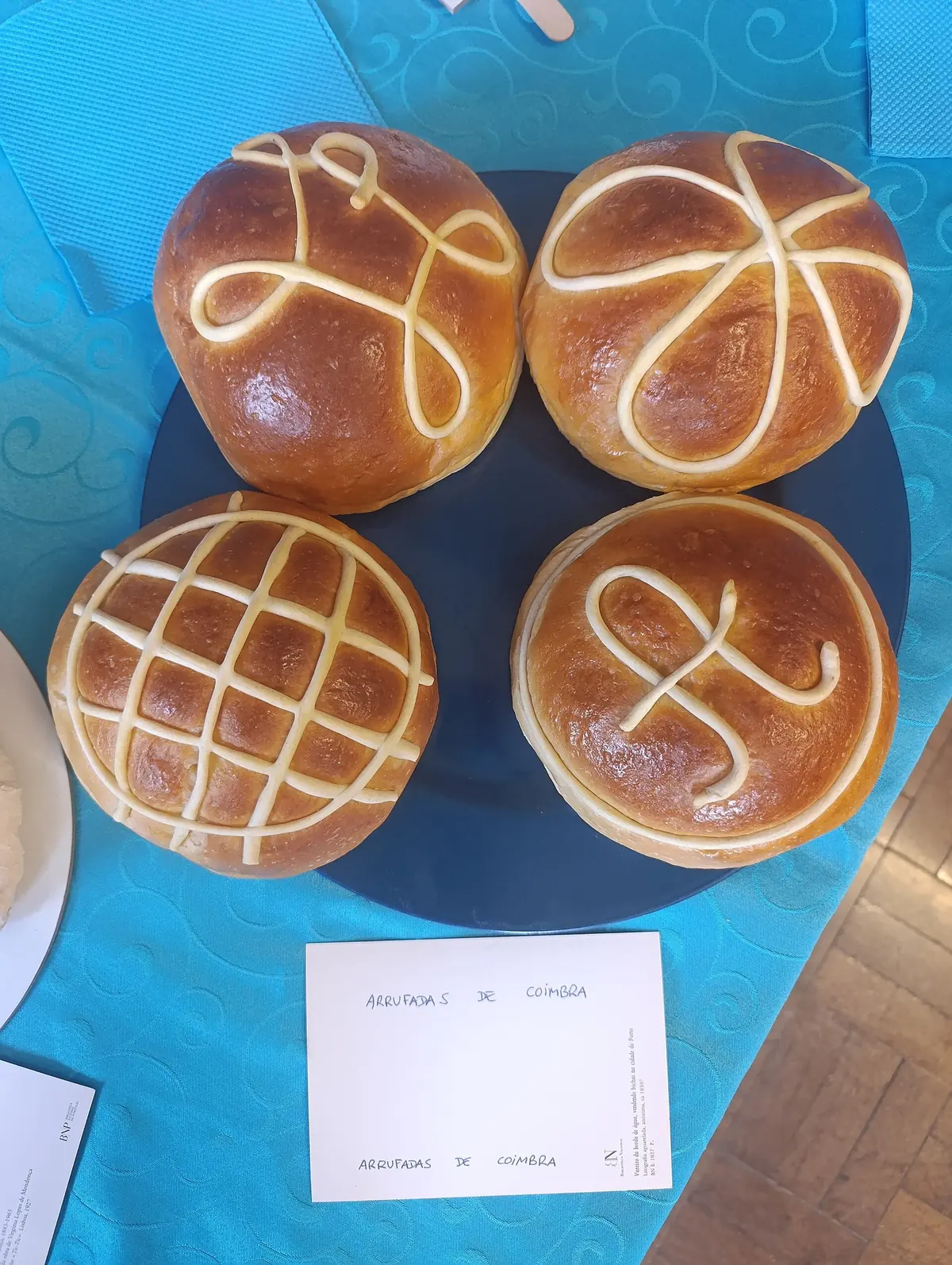
Arrufadas de Coimbra carry the city’s name and appear on Turismo de Coimbra’s own conventual-sweets page, which describes them precisely: a rounded sweet bread with a light, fluffy dough, lightly sweetened, and aromatizada com canela e erva-doce — flavoured with cinnamon and aniseed.
Every word there is doing work. Rounded, not plaited. Light, which means a long enriched dough rather than a cake. Lightly sweetened, which is the part that surprises people expecting a dessert. And two aromatics, of which the aniseed is the one that separates an arrufada from every other sweet bread in Portugal. If what arrives is heavily sugared and tastes only of cinnamon, it is not one.
Pastéis de Santa Clara are half-moon pastries with a tender baked crust — not fried — filled with doce de ovos, egg sweet, with ground almond worked into it. The Portuguese agriculture ministry’s traditional-products register states they originate from the Convento de Santa Clara in Coimbra, and that the convent gave its name to some of the best-known conventual sweets of the Beira Litoral.
Both belong to the docaria conventual, the convent-sweet tradition, which is one of the strangest and most productive accidents in European food history. Convents used enormous quantities of egg white — for starching habits and for clarifying wine — and were left with yolks by the bucket. What they did with the yolks became a national cuisine.
Turismo de Coimbra documents the rest of the local canon alongside them: Arroz Doce de Coimbra, traditionally offered by newlyweds to wedding guests and served in vessels from Almalaguês; Barrigas de Freira, from yolks, sugar and bread; Crúzios, thin crisp pastry with egg-and-almond cream; Manjar Branco; Pudim das Clarissas; Rosas da Rainha, egg threads shaped into roses; and Talhadas de Príncipe.
The Crúzio is the easiest to find, because it is the house sweet at Café Santa Cruz, created in 2012 from sweet egg and toasted almond as a nod to the monastic building it is sold in.
What the region sends in
Five famous dishes, five other postcodes. This is where most guides go wrong, so each one gets its actual address.
Leitão da Bairrada — whole roast suckling pig with glass-thin crackling — belongs to the Bairrada, centred on Mealhada, about twenty kilometres north of Coimbra and largely in the Aveiro district. Not Coimbra. A certification process has been running through the Associação Rota da Bairrada, but whether IGP registration is complete as of 2026 is not something we could confirm, so we do not write “IGP” beside it. In Mealhada itself the named houses are Pedro dos Leitões, founded 1941, Rei dos Leitões, 1947, and Churrasqueira Rocha, 1979.
Chanfana is old goat — cabra velha — braised for hours in red wine in a sealed clay pot in a wood oven. Its documented origin is the Mosteiro de Semide, near Miranda do Corvo, in the hill country south of the city, where nuns received goat meat as rent and preserved it by cooking it in wine. Three municipalities dispute primacy — Miranda do Corvo, Lousã and Vila Nova de Poiares — and each holds an annual gastronomic week about it.
Ignore the Napoleonic story. The romantic version ties chanfana to the French invasions; the source we relied on states plainly that those versions lack documentary support, and that the practical explanation — using up goats past breeding age — is more historically plausible.
Negalhos belong to the same tradition and the same hills: a tripe dish using the rest of the animal chanfana does not, alongside sopa de casamento made from the chanfana broth and chispe from the feet. We could not source a precise definition — the Miranda do Corvo municipal page that held it returns a 404 — and we could not find a single documented Coimbra address serving it.
Pastel de Tentúgal is IGP-protected and comes from Tentúgal, in Montemor-o-Velho, about twenty kilometres west — in Coimbra district, not Coimbra city. The dough is stretched to between 0.06 and 0.15 millimetres and rolled around egg yolk and whole egg in sugar syrup. It comes from the Convento de Nossa Senhora da Natividade, where Carmelite nuns lived from 1565 to 1898, with the first written reference dated 1611.
Queijo Rabaçal is DOP, made from a blend of sheep’s and goat’s milk, over a production zone of roughly 850 square kilometres: all of Penela plus parts of Condeixa-a-Nova and Soure in Coimbra district, and all of Ansião plus parts of Alvaiázere and Pombal in Leiria district. Coimbra city is not in the zone. The milk proportions are not published.
Bairrada sparkling wine is Bairrada, like the pig. And here we have to be blunter still: we could not verify its demarcation date, its rules, its permitted grapes or the common claim that Bairrada is Portugal’s leading sparkling region from any authoritative source. Drink it. We are just not going to tell you facts about it that we made up.
Where to eat what
Coimbra’s restaurant scene is under-documented to a degree that surprised us. Most houses publish neither a menu nor a price. So this is what is on the record, and nothing else.
For the city’s own sweets: Pastelaria Briosa, at Largo da Portagem at the river end of the Baixa, is documented as selling pastéis de Santa Clara, pastéis de Tentúgal, queijadas de Coimbra and its own Suspiro Briosa. Pastelaria O Alfonso, Rua Gen. Humberto Delgado 412, is documented for Tentúgal. No source we read attaches arrufadas to a named shop, so we will not invent one — Briosa is the obvious place to ask first, and neighbourhood bakeries in the morning are the better hunting ground.
For chanfana: A Cozinha da Maria, whose version one named writer calls the best she has eaten, and Taberna Casa Costa, the cheaper of the two. Note that two reputable sources give A Cozinha da Maria two different addresses; our page sets out both. Zé Neto is locally associated with chanfana but no source we read confirms it on the menu, so ask at the door.
For leitão in the city: João dos Leitões, Rua da Gala 45, for the whole pig and for the sandwiches. It is a Coimbra address serving a Bairrada dish, and there is nothing wrong with that as long as you know it.
For the one house everybody should try: Zé Manel dos Ossos, seven tables in a blind alley off the Baixa edge, walls papered with customers’ written notes, thirty years of an unchanged menu. Pig bones, wild boar bean stew, oxtail, cod with white beans. Service starts 12:30 for lunch and 19:00 for dinner, there is a queue by noon, and the house joke is that the bones are just for rent and must be returned to the chef once the meat is eaten and the bread dipped.
For a modern meal: Dux for petiscos — caramelised goat cheese with honey, prawn açorda, squid with aioli — or Refeitório da Baixa, the top price band in the lower town. Arcadas, across the river, is the most ambitious kitchen in the city; we are not printing a Michelin star for it, because its own site does not claim one.
One to check before you walk: Loggia has the best view in Coimbra according to two independent food writers — and it is inside the Machado de Castro museum, which has been closed since February 2026. Nobody publishes whether the restaurant still trades. Our ranked restaurants guide puts the whole field in order.
Eating cheap in a student city
Coimbra has roughly a fifth of its population passing through a university, and that keeps the bottom end of the market honest.
The counter costs less than the table. This is national rather than local, and it is the single most useful money rule in Portugal: a coffee and a pastry ordered standing at the bar is cheaper than the same order brought to a seat, and the difference is not trivial in a tourist city. Ask for um café for an espresso or um galão if you want milk.
The university canteens are the one place in Coimbra where an official body publishes hard prices. The University’s student services publish a Refeição Social at 2.40 EUR for UC students, and a Refeição Completa at 4.90 EUR for non-UC students and students of other institutions. Both include bread, soup, a main course and dessert. Water is free at all the food units. The named canteens include the Cantina Central, Cantina Amarela, Cantina Químicas, Cantina São Jerónimo, Cantina Luzio Vaz, Cantina Vermelhas and Cantina Branca.
Now the caveat, and it is a real one. That 4.90 EUR tier is worded for students of other institutions, not for the general public. The university’s pages do not state anywhere that a tourist with no student card may eat in the canteens. It is strongly implied and it may well be fine. We are not telling you to turn up on the strength of an implication — if you want to try it, phone the numbers on the SASUC food page first.
Where the cheap restaurants are. The densest cluster of documented restaurant addresses in this city is in the flat lower town — Rua da Sota, Rua das Azeiteiras, Rua Direita, Praça do Comércio, Terreiro da Erva. Walk those five streets before you book anything. The Baixa page maps them.
And the free thing. There is free Coimbra fado at Café Santa Cruz at 18:00 and 22:00 daily, no 22:00 session on Sundays, for the price of a coffee. An hour of the city’s own music, sitting inside a church that was deconsecrated in 1834, costs you an espresso. The fado guide has the rest.
How to order, and when
Portuguese meal times run later than northern European ones and earlier than Spanish ones. Lunch from about 12:30, dinner from about 19:30, and the houses that fill up are full by 13:00 and 21:00. Zé Manel starts service at 12:30 and has a queue outside by noon, which tells you everything about how the good places work here.
Buy sweets in the morning. An enriched bread like an arrufada is a morning product everywhere in Portugal and it goes stale within the day. What is on the counter at 17:00 was baked for breakfast. This is the difference between understanding why locals love a thing and wondering what the fuss was about.
Do not expect the sweets to be very sweet, and do not judge them for it. The register of the conventual tradition is egg and almond rather than sugar, and the arrufada in particular is gentle by design.
On portions. Portuguese main courses are large and many houses serve a meia dose, a half portion, which is a normal thing to order and not an admission of weakness. In a tasca, ordering two half portions between two people is often the right move.
On the couvert. The bread, olives and cheese that arrive unasked at the start of a Portuguese meal are chargeable and optional. Sending them back is completely normal and nobody will be offended.
On drinking. The regional sparkling wine is from the Bairrada, as above, and the regional red is the Baga grape from the same country. Our page on it is candid that we could not verify the basics, which is a strange thing to have to write about the most famous wine within twenty kilometres of a city, and is exactly why it is written down.
One last note, because this is the part people argue with. None of the above is an argument against eating the regional dishes. The leitão is superb, the chanfana is one of the great slow-cooked dishes of Europe, and Coimbra is the market town that has been selling both for centuries. The argument is only against calling them Coimbra dishes — because the moment a guide does that, it stops being able to tell you where the good ones actually are, and the good leitão is in Mealhada, at houses founded in 1941, 1947 and 1979.
If you want the food in an itinerary rather than a list, the one-day plan puts a lunch and an 18:00 fado show around the university circuit, and the restaurants shortlist ranks the field with reasons.