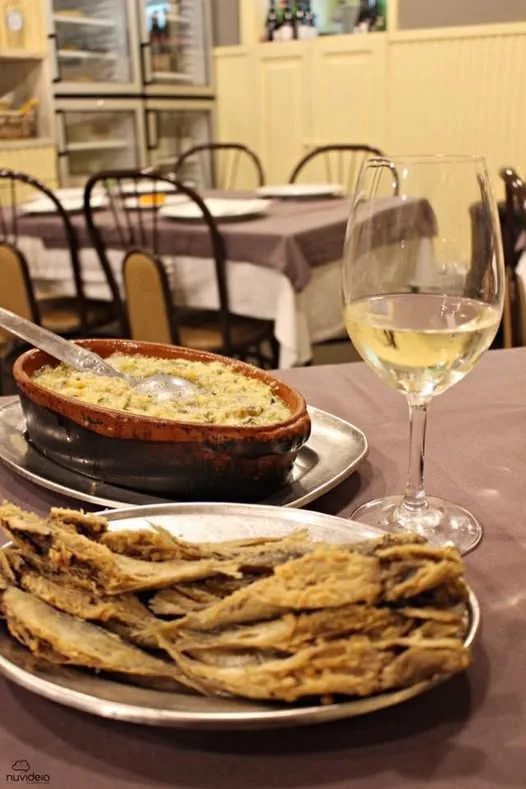

Rua das Azeiteiras is the oil-sellers’ street, thirty metres of the Baixa with doorways on both sides and a cobbled strip of ground between them where waiters put tables out in summer. Zé Neto is at numbers 8 to 10. In a city this size, a restaurant that keeps a street address for decades acquires a reputation, and this one’s reputation is a single dish.
Ask a Coimbra resident where to eat chanfana and this name comes up. We are going to be careful with that, because no named source we read confirmed chanfana on Zé Neto’s menu when we checked on 15 September 2026. The association is real and widely held. The documentation is not there. This page tells you both things and shows you how to settle the question yourself in one phone call.
The chanfana question
Chanfana is old goat — cabra velha — braised for hours in red wine, traditionally in a black clay pot in a wood oven. It is the great dish of the hill country south of Coimbra, and it is not a delicate thing: dark, winey, slightly gamey, falling off the bone.
It is also, strictly, not a Coimbra city dish. The documented origin claim points to the Mosteiro de Semide near Miranda do Corvo, and three municipalities — Miranda do Corvo, Lousã and Vila Nova de Poiares — each hold an annual gastronomic week and each claim primacy. Coimbra serves it. Coimbra did not invent it.
So does Zé Neto cook it? Probably, on the strength of local word of mouth. But nobody has published it, the restaurant has no website, and we are not going to convert a strong rumour into a menu listing. The two chanfana addresses in this guide with a named writer behind them are A Cozinha da Maria and Taberna Casa Costa.
If chanfana is the reason you are walking down Rua das Azeiteiras, phone first or read the board on the door. It is a dish that gets cooked in quantity on set days rather than held on the menu all week, which is another reason a printed menu would not settle it anyway.
One more thing worth knowing about the dish before you chase it. The romantic story you will hear — that chanfana was invented to feed or to poison Napoleonic troops — is not supported by the documentary record. The sourced account prefers the practical explanation: goats past breeding age had to be used, and long braising in wine was how you made them edible. Nobody needs an invasion to explain a tough animal.
What is documented
The record for this restaurant is short and you should see it in full.
The address, Rua das Azeiteiras 8–10, published by the local title Coimbra Coolectiva in a list of thirty-six restaurants taking part in a citywide cod-week promotion. The cuisine, traditional Portuguese. That is the extent of it.
No price band. No opening hours. No official website. No dish recommendation from a named source. No rating we are willing to reprint — aggregator scores exist, but a figure assembled from anonymous submissions about a small family restaurant is not evidence and we do not treat it as such.
What the cod-week listing does tell you is that this is a house the local press knows about and includes in a citywide promotion, which is a meaningful signal in a small city. It is a weaker signal than a named writer’s recommendation. Weigh it accordingly.
There is a reason so many entries in this quarter read like this. Coimbra’s small restaurants are family businesses that have never needed a website, because their customers live within a kilometre and have been coming for twenty years. The city’s tourism grew faster than its restaurants’ paperwork, and the gap shows up as a page like this one. The alternative — filling it in from plausible guesswork — would be worse than the gap.
Rua das Azeiteiras
The street is worth knowing in its own right. It sits in the tightest restaurant cluster in Coimbra, one lane off Praça do Comércio, and it is the closest thing the city has to a dedicated eating street.
That has a practical consequence. One of the two published addresses for A Cozinha da Maria is also on this street, at number 65, while a second source puts that restaurant on Praça do Comércio instead. Two sources, two streets. If you are walking down here looking for chanfana, you may pass both candidates in ninety seconds.
Everything else is close too: Solar do Bacalhau on Rua da Sota, Adega Paço do Conde, Dux. The Baixa is flat and the whole cluster fits inside five minutes on foot, which makes a closed door a minor inconvenience rather than a ruined evening.
Come down here from the university at the end of the Alta to Baixa descent and you arrive with an appetite and no climb left to do.
How to eat here
Standard practice for an unlisted Portuguese tasca, which is what this is.
Ask for the prato do dia. At lunch it is usually the best-value plate in the room and often the best cooking, because it is what the kitchen committed to that morning. If chanfana appears at all, this is where it will show up.
Order the house wine in a jug. Order a meia dose rather than a full portion if there are two of you and you want two dishes; Portuguese portions are generous and half portions are a normal order, not an apology.
The couvert — bread, olives, sometimes cheese or a sausage — arrives without being ordered and is charged for. Send back what you do not want. Nobody is offended.
Go at Portuguese hours: lunch from about 12:30, dinner from about 19:30, and expect the room to fill an hour later than instinct suggests. Coimbra has thirty thousand students in term time and they set the rhythm of the evening.
Pay attention to what the next table has. In a tasca with no printed English menu the most reliable ordering method in Portugal is still pointing at somebody else’s plate and raising an eyebrow, and it works here as well as it does anywhere. Waiters in this quarter are used to it and nobody treats it as rudeness.
The verdict
A fair bet on a good street, with one claim attached to it that we cannot stand behind.
Go if you are in the Baixa, want a traditional Portuguese dinner at the cheap end, and are content to find out the menu when you arrive. That covers most evenings, and this is a perfectly sensible address for one.
Do not go specifically for chanfana without checking first. If the dish is the whole point of the trip, use one of the two addresses a named writer has actually eaten it at, or drive out to the hill country where it comes from — the Lousã schist villages put you inside the disputed zone and in front of the real thing.
And read the wider picture before you build a food itinerary around any of this. What to eat in Coimbra sets out which of the region’s famous dishes are genuinely the city’s and which belong to somewhere else entirely. It is a shorter list than most guides suggest.