
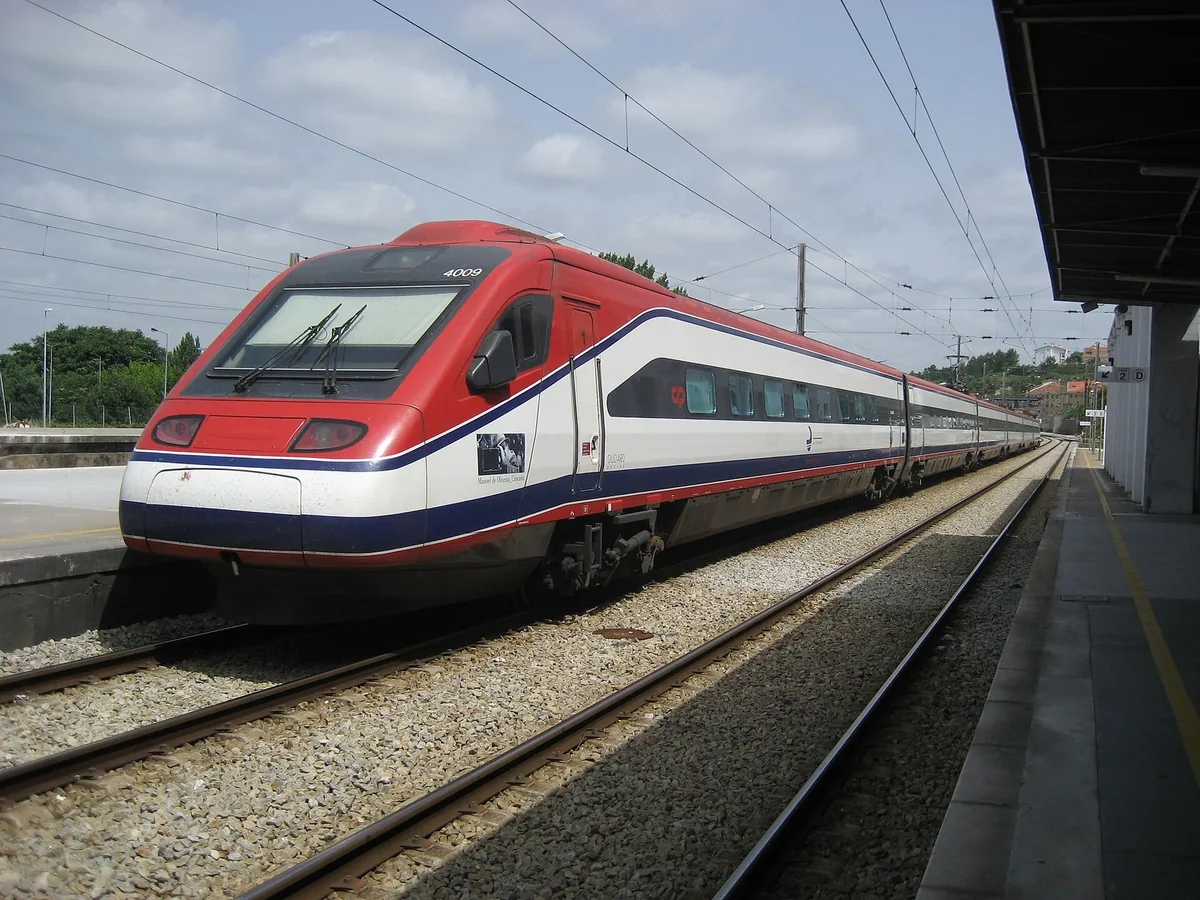
Coimbra sits roughly halfway down the Linha do Norte, the spine that carries every fast train between Porto and Lisbon. That is the reason the city is easy to reach, and the reason almost nobody flies here: you arrive at an airport at one end of the country or the other and take a train into the middle.
The catch is the last two kilometres. The fast trains stop at Coimbra-B, outside the city, and the little rail shuttle that used to carry you in from there was abolished on 12 January 2025. Most published advice about arriving in Coimbra still describes that shuttle. Get the arrival right and the rest of this city is a ten-minute walk wide.
By train
This is how you should come. Coimbra-B is served by Alfa Pendular (the fastest, seat-reserved), Intercidades, and slower InterRegional and Regional trains, from both Lisbon and Porto. CP sells all of them, and the fast services want booking ahead for price rather than availability.
We are not printing a journey time or a fare. CP publishes both, they change with the timetable and the operator’s pricing, and a number copied from a guide is a number that will be wrong by the time you read it. Pull your date from cp.pt. What we can tell you with confidence is the thing CP’s booking flow will not: the station you land at is not the station in the city.
Read the full Coimbra-A versus Coimbra-B explanation before you travel. It is the single piece of Coimbra logistics that competing guides get reliably wrong, and it is a five-minute read that saves a confused half hour on a platform.
Arriving at Coimbra-B
You get off, you follow the signs to the marked Metro Mondego stop beside the station, and you ride into the city free on the strength of your CP ticket. Infraestruturas de Portugal put the peak provision at twelve buses an hour, timed to connect with arriving trains. Keep the ticket in a pocket.
Since 10 September 2026 the Metrobus itself reaches Coimbra-B and Praça da República, running an average five-minute peak frequency on the urban section after weekday runs jumped from 291 to 452. In practice this means the transfer is no longer a shuttle you wait for; it is a service that turns up.
Get off by the river for the Baixa, or at Praça da República for the university side of the hill and the Alta. With luggage, that choice matters more than anything else about your arrival.
From Lisbon and Porto airports
Coimbra has no airport of its own worth the name. You fly into Lisbon or Porto and take a train north or south to Coimbra-B. Porto is the closer of the two to Coimbra; both are on the same mainline the Coimbra trains use.
Airport-to-station connections and journey times: check with the airport operator and CP. We could not source a current, official door-to-door timing for either airport, and an invented one is worse than none. Build the day around catching a train from the city-centre station at your arrival airport, not around a figure you read somewhere.
If you are coming for the day rather than staying, the arithmetic is different and worth reading first: see the day trip from Lisbon and the day trip from Porto.
By car and by bus
You do not want a car in Coimbra. The historic core is a hill of one-way medieval lanes with a walled gate at the bottom, parking in the Alta is awkward by every account we trust, and every single thing on this site except the day trips is walkable from the Baixa. If you are driving Portugal end to end and Coimbra is a stop, the honest advice is to park once on the flat and not touch the car again.
A car earns its keep in exactly one situation: the Buçaco forest, where public transport from Coimbra is not something we could verify at all, and where the entrance charge is levied on the vehicle rather than the person — 7 EUR per car regardless of how many of you are in it.
Long-distance coaches serve Coimbra and are the cheap option on the Lisbon and Porto runs. We have not sourced current operators, stops or fares to the standard this site publishes at, so check the operator directly rather than taking a timetable from us.
What to do in the first hour
Drop the bags first. The where-to-stay guide splits the city into the flat, convenient Baixa and the atmospheric, steep Alta, and the choice governs how much climbing your trip contains.
Then book the one thing that cannot be improvised. Entry to the Joanina Library is a fixed timed slot — 50 people every 20 minutes — and the time printed on the ticket is the only element of the university circuit you cannot move. Everything else in the city flexes around it.
If you have one day, the one-day itinerary is built from published opening hours rather than optimism. If you have two, the second is where the day trips become possible.