
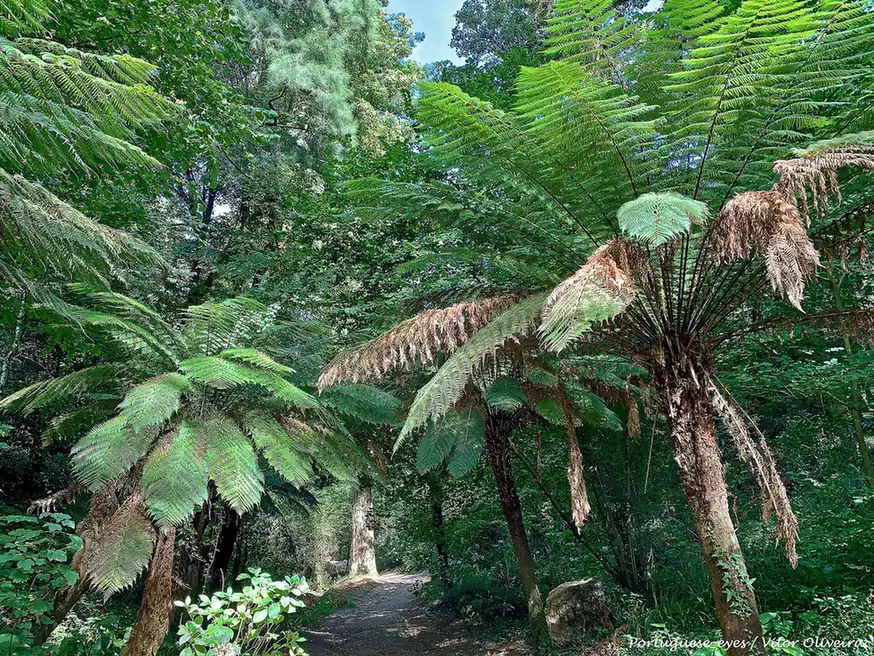
A walled forest of imported species, planted by Carmelite friars, laid out along a Via Sacra of hermitages, with a neo-Manueline palace hotel dropped into the middle of it in the nineteenth century. Buçaco is not a park with some history in it; it is a designed religious landscape that a monarchy later built a hotel inside.
It is also the place where guidebook arithmetic most reliably fails. Buçaco charges the vehicle, not the person. Walk in and you pay nothing at all. Drive in and it is 7 EUR for the car regardless of how many of you are in it. Four adults in one car pay 7 EUR between them; four adults on foot pay zero. Almost every guide reports this as a per-person entrance fee. It is not.
The entrance fee, correctly
The Fundação Mata do Bussaco publishes the tariff by vehicle class, and this is the whole of it:
| How you arrive | Charge |
|---|---|
| On foot | Free |
| By bicycle | Free |
| Two-wheeled motor vehicle | 3 EUR |
| Car | 7 EUR |
| Motorhome | 15 EUR |
| Minibus, up to 25 seats | 25 EUR |
| Coach | 50 EUR |
There is no adult ticket, no child ticket and no concession, because there is no personal ticket at all. The toll is on what you drive through the gate.
The convent is separate. The Convento de Santa Cruz do Bussaco charges 3.00 EUR per person over 12, free for children up to 11, and 4.00 EUR per person for a guided visit. Guided visits are organised for groups of at least fifteen on prior request; smaller groups are accepted by prior quotation.
So a couple who walk up from Luso and visit the convent pay 6 EUR between them, total, for a day in a walled national forest. That is the cheapest serious day out within reach of Coimbra.
Hours, and a caveat about them
The tollgates, shop, café, convent and information post all keep the same hours:
- Summer, June to September: every day 09:00–19:00
- Winter: every day 09:30–17:00
Now the caveat, because we would rather flag it than hide it. The foundation’s hours page carries a last-updated stamp of 14 December 2021. It is the organisation’s current published page and we have no better source, but it is five years stale. The entry-fee page is more recent, updated April 2024.
Treat the hours as indicative and telephone ahead on +351 231 937 000 if your day depends on them — particularly at the season changeover in June and October. The June and October guides cover the wider seasonal shift.
Getting there — and the gap we cannot fill
This is the honest weak point of the page. We could not source travel information from Coimbra to Buçaco from any official body. No distance, no bus line, no journey time.
What we know: the forest is at Luso, and Luso sits on the Linha do Norte corridor with a Luso-Buçaco station. We did not verify current services and will not assert them. Pull the timetable from CP for your date.
What this means practically is that Buçaco is the one destination on this site where a car genuinely earns its keep — and note the irony that driving is also the only way to pay to get in. If you are touring Portugal by road, this is the stop that justifies the hire.
If you are not driving, and you can reach Luso, walking in from the town is both free and the intended way to experience a Via Sacra. We have not measured that walk and so we do not describe it.
For the rest of the region’s transport, which changed substantially on 10 September 2026, see getting around Coimbra.
The Palace Hotel: what you can and cannot do
The neo-Manueline Palace Hotel do Bussaco is the building on every photograph of the forest. It is a working five-star hotel, not a museum.
We could not source any visitor access policy for it. The Fundação Mata do Bussaco lists it as built heritage but publishes no visiting arrangement, and we are not going to tell readers they can tour a hotel on the strength of other guides saying so.
What you can certainly do is look at it from the outside, which is free once you are in the forest, and which is most of what people want from it anyway. If you want inside, approach it as a hotel: book a room, or contact the hotel about dining.
The forest is currently a candidate for UNESCO World Heritage listing. Coimbra already has one inscription, the University of Coimbra — Alta and Sofia, listed in 2013 across 32 buildings.
How to spend the day
Allow three to four hours minimum, and a full day if you walk the trails. That is the realistic range for a forest laid out as a devotional route rather than a viewpoint you drive to.
The structure to follow is the Via Sacra and its hermitages, which is what the Carmelites built the place around. The trees are the other half: a walled collection of exotic species assembled over centuries, which is why the forest reads as an arboretum with a monastery in it.
Pair it with the convent at 3.00 EUR, and pair the day with Luso itself if you are travelling by public transport, since that is where you will arrive and depart.
Compared with the other day trips from Coimbra: Conímbriga is the archaeology and has a verified bus; Figueira da Foz is the beach and has a train; Lousã is the mountain and has just become reachable again. Buçaco is the one that wants a car.