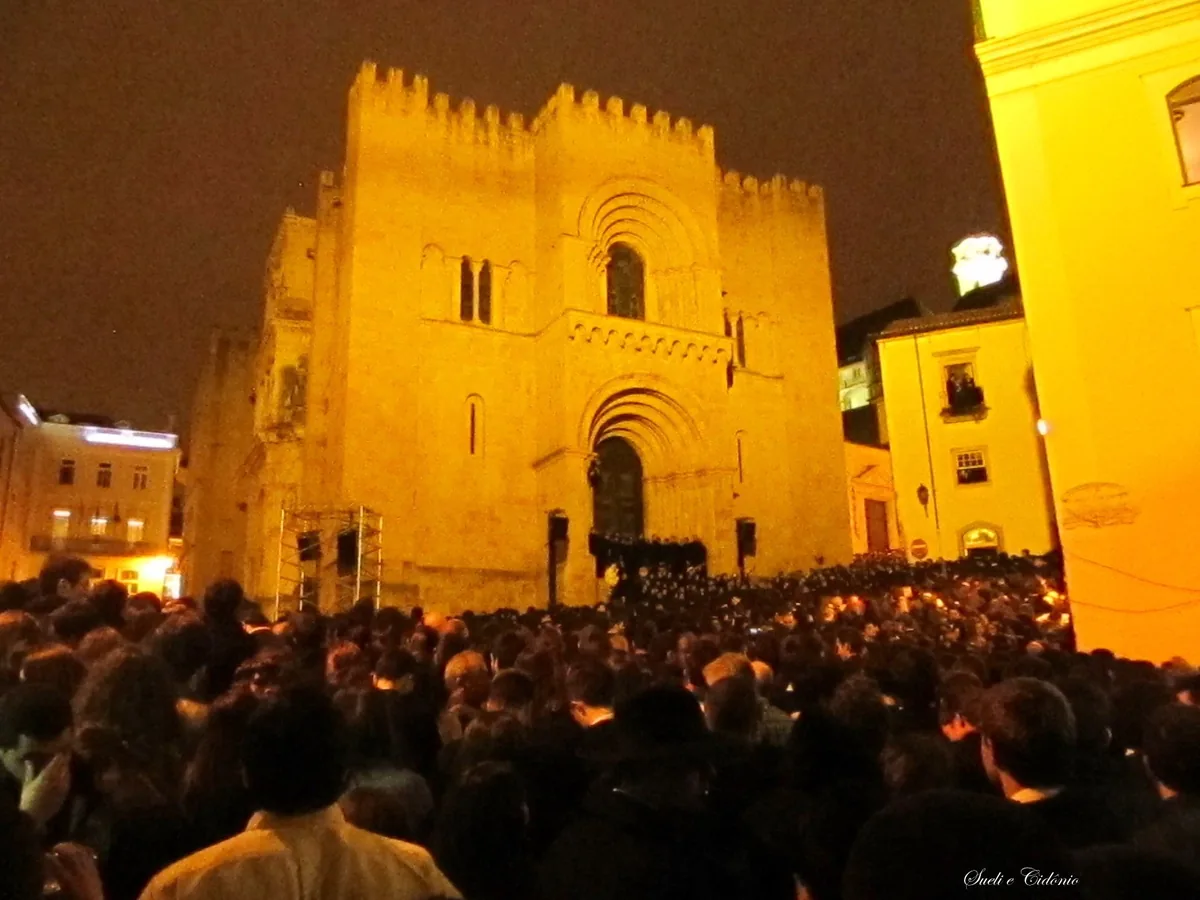

Midnight on the Largo da Sé Velha. The bell finishes twelve strokes and the first guitar chords go up from the cathedral steps, and then several thousand people stop talking at once. That is the Serenata Monumental, and it opens the Queima das Fitas — the burning of the ribbons — which the Câmara Municipal de Coimbra describes flatly as the largest student festival in the whole of Europe.
It runs eight days in May, one for each of the university’s eight faculties. It was first organised by Coimbra students in the 1850s, suspended in 1969 as academic mourning in protest against the dictatorship, and resumed in 1980. For finalists it is the goodbye to student life; for freshers it is formal initiation into the Academia. The same eight days mean opposite things at either end of a degree.
The Serenata Monumental
This is the one to see, and the timing is not a schedule but a signal. The Serenata begins after the twelve strokes sound, when the first guitars start and the students on the staircase of the Sé Velha begin the Canção de Coimbra.
It is sung, not performed at you. Coimbra fado is a serenade and a street music — sung standing, outdoors, to someone — rather than a seated tavern lament, and the Serenata is that idea at civic scale, on the steps of a Romanesque cathedral begun in 1164.
In 2026 there were new access and security arrangements including a marked enclosure beside the monument. Expect a managed crowd rather than an open square, and arrive well before midnight if you want to be inside it.
In 2026 the Serenata fell on the night of the 21st into the 22nd of May — the night before the festival’s first full day.
What happens across the eight days
In order, with the 2026 dates as the worked example:
- Serenata Monumental — the night of 21 into 22 May, Largo da Sé Velha, after midnight.
- “Queima” do Grelo — 24 May, Largo da Sé Nova, 10:00.
- Cortejo dos Quartanistas — the parade, 24 May. Students process through the city with carros alegóricos covered in paper flowers in their faculty colours, carrying social satire and student demands.
- Baile de Gala das Faculdades — 26 May, at the university stadium.
- Noites do Parque — nightly concerts at the Praça da Canção.
Separately, in June, comes the Benção das Pastas, the blessing of the folders: 13 June 2026 for Polytechnic Institute students and 14 June for University of Coimbra finalists.
The fitas themselves — the faculty-coloured ribbons that give the festival its name — are burned as the ceremonial act at the heart of it, in a city where the black cape and the traje académico are still ordinary term-time dress.
What it closes — read this before booking
This is the planning fact, and it is the proof of how seriously the city takes the festival.
The University of Coimbra closes its entire tourist circuit for it. The university shut everything on 24 May 2026 for Academic Week, and its published closure list also names 4 October 2026 for the Latada. That means no Joanina Library, no Royal Palace, no Sala dos Capelos, no Science Museum.
The Santa Cruz monastery closes on the day of the Queima parade, listing it as a movable date alongside Christmas Day, New Year’s Day, Easter Sunday and Army Day.
So: a World Heritage site and a national pantheon both shut their doors for a student party. A visitor who books parade day expecting the Baroque library will see neither it nor the monastery. Check the university’s own visitor information page before you book anything in late May.
Practical advice for visitors
Beds. Festival week is the annual peak for accommodation in Coimbra, and the Alta stops being a quiet quarter with some student noise and becomes the venue. If you want to watch rather than participate, the Baixa or Santa Clara across the river gives you a door that shuts.
Geography. The set-pieces are split. The serenade is at the Old Cathedral in the upper town; the concerts are at the Praça da Canção, outside the historic centre. Movement between the two governs the nights.
Dates. The 2027 dates were not published as of 15 September 2026, and we will not extrapolate a rule from past editions — some sources describe a first-Friday-of-May start, but that is not confirmed by the university or the municipality. Confirm with the organisers on the dates you are considering.
Faculty colours. Only one is confirmed from an official source: medicine is yellow, which is why the Royal Palace’s Yellow Room is lined in yellow silk. The full colour-to-faculty list that circulates online is not something we could verify, so we do not print it.