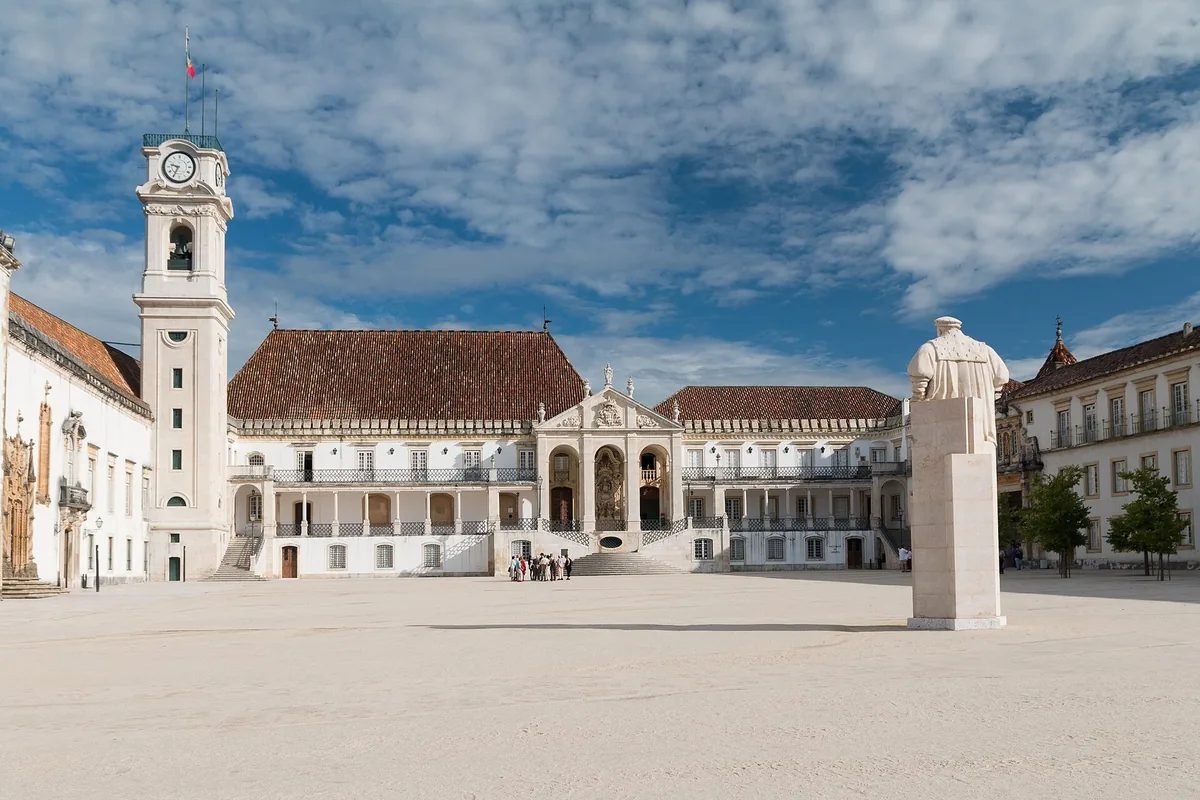

You come up out of the Alta’s lanes and the city stops. The Paço das Escolas is a courtyard open on one side, and the drop is the first thing you feel: the Mondego valley laid out below the balustrade, the Baixa roofs small and far down, wind that was not in the street thirty seconds ago. Behind you the Via Latina colonnade runs the length of the palace, the closed clock tower stands off to the right, and students in black capes cut across the flagstones as if nobody were looking at them.
This courtyard has been three things. At the end of the 10th century it was a fortress, the seat of the city’s governor under Islamic rule. In 1131 it became the first Portuguese royal household, the residence of Afonso Henriques. In 1544 the University moved in permanently and never left. You walk through a Moorish fort that became a palace that became a lecture hall, and the doorway is the same doorway.
What to look for inside
The ticketed palace is three linked spaces, and the first is the Armoury, the Sala das Armas. Weapons, in a university, and the jarring is the useful part: this institution policed itself for centuries, kept its own gaol under the library, and answered to nobody in the city below.
Beside it is the Yellow Room, and the yellow is not a decorator’s choice. The walls are lined in yellow silk in honour of the Faculty of Medicine. Every faculty at Coimbra has a colour, and the palace has rooms in those colours. Stand in the Yellow Room and you are standing inside a piece of the same code the students wear on parade.
That code is the thread to pull if you only have one idea to carry round the building. The ribbons burned at the Queima das Fitas are faculty-coloured. The floats are decorated in faculty colours. The rooms here are faculty-coloured. Medicine is yellow — that one is confirmed by the University itself. The full colour-to-faculty list circulates widely online but is not published by the University or the Academic Association, so treat any complete table you find as folklore until someone sources it.
The clock tower above the courtyard is part of the same complex and part of the same silhouette on every postcard of Coimbra. It is currently closed, and the University says so plainly on its own visitor page with no reopening date. Read the tower page before you climb up here expecting to climb further.
Then the two examination halls. The Sala dos Capelos, the Great Hall of Acts, is the former throne room of the first Portuguese dynasty and the room where doctorates are still conferred. The Private Examination Room next door is smaller, darker and, for my money, the better room.
Outside, before or after, walk the courtyard edge. The balustrade view over the Mondego is free, open all hours, and the single best orientation you will get to a city that otherwise makes no sense from street level.
Take the Armoury slowly. An arms room belongs to a jurisdiction rather than to a campus, and that is what Coimbra was: a body with its own law, its own gaol under the library, and the means to enforce both.
The silk in the Yellow Room is also a lesson in how the building works. Nothing here is neutral surface. Colour carries rank, faculty and function, and once you see that you start reading the rooms rather than admiring them.
The Private Examination Room
This is where Coimbra shows you what it actually is. The walls carry portraits of 38 rectors from the sixteenth to the eighteenth centuries, and each is captioned with the exact number of years, months and days he headed the University. Not the dates. The count.
Read two or three of those captions and the room turns from decoration into an argument about power. Some rectorships are measured in decades. Some in weeks. The institution kept score, and hung the score on the wall where the candidates could see it.
The examination the room is named for was an oral test taken at dusk, in private, with only the candidate and his professors present. No audience, no ceremony, no witnesses. It was abolished under the Marquis of Pombal’s reforms, along with a good deal else about the old university. The ceiling is dated 1701.
The modern coda is worth a sentence: today a rector is capped at two four-year terms. Eight years, maximum, against the open-ended reigns on the wall.
Give the room ten minutes and read it properly. Most groups pass through it in ninety seconds on the way to the bigger hall, which is exactly why it is the one you will remember.
The room is small, which is the point. A doctoral candidate stood in it with the men who would decide his life, no gallery, no family, no ceremony to hide behind, while daylight went out of the windows. The Sala dos Capelos next door is theatre. This was the actual test.
The portraits are not flattering in the way a boardroom wall usually is. They are records, hung as evidence, and they turn the room into an institutional memory device: this is how long each man lasted, and here is his face while he lasted.
The Pombaline reforms that abolished the dusk examination did the same thing across the University — new statutes, new faculties, a new chemistry laboratory, a botanical garden. Half of what you visit on this ticket dates from that single reforming push in the 1770s.
How to visit
Three programmes get you in, and the difference between them is the library, not the palace. University + Science Museum at 12.50 EUR (2h30) covers the Royal Palace, St Michael’s Chapel, the Chemistry Laboratory, the Academic Museum, the Cabinet of Curiosities and the Mineral Gallery. 16.50 EUR adds the Biblioteca Joanina on a fixed timed slot. 25.00 EUR buys the 1h30 guided tour of the Joanina, the palace and the chapel, with the Science Museum spaces open to you unguided on the same ticket.
If the Joanina slots have gone for your date, take the 12.50 EUR ticket without hesitation. The palace is not the library’s antechamber; it is the older, stranger building, and the Sala dos Capelos on its own is worth the money.
Tickets are valid two days, which is genuinely useful here: the palace circuit and the Science Museum spaces do not have to happen in one push. Only the Joanina is pinned to its printed time.
The guided tour leaves the ticket office kiosk at 11:00 and 15:00 in Portuguese and English, subject to guide availability, and can only be booked up to three months ahead “due to the large influx of bookings”. Youth 6–25 pay 17.50 EUR and under-6s go free — those are the only reduced tiers the University publishes. For the self-guided programmes, the child, youth and senior rates appear only inside the booking flow, so do not trust the numbers aggregator sites print.
No refunds, no exchanges, one entry per space. Those three rules apply to every programme.
A word on which programme suits which traveller. Families with small children will do better on the 12.50 EUR ticket: no fixed slot to hit, no twenty-minute silence to enforce, and the Cabinet of Curiosities is the room children actually like. Anyone who has come to Coimbra specifically for the Baroque library should pay the 16.50 EUR and book early.
Do not buy the 16.00 EUR Science Museum + UC Exploratório programme for this building. It explicitly excludes the Palace of Schools, and the exclusion is easy to miss on the booking page.
Practical logistics
The palace is open every day, 09:00 to 19:30, with last admission at 19:15. The Science Museum spaces on the same ticket keep different hours — 10:00 to 19:00, last admission 18:45 — so an early start belongs on the palace side and a late one does not.
Buy at the ticket office kiosk in front of the Faculty of Medicine. Its official GPS is 40.207938, -8.424189, which is worth saving, because map apps routinely drop you at the wrong end of the Alta. Online sales close 20 minutes before entry for the combined Joanina ticket and two hours before for the guided tour.
Photography: flash is banned in all visiting spaces, as are tripods and selfie sticks. The palace rooms themselves are photographable; the Joanina’s Noble Floor is not. Drones need prior authorisation.
Closure dates for this cycle are 24 and 25 December 2026, 31 December 2026 and 1 January 2027, plus the movable academic days. The entire circuit shut on 24 May 2026 for Academic Week and closes again on 4 October 2026 for the Latada. Check before booking anything in late May or early October.
Getting up here: the Alta is a climb, and the honest answer is in the walkability piece — the Elevador do Mercado covers a 51-metre rise in two stages and takes any valid SMTUC ticket, Monday to Saturday 07:30–21:00 and Sundays 10:00–21:00. It is not a tourist gimmick, it is the local solution.
Time your arrival against the queue rather than the opening hour. The kiosk handles every programme at one counter, so July mid-mornings back up badly; either come at 09:00 or buy online in advance and walk past it.
The Palace of Schools gift shop runs 09:00 to 19:15. The museum gift shop closes for lunch — 09:00–12:30, then 15:00–18:45 — which surprises people who have left their souvenir buying to the end of the Science Museum side.
House rules inside the visiting spaces: no animals except service dogs, no smoking, no eating or drinking, no dangerous objects. Simple, and enforced.
The courtyard is free
Say this plainly, because no ticket office will: you can walk into the Paço das Escolas without paying anything. The courtyard is open. The Via Latina colonnade, the facade of the library, the base of the clock tower and the balustrade view over the Mondego all cost nothing.
What you pay for is the interiors — the Armoury, the Yellow Room, the two examination halls, the chapel and the library. That is a real distinction, and if you are on a tight day or a tight budget you should know it before you decide.
The free courtyard also has a social life the ticket does not show you. Term-time afternoons bring capes across the flagstones, photographs against the balustrade, guitar cases, and in the right weeks the rehearsals for things that end up being sung on the steps of a cathedral at midnight.
My verdict: pay. The courtyard is the photograph, but the Sala dos Capelos is the reason people come back to Coimbra. Still, if you arrive at 18:45 with no ticket, do not walk away. Go and stand at the edge of the terrace as the light goes off the river.
One caveat for anyone planning a shoot: commercial and academic image use requires prior authorisation from the University, courtyard included.
There is a second free thing worth knowing. The Botanical Garden, also university property and also part of the 2013 UNESCO inscription, is free access — 13 hectares of it, downhill from here, with only the guided tours charged at 10.00 EUR. Between the courtyard and the garden you can spend a good half day inside a World Heritage site for nothing.
What that does not buy you is the interiors, and I would not pretend otherwise. The free version of the University is a magnificent exterior and a view. The paid version is the three halls, the chapel tiles and the library.
What to combine
The obvious pairing is everything on your own ticket, and people still leave two-thirds of it unused. The Science Museum spaces in the Pombaline Chemistry Laboratory are five minutes downhill, and the Academic Museum — the one that explains the capes, the rituals and the repúblicas — is included and routinely skipped.
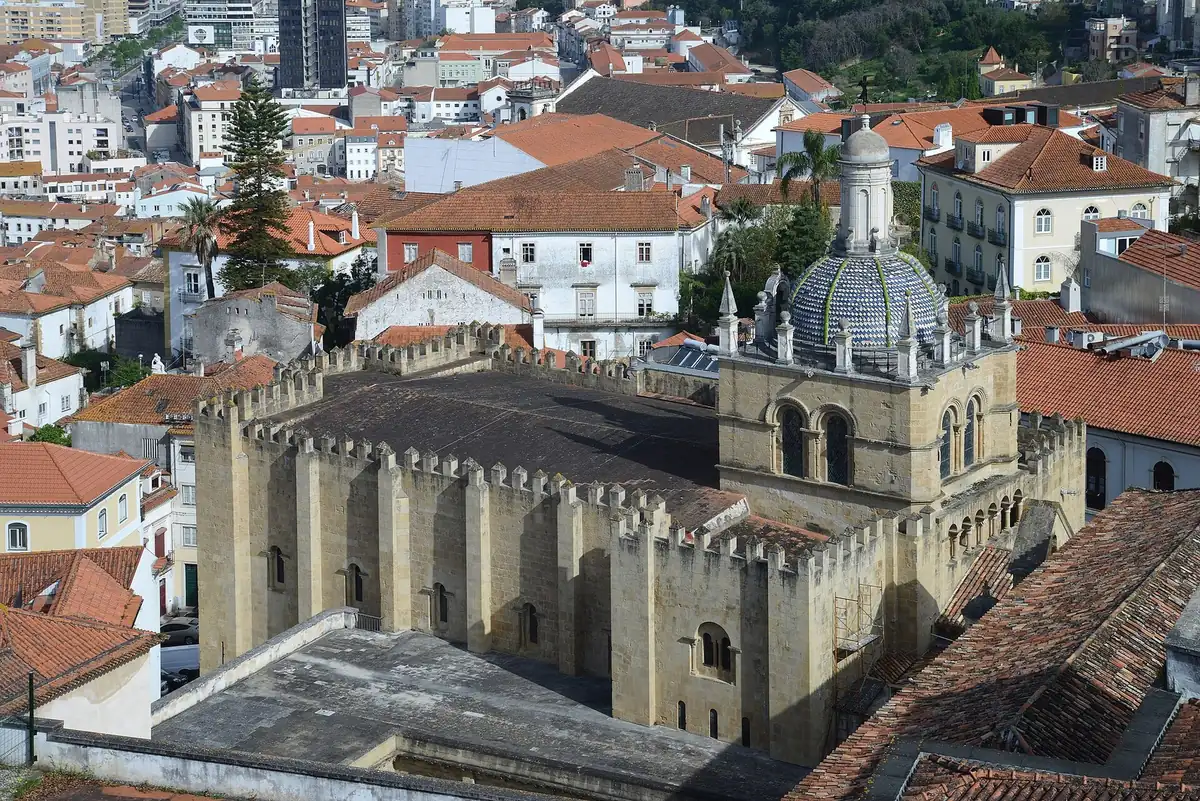
Outside the ticket: the Sé Nova is a minute away and costs 1.00 EUR. The Botanical Garden, 13 hectares and free, is a ten-minute walk downhill and part of the same UNESCO inscription. The clock tower is closed, so do not plan the view from it.
The Museu Nacional Machado de Castro, just below the Sé Nova, has been closed since February 2026 with no published reopening date — an important gap in any Alta itinerary this year.
Then go downhill properly. The Alta to Baixa descent starts at this courtyard and ends at Santa Cruz, and it is the walk that makes the shape of Coimbra click. For the whole ticket compared side by side, read the guide to visiting the University.
If you have two days, split the ticket across them — it is valid for two — and use the second morning for the Science Museum spaces before 12:30, while the gift shop and the labs are both open and the Alta is still quiet.
For a full day that works around the fixed Joanina slot and the churches’ awkward hours, the one-day Coimbra itinerary does the arithmetic. Sunday is the worst day to attempt it.