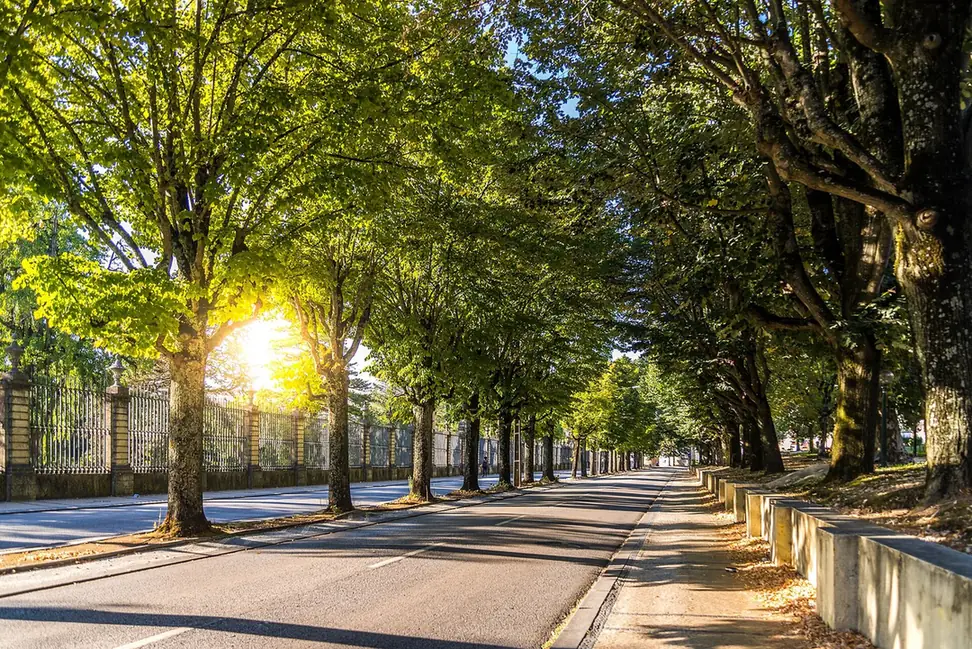

Everything else in the Alta costs money and has a queue. This does not. Ten minutes downhill from the university ticket kiosk, the ground opens into 13 hectares of terraced botanical garden running down the hillside toward the Mondego, with a nineteenth-century iron greenhouse at one end and gravel walks that empty within a hundred metres of the gate.
It is free — the University says so in as many words — and it is part of the same 2013 UNESCO inscription as the library and the palace above it. That makes it the largest free thing in Coimbra by a very wide margin, and the most underused hour in the city.
Free, and thirteen hectares
Say the first part plainly, because visitors keep assuming otherwise: the Botanical Garden is free access. There is no ticket, no kiosk and no gate charge. The University publishes that in its own booking text.
The only thing you can pay for is a guide, and that is optional. Two tours, 10.00 EUR each, both covered below.
Thirteen hectares is a lot of garden. For comparison, you can spend the whole Joanina Library slot — twenty minutes — and still not have crossed this site once.
It was created on the initiative of the Marquis of Pombal in 1772, in the same reforming push that rebuilt the University’s teaching, founded the Chemistry Laboratory that is now the Science Museum, and remodelled the Academic Prison a decade later.
So it is not a park that happens to sit beside a university. It is a teaching instrument built by a state that had decided what a university was for.
The UNESCO listing follows the same logic. “University of Coimbra – Alta and Sofia” was inscribed in 2013 and covers 32 buildings across the Alta and Rua da Sofia, and this garden belongs to that ensemble.
Which gives you an unusual proposition: a World Heritage site, 13 hectares, open daily, costing nothing.
It is also the only place in the Alta where you can sit down for nothing. Coimbra’s upper town has very little public space that is not either a monument or a narrow street, and this is the exception.
One to two hours covers it at a wander. An hour is enough if you are fitting it between ticketed things.
What to look for
The Central Square is the heart of the garden and the place to orient yourself. It was completed in 1791, which puts it within twenty years of the garden’s founding and makes it part of the original design rather than a later formalisation.
Stand there and read the site. The garden is terraced down a slope, and the terracing is the design response to a hillside that everything in Coimbra has to negotiate.
Then the Great Greenhouse, which is the building to see. It is one of the oldest iron-architecture buildings in Portugal, from the second half of the nineteenth century — the moment glass and iron changed what a greenhouse could be.
Its 2017 requalification won the National Urban Rehabilitation Award for Best Intervention with Social Impact, which is a specific and unusual category: the prize was for what the restoration did for people, not only for the fabric.
The Tropical Greenhouse is a separate matter and is excluded from the standard garden guided tour. If that is what you want, the Great Greenhouse tour is the one to book.
Beyond the set pieces, the garden rewards drifting. It is large enough that the paths away from the Central Square are usually empty even in July, and the drop toward the river gives you views back up at the Alta.
The garden is still a working scientific collection rather than a municipal park, which shows in how it is planted — beds organised by relationship rather than by display, and labels that assume you are interested in the answer.
Bring water in summer. Thirteen hectares on a south-facing slope in August is more walking than it looks on a map.
And take the slope seriously in both directions: this is a downhill garden, and you have to come back up to reach the university.
The two guided tours
Two paid options exist, both 10.00 EUR, and they are not the same thing.
The Guided Tour to the Botanical Garden runs 1h30 and covers the garden — but excludes the Tropical Greenhouse. That exclusion is stated by the University and is worth reading before you book.
The Guided Tour to the Botanical Garden Greenhouse runs 1 hour and covers the Great Greenhouse and its west wing.
Both are booked through [email protected] rather than through the main ticket flow.
The detail I like: the University states that visits to the Botanical Garden proceed irrespective of the weather conditions. The tours run in rain, and the only thing that cancels them is the absence of a guide.
That is a refreshingly honest policy and it tells you what to bring in winter. There is no wet-weather alternative; there is a coat.
Is a guide worth it in a free garden? If you have a real interest in plants or in eighteenth-century scientific institutions, yes. If you want an hour of green between two ticketed interiors, walk it yourself and spend the ten euros on lunch.
The same booking rules that govern the rest of the university’s programmes apply: no refunds, no exchanges.
How to visit
Hours are seasonal and generous. 1 April to 30 September: 09:00–20:00. 1 October to 31 March: 09:00–17:30. No closing day is published.
The summer 20:00 close is the most useful opening time in Coimbra. Everything else in the Alta has shut — the Palace of Schools at 19:30, the cathedrals long before — and the garden is still open with the best light of the day on it.
The entrance is on Calçada Martim de Freitas, about ten minutes downhill from the university ticket office. The garden sits between the Alta and the river.
No ticket, no booking, no queue for general entry. Walk in.
For the guided tours, email [email protected] in advance.
Accessibility: it is a terraced garden on a hillside with gravel paths. Some of it is level and some of it is not, and no step-free route is published by the University.
With children, this is the easiest hour in the Alta: space to run, no silence to enforce and nothing to break. It pairs well with the Cabinet of Curiosities on the university ticket.
Getting back up is the part people underestimate. The Elevador do Mercado covers a 51-metre rise between the Baixa and the lower Alta on any valid SMTUC ticket, Monday to Saturday 07:30–21:00 and Sundays 10:00–21:00 — see is Coimbra walkable.
What to combine
The university circuit is ten minutes uphill: the Paço das Escolas, whose courtyard is also free, the Joanina Library on its fixed slot, and the Science Museum in Pombal’s chemistry laboratory.
The Sé Nova at 1.00 EUR and the Sé Velha at 3.00 EUR are the two cheapest interiors nearby, and between them and this garden you can have a full day in a World Heritage quarter for four euros.
The Museu Nacional Machado de Castro has been closed since February 2026 with no reopening date — another reason a free garden is worth an hour this year.
Downhill and across the river, the Mondego riverside walk is the flat counterpart to this hillside, over the Pedro e Inês footbridge.
And for the whole free-versus-paid calculation in one place, read things to do in Coimbra.