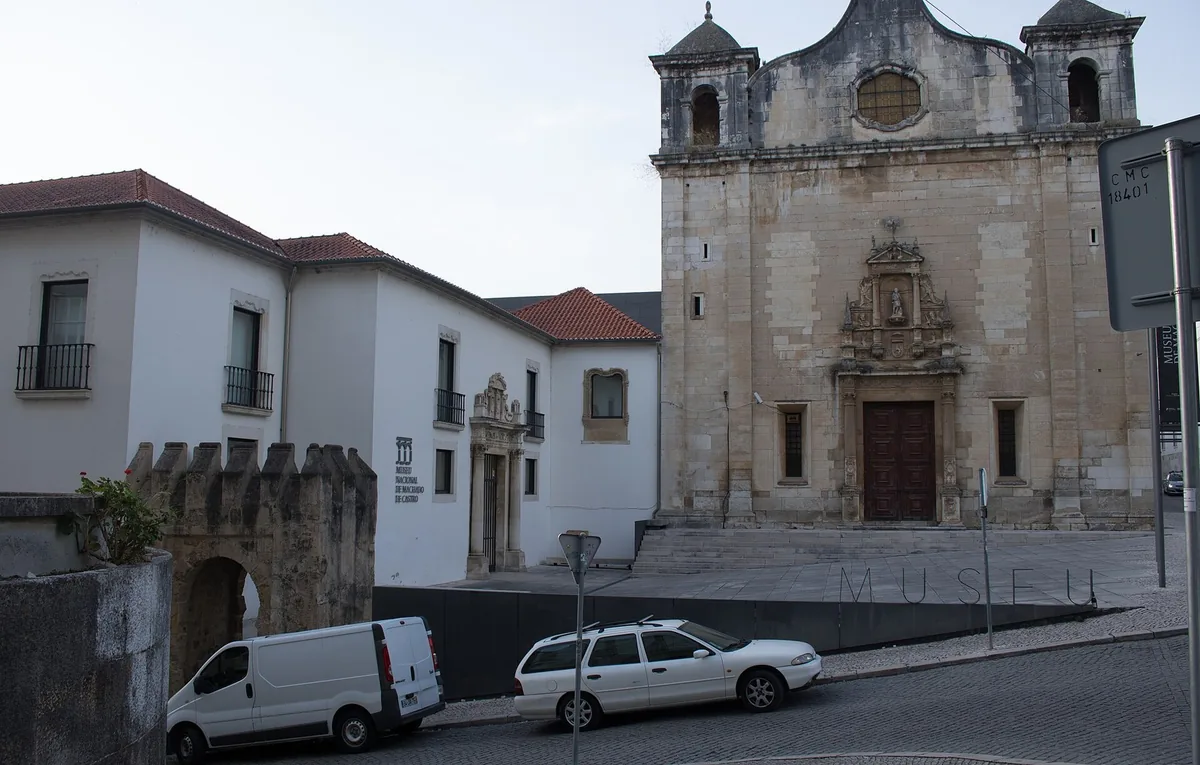

The Museu Nacional Machado de Castro is closed. It has been closed to the public since mid-February 2026, for conservation works funded under the PRR, and as of 15 September 2026 the official museum page still carries the closure notice. No reopening date is published.
This is the biggest hole in a Coimbra itinerary this year. The museum is one of Portugal’s most important — sculpture, sacred goldsmithing and painting — and it is built over and around the Roman cryptoporticus of Aeminium, the vaulted substructure of the first-century forum, which the museum itself calls one of its most important attractions. You cannot see any of it at the moment, and this page explains what is known, what is not, and where to spend the two hours instead.
The closure
The official notice is one line: Encerrado temporariamente para obras de conservação no âmbito de PRR — temporarily closed for conservation works under the PRR.
The timeline, as far as it has been reported, runs like this. Works began in 2025. The museum also took storm damage over the winter. It closed to the public from mid-February 2026.
In February 2026 the museum’s director, Sandra Saldanha, said it would be totally closed for the conclusion of the works until June.
By 12 June 2026 the reported plan had changed to a phased reopening after the summer. That is the most recent substantive statement I can find.
Summer is over. As of today the official page still shows the museum as closed, and no phase has been announced as open.
No reopening date is published, and no admission price is displayed. I would rather print that than carry forward a fee from before the works.
So: do not plan around it. If you are travelling in the next few months and this museum is a reason you chose Coimbra, check the official page yourself before you book, and consider emailing the museum directly.
One technical note if you go looking. The site’s English URL path for this museum returns a 404 — the English routing is broken. Use the Portuguese page, which is the one that carries the notice.
It is also worth noting how the reported timeline has slipped. February said June; June said after the summer; September says nothing. That is not evasion, it is what conservation projects do — but it means any date you read should be treated as a plan rather than a promise.
What is inside
Worth knowing, because it is what you are missing and what you will come back for.
The collection is sculpture, sacred goldsmithing and painting, and it exists because of a political act rather than a bequest. Most of it came from the convents, monasteries and churches politically extinguished in 1834, when the Portuguese state suppressed the religious orders and took their property.
That is the same year Coimbra’s university lost the Foro Académico and shut the Academic Prison as a working gaol. The 1830s dismantled a lot of medieval Portugal at once, and this museum is the storeroom of the result.
The museum is named for Joaquim Machado de Castro (1731–1822), the sculptor, who was a Coimbra native. It opened in 1913 and became a National Museum in 1965.
Beneath it is the cryptoporticus, dating from the mid-first century AD — the vaulted substructure built to level the ground for the forum of Roman Aeminium. It is not a basement bolted on for interest; it is part of the visit route.
The building itself is worth the ticket. The museum closed from 2006 to 2012 for a rebuild by the architect Gonçalo Byrne, and that work won the Piranesi / Prix de Rome in 2014, specifically for how it handles the relationship between new construction and archaeological inheritance.
So the site is three things stacked: a Roman forum substructure, a bishop’s palace above it, and a prize-winning contemporary museum threaded through both.
Stated visit time when open was 2 hours. Treat that as a minimum if the Roman level interests you at all.
The collection’s strength is medieval and Renaissance sculpture, and Coimbra was a major carving centre — the sculptors who cut the Porta Especiosa at the Sé Velha, João de Ruão and Nicolau de Chanterenne, worked in this city.
So the museum is not a national collection that happens to be here. It is the local one, promoted, and the buildings it was gathered from are mostly within walking distance of its door.
Hours and prices when it returns
For planning a later trip, the timetable published before the closure was Tuesday to Sunday, 10:00–18:00, with last entry at 17:30 and the shop closing at 17:45.
Annual closures were 1 January, Easter Sunday, 1 May, 4 July and 25 December. The 4 July date is Coimbra’s municipal holiday and it closes several state sites in the city on the same day.
The museum itself published those hours as subject to change in line with the progress of the works, which is a clear signal that the reopened museum will run on a different schedule, at least while phases are being brought back.
A phased reopening also means partial access. Expect some galleries open and others closed, and expect that to be reflected in the price.
The admission price is not displayed and I will not print one. Check the official page on the day.
The museum’s phone number is +351 239 853 070, and it sits on Largo Dr. José Rodrigues, immediately below the Sé Nova in the Alta.
When it does reopen, the announcement will come from Museus e Monumentos de Portugal first. Aggregator sites will follow weeks later, and some will still be saying it is closed when it is not.
The same discipline applies in reverse right now, which is the whole point of this page.
What to do instead
Two hours is the gap to fill, and the Alta can fill it without a national museum.
The Science Museum of the University of Coimbra is the direct substitute and is included in the standard university tickets: the Pombaline Chemistry Laboratory, the Cabinet of Curiosities, the Mineral Gallery and the Physics Cabinet, open every day 10:00–19:00 with last admission 18:45. Note that its Natural History Gallery is closed.
The Museu Académico is on the same ticket at no extra cost and covers Coimbra student life — the capes, the rituals, the republics and the Queima. It is the most skipped room in the city.
The Museu Municipal de Coimbra runs six sites in the historic centre, including the walled-city display in the Torre de Almedina, the Coimbra guitar and fado collection in the Torre de Anto, an exhibition on the Jews of Coimbra and a mikveh. Most open Tuesday to Saturday only, with a 13:00–14:00 gap.
For sculpture and stone rather than display cases, the Sé Velha is three minutes downhill at 3.00 EUR, and its Romanesque capitals carry the richest iconographic programme of the Romanesque in Portugal — with no human figures and no biblical scenes in it at all.
For Roman Coimbra specifically, the answer is out of town. Conímbriga is the best-preserved Roman town in Portugal, open Monday to Sunday 10:00–18:00 with the ticket office closing at 17:15, and entry is 10.00 EUR. It is the natural substitute for the cryptoporticus.
And the free one: the Botanical Garden, 13 hectares, part of the 2013 UNESCO inscription, open to 20:00 from April to September.
For the full shortlist of what is actually open in Coimbra this year, read what to see in Coimbra.
If your interest is specifically sacred art, Santa Cruz in the Baixa keeps its own Museum of Sacred Art behind a 5.00 EUR ticket, along with the Cloister of Silence and the relics of St Teotónio. It closes at 16:30 Monday to Saturday.
How to check before you go
Use the museum’s own page on museusemonumentos.pt, in Portuguese, and look for the closure notice. If the notice has gone and tickets are on sale, it is open.
Do not judge by search results. Press coverage from February and June 2026 is still circulating and describes plans that have since moved.
Do not judge by mapping apps either. Their opening hours are largely user-generated and lag official closures badly.
If you need certainty for a fixed date, the museum’s phone number is +351 239 853 070 and the institution publishes communications contacts on its own site.
Coimbra has an unusual concentration of closures this year, and the same method applies to all of them: Santa Clara-a-Velha has been shut since 20 October 2025, and the University Tower is closed with no reason given.
For Santa Clara-a-Velha there is an extra trap worth knowing: an official-looking “Reabertura” page dated 22 June 2023 keeps surfacing in search results and refers to an earlier reopening entirely.
Assume closed, verify open. In Coimbra in 2026, that is the rule.