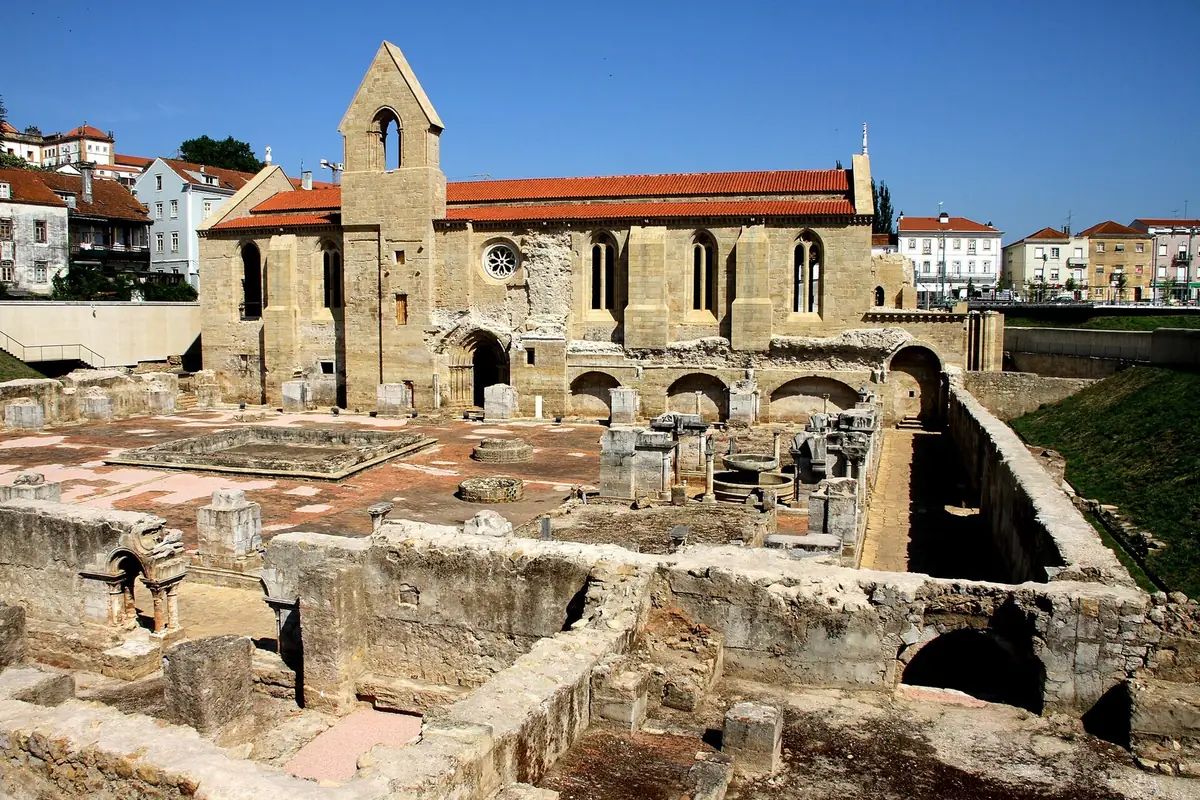

Santa Clara-a-Velha is closed. It has been closed since 20 October 2025, and no reopening date has been published by anyone. The official state ticketing portal carries one line about it: Encerrado temporariamente: por motivos de obras — temporarily closed for works. If you have this monument on a Coimbra itinerary, take it off, and read the next section before you trust anything you find that says otherwise.
It is a real loss. This is the fourteenth-century Gothic monastery founded by Queen Isabel on the left bank of the Mondego, abandoned to three centuries of flooding, and excavated back out of the river silt in the 1990s — one of the strangest and best archaeological sites in Portugal. A National Monument since 16 June 1910. It will come back. It is not back yet.
The closure
The monument closed on 20 October 2025. The works are funded under the PRR, Portugal’s recovery and resilience plan, and are formally described as the Requalificação do Centro Interpretativo, Casa do Paço, Arranjos Exteriores e Melhoramentos Gerais.
In plain English: the interpretation centre, the Casa do Paço, the external works and general improvements. The published budget is 1,539,932.88 EUR plus VAT.
That is a substantial programme, not a fortnight of repointing. A budget of that size on a site with a visitor centre and an excavated ruin implies a long closure, and the timeline so far bears that out: as of 15 September 2026, eleven months in, the official ticketing page still shows the closure notice.
No reopening date has been published. Not by Património Cultural, not on the ticketing portal, not in any official announcement I can find. I would rather print that gap than fill it.
So the practical advice is simple. Do not build a day around this monument. Do not book a left-bank morning on the assumption it will be open. And if you are travelling in the next six months, check the ticketing portal yourself before you cross the river.
It is worth adding that Coimbra has an unusual number of closures right now. The Museu Nacional Machado de Castro has been shut since February 2026, and the University Tower is closed with no stated reason. Three of the city’s headline sights are unavailable in the same year.
It also changes what a first visit to Coimbra looks like. Without the national museum and without this monastery, the city’s visitable heritage is concentrated almost entirely in the Alta and on Praça 8 de Maio, which is a smaller footprint than the guidebooks describe.
That is bad luck for a visitor and a genuine planning problem, and it is why every Coimbra page on this site leads with status rather than burying it.
The flip side, bluntly, is that one day in Coimbra goes further in 2026 than it normally would. With the two biggest museums closed, the core of the city fits into a day more comfortably than it usually does.
One more consequence worth flagging for anyone planning a longer trip. The PRR programme has a fixed horizon, and a great many Portuguese monuments are being worked on under it simultaneously. Closures like this one are not isolated.
If your itinerary covers several state-run sites in central Portugal, check each one on the same ticketing portal rather than assuming that a national monument is open because it is famous.
The “Reabertura” trap
Here is the thing that will mislead you, and it has already misled several published guides.
Search for this monastery and you will surface an official-looking page from culturacentro.gov.pt headed “Reabertura do Mosteiro de Santa Clara-a-Velha” — reopening of the monastery. It reads like current news. It is not.
That article is dated 22 June 2023 and refers to an earlier reopening, after an earlier closure. It has nothing to do with the works that began in October 2025.
Several aggregator guides have picked it up and republished it as though it were current, which is how a 2023 press release ends up telling a traveller in 2026 that a closed monument is open.
The test is the date, and it is the test to apply to everything you read about Portuguese monuments. A government domain does not make a page current.
The authoritative source for the live status is the state ticketing portal, bilheteira.patrimoniocultural.gov.pt, because it is transactional: if the monument were open, it would be selling tickets. It is not selling tickets.
If you want a second check, look for a price. No admission price is displayed anywhere while the monument is closed, and none is published elsewhere by an official source. A page quoting you an entry fee for Santa Clara-a-Velha is quoting an old one.
This is not a small pedantry. A left-bank morning is a river crossing and a walk, and turning up at a locked gate costs you an hour you did not have.
Finally, be sceptical of confident reopening predictions, including cautious ones. Nobody outside Património Cultural knows, and the honest position for a guide is to say so rather than to split the difference with a guess.
When it does reopen, expect the announcement on Património Cultural’s own channels and the ticketing portal first, and expect the aggregators to follow weeks later.
There is a second, subtler version of the same trap. Travel guides updated “in 2026” frequently keep their monument sections from an older edition, so a page can be genuinely republished this year and still describe a site as it was in 2024.
The giveaway is precision. A page that gives you a price, an opening time and a closing day but no mention of the works is describing the past, however recent its timestamp looks.
The monastery the river took
The story is worth knowing even while the gate is shut, because it is the best story on the left bank.
Queen Isabel founded the monastery in the fourteenth century, beside the Mondego. The river then spent three centuries trying to take it back.
This is the detail that guides flatten into “it flooded”. It did not flood once. The Mondego’s cyclical floods made life inside the walls progressively unbearable until the Poor Clares gave up and left permanently in 1677 for Santa Clara-a-Nova, on the Monte da Esperança above.
Three hundred and fifty years of a community losing an argument with a river, and then the silt closed over the building.
It was dug back out in the 1990s. What the excavation uncovered is a Gothic church and monastic complex preserved by the mud that destroyed it — the reason the site is archaeologically extraordinary rather than merely picturesque.
And it is not over. The monument’s own official page states that the most recent floods occurred in December 2019. Twenty-five years after the excavation, the river reached it again.
Hold that next to the current works. A site that has to be defended against a river needs external works, drainage and a maintained interpretation centre, and the 1.5 million euro programme reads rather differently in that light.
When the nuns left, they took the queen with them. Her original Gothic stone tomb, carved by Mestre Pero in 1330, was dragged up the hill and is in the lower choir at Santa Clara-a-Nova today. That is where to go while this is shut.
There is one more reason the excavation mattered. A monastic complex sealed in river silt preserves floor levels, burials and building phases that a continuously occupied site loses to every later renovation. Santa Clara-a-Velha is a fourteenth-century building that stopped, rather than one that was modernised.
National Monument since 16 June 1910, for the record. The classification is more than a century old; the building is seven hundred.
The geography explains the whole thing. The Mondego runs wide and shallow past Coimbra, the right bank rises steeply into the Alta, and the left bank does not. Everything built low on that side has had to negotiate with the river.
Which is also why Queen Isabel needed a water supply piped in. In a document dated 26 June 1326 she asked the friars of Santa Cruz for the land around two springs, 500 metres away, so water could reach her convent. Those springs are in the Quinta das Lágrimas gardens today.
Hours and prices when it returns
For planning a future trip rather than this one, the timetable published on the ticketing portal before the closure was:
- 15 October to 31 March: Tuesday to Sunday, 09:00–17:00
- 1 April to 14 October: Tuesday to Sunday, 10:00–18:00
- Last entry 30 minutes before closing
- Closed Mondays, 1 January, Easter Sunday, 1 May, 4 July and 25 December
Note the 4 July closure. That is Coimbra’s municipal holiday, and it closes several state sites in the city on the same day — a date worth avoiding for a monument-heavy itinerary.
Treat all of that as historic rather than forecast. A refurbishment of this scale usually comes with revised hours, a revised route through the site and a revised price.
The admission price is not published. It is not displayed while the monument is closed, and I will not carry forward a figure from before the works. Whatever you read elsewhere, check it against the ticketing portal on the day.
One more thing to expect: the works specifically cover the interpretation centre. Whatever reopens will probably present the site differently from whatever you read about in an older guide.
The monument sits on Rua das Parreiras on the left bank, next to Portugal dos Pequenitos and a few minutes from the river. It is an easy addition to a Santa Clara morning — once there is something to add.
The Tuesday-to-Sunday pattern is standard for state-run monuments in Portugal and is worth internalising for the whole country: Monday is the default closing day, and it is the day that ruins the most itineraries.
In Coimbra specifically, Monday also closes the Quinta das Lágrimas gardens and the municipal museum sites. Portugal dos Pequenitos and the university circuit are the reliable Monday options on this side of the city.
What to do instead
The left bank is still worth the crossing, and three of its four attractions are open.
Santa Clara-a-Nova, on the hill above, is where this story ends and it is the direct substitute. Queen Isabel lies there twice: in a silver-and-crystal urn in the main chapel, and in her original 1330 Gothic stone tomb in the lower choir, the one the nuns hauled up from the flooded monastery. Entry 6.00 EUR, under 12 free, no visits during services.
Portugal dos Pequenitos is next door on the Rossio de Santa Clara, open every day except Christmas Day, 10:00–19:00 from March to mid-October and 10:00–17:00 the rest of the year. The park states a minimum visit of 90 minutes.
Quinta das Lágrimas has the gardens where Inês de Castro was killed in 1355, open Tuesday to Sunday and closed Mondays, with the Fonte das Lágrimas — which, contrary to the postcards, is not a carved stone fountain. It comes straight out of the rock.
And the river itself. The Mondego riverside walk crosses the Pedro e Inês footbridge and gives you the whole Alta stacked above the water, which is the view this bank is actually for.
On the right bank, if you would rather not cross at all: Santa Cruz holds the first two kings and closes at 16:30, and the Sé Velha costs 3.00 EUR.
And if the left bank is your base rather than a day trip, the Santa Clara side has the river, the park and the hill in a compact walk, with the Alta always in view across the water.
For a day assembled around what is actually open this year, read what to see in Coimbra.
If you are travelling with children, the substitution is easy: Portugal dos Pequenitos is fifty metres from this gate and is the one attraction in Coimbra designed for them. Adults 14–64 pay 14.95 EUR, children 3–13 pay 9.95 EUR, and under-3s go free.
How to check before you go
One page, one test. Open the state ticketing portal entry for this monument and look for two things: a closure notice, and a ticket on sale.
If the notice is there, it is shut. If tickets are on sale with a date and a price, it is open. That is the whole method, and it beats every listing site.
Ignore search results by headline. “Reabertura” in a title tells you nothing without the date underneath it, and the 2023 page will keep surfacing.
Ignore mapping apps for status too. Opening hours on maps are frequently user-generated and lag official closures by months.
If you need certainty for a fixed date, Património Cultural is the body responsible and its channels carry reopening announcements first.
The same discipline applies across Coimbra this year. The Machado de Castro closure has its own moving timeline — the museum was reported in June 2026 as planning a phased reopening after the summer, and as of mid-September the official page still showed it closed.
Assume closed, verify open. It is a miserable rule for a travel guide to have to print, and in Coimbra in 2026 it is the correct one.
And if you want one page that keeps all of Coimbra’s moving parts in one place — closures, transport changes, opening-hour traps — the practical information guide is the one to read before you book anything.