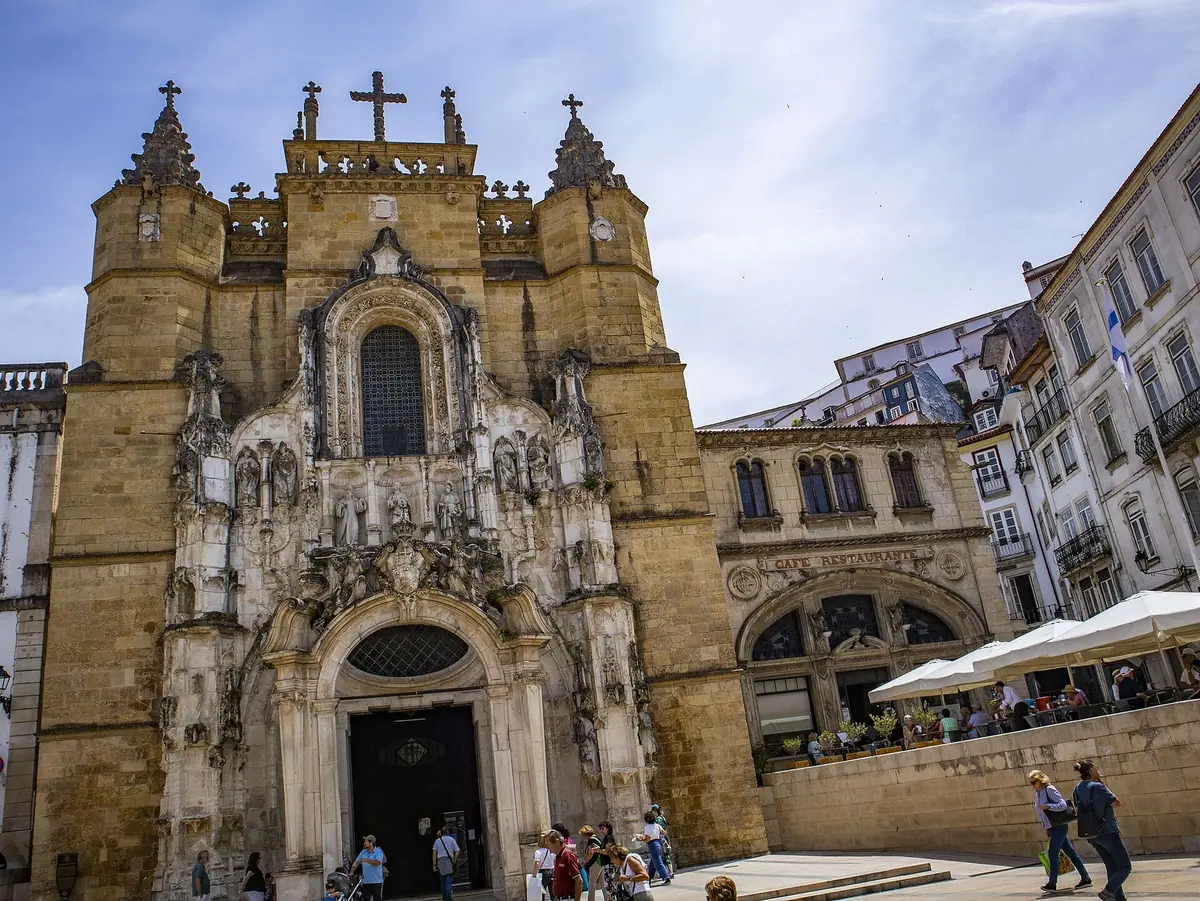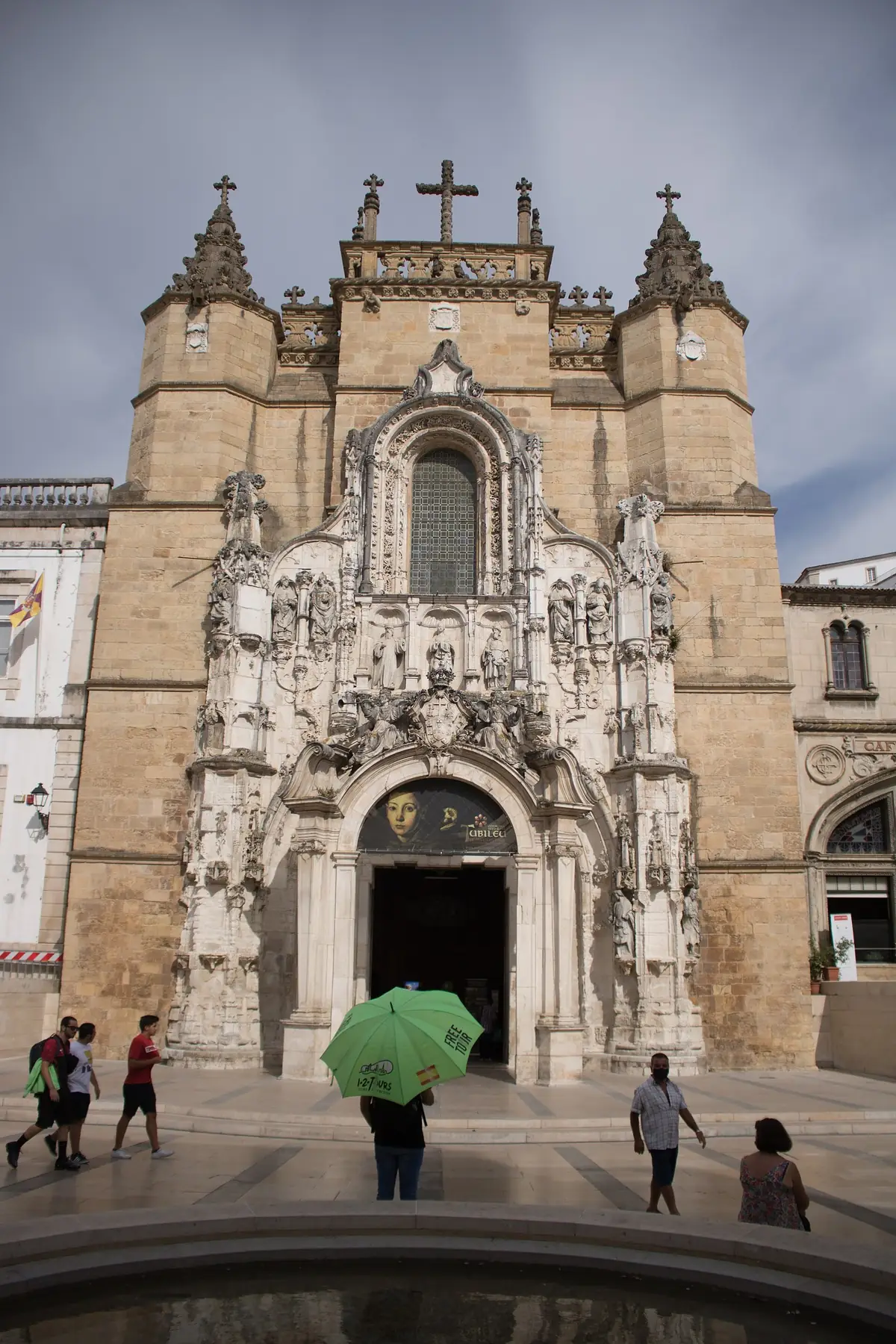

The Baixa’s main square has a café on one side, a fountain in the middle, buses going round it, and on the far edge a carved stone facade that looks like it was cut out of a different city and dropped here. Push the door and you are in a long, cool, vaulted nave with two royal tombs raised on either side of the high altar. Portugal’s first two kings are in this room. You did not pay to come in.
That is the thing to understand about Santa Cruz before you arrive. The monastery was founded in 1131, rebuilt in the sixteenth century to a plan by Diogo de Boitaca, and is a National Pantheon. The nave and the tombs are free. The 5.00 EUR ticket buys everything most visitors never see: the Cloister of Silence, the Chapter House, the sacristy paintings, the Museum of Sacred Art and the high choir stalls on the second floor.
What the ticket actually buys
Most people walk in, photograph the two tombs, look up at the vault and leave. They have seen the free part and they think they have seen Santa Cruz.
The 5.00 EUR ticket opens five things. The Claustro do Silêncio, the Cloister of Silence. The Sala do Capítulo, the chapter house. The sacristy paintings. The Museum of Sacred Art, which holds the relics of St Teotónio. And the Cadeiral do Coro Alto, the high choir stalls, on the second floor.
Take that last one seriously. The high choir is the only place you get the panoramic view down the whole length of the church — nave, vault, tombs and altar, from above and behind. It is the photograph of Santa Cruz, and it is behind the ticket desk.
The cloister is the other reason to pay. A sixteenth-century cloister called the Cloister of Silence, in a monastery on the loudest square in the Baixa, is exactly as good as it sounds.
The Chapter House and sacristy are smaller pleasures, but the sacristy paintings are the sort of thing that would be a headline in a smaller town.
St Teotónio, whose relics the Museum of Sacred Art holds, was the monastery’s first prior. The community he led is the one that founded this place in 1131 and buried the kings.
So the honest framing is this: the free visit is ten minutes and gives you two tombs. The paid visit is forty-five to sixty minutes and gives you the monastery.
At five euros I would not hesitate, and I would budget the full hour. Groups of twelve or more pay 3.50 EUR each, or 4.00 EUR with an audioguide.
If you genuinely only have ten minutes, take the free nave and come back another day. That is a real option here in a way it is not at the university.
There is a reason the split catches people. The ticket desk is discreet, the nave door is wide open onto the square, and nothing outside tells you that most of the monastery is behind another door.
Compare it with how the university sells itself. Up the hill, nothing is free except a courtyard and the price is on a board. Down here the most famous objects are free and the ticket is almost hidden.
So ask at the desk. The staff will tell you exactly what the five euros opens, and they are used to visitors who did not know there was anything else.
What to look for inside
Begin with the facade, from the square. It is sixteenth-century work, ornate against a plain stone town, and it announces a building that was rebuilt rather than merely repaired.
The rebuilding was to a plan by Diogo de Boitaca, one of the architects of the Portuguese sixteenth century, and it covered the church, the cloister and the chapels. What you walk into is a Manueline reinvention of a twelfth-century foundation.
Inside, the two royal tombs flank the high altar, raised, carved and impossible to miss. They are the point of the free visit and they are genuinely moving objects: not effigies in a side chapel, but the founders of a country given the best seats in the house.
Look at the vault as you walk the nave. The proportions are long and low compared with the Jesuit church up the hill, and the room is built for a monastic community rather than for a preaching crowd.
Then, with a ticket, go up to the Cadeiral do Coro Alto. Second floor, behind and above the nave, looking straight down its length. The choir stalls themselves are carved, and the view is the reward.
The Claustro do Silêncio is the next stop. Take it slowly; it is the only enclosed quiet in the Baixa, thirty metres from a bus route.
In the sacristy, look at the paintings rather than the furniture. In the Museum of Sacred Art, look for the relics of St Teotónio, which are the reason the room exists.
A word on the square outside, because the setting is part of the visit. Praça 8 de Maio is a working civic space rather than a monument plaza: buses, deliveries, students, a fountain, and a national pantheon on one edge of it. Nobody has curated the view.
Allow 45 to 60 minutes for all of it. That is the parish’s own framing and it is accurate.
One practical note: this is a working church on a busy square, not a museum with a cloakroom. Come as you would to any active church.
The building is layered rather than uniform, and it helps to know the two big dates. 1131 is the foundation; the sixteenth century is the rebuild. Almost everything you can see belongs to the second, and almost everything that matters historically belongs to the first.
Boitaca’s generation was building the Jerónimos monastery in Lisbon and the great Manueline churches at the same moment, funded by the same maritime wealth. This is Coimbra’s share of that boom.
Two kings and a saint
Santa Cruz holds Afonso Henriques, who made Portugal a kingdom, and Sancho I, his son. First king, second king, one room.
That is why the monastery is a National Pantheon. It is also why the coronation myth attached to the Sé Velha is worth correcting: the cathedral uphill was begun in 1164, consecrated in 1184, and hosted Sancho I’s coronation in 1185, by which time Afonso Henriques was dead. The place where Portugal’s first king is actually commemorated is down here, on a shopping square.
The foundation date is 1131, the same decade in which the fortress up the hill became the first Portuguese royal household. Coimbra in the twelfth century was the working capital of a new country, and this monastery was its intellectual centre.
Which brings in the saint. St Anthony of Padua studied theology here. Before he was Anthony of Padua he was Fernando de Bulhões of Lisbon, and Coimbra is where he did the reading.
He is one of the most widely venerated saints in the Catholic world, claimed by Lisbon by birth and by Padua by death, and the years that made him a theologian were spent in this cloister.
Very few English-language guides mention it. Nobody in Padua mentions it either.
Hold all of that against the building’s setting. A royal pantheon and the school of a universal saint, on a square with buses, deliveries and people eating pastries at the café on the corner.
That is Coimbra in one square, and it is why the Baixa is worth more than the twenty minutes most itineraries give it.
The Café Santa Cruz, on the same square, is the obvious place to sit afterwards and think about it.
One more thread, for anyone following the queens rather than the kings. Queen Isabel, who founded Santa Clara-a-Velha across the river, asked the friars of Santa Cruz in 1326 for land around two springs so she could pipe water to her convent. The estate is now the gardens of Quinta das Lágrimas.
The same community, then. Kings buried here, a saint taught here, and a queen negotiating with the prior for a water supply.
How to visit
Entry is 5.00 EUR for an individual. Groups of twelve or more pay 3.50 EUR each, or 4.00 EUR each with an audioguide. School groups are 2.00 EUR per pupil, or 2.50 EUR with audioguide. A guided visit for groups over twenty, with audioguide, is 6.00 EUR each.
The church nave, with the two royal tombs, can be seen without a ticket. That distinction is not signposted clearly, and it is the single most useful thing on this page.
Hours are the trap. Monday to Saturday 09:30 to 16:30. Civil holidays the same. Sundays and religious holidays 13:00 to 17:00.
A 16:30 closing time is early by any standard, and it is much earlier than the university circuit, which runs to 19:30. If you do the Alta in the morning and drift downhill, you will miss this.
The correct order for a one-day visit is therefore: Santa Cruz or the cathedrals first, university afterwards. The university stays open late; nothing else here does.
On Sundays the 13:00 opening is worse. Combined with the Sé Velha opening at 11:00 and the Almedina tower museum being shut all day, Sunday is the worst single day to attempt Coimbra.
No advance booking is published or needed for individuals. Turn up and pay.
Accessibility: the high choir is on the second floor and the building is twelfth-century in origin and sixteenth-century in fabric. No step-free route is published.
Prices and hours at Portuguese monuments are revised in January and again mid-season, so check the parish page before a tight schedule.
If you are travelling as a group of twelve or more, the audioguide upgrade is worth the extra 0.50 EUR a head. There is limited signage inside and the sacred art room in particular is hard to read without commentary.
And if you only have a euro or two of interest, remember the nave is free and the Sé Nova up the hill is 1.00 EUR. Coimbra is unusually cheap once you are past the university.
The days it closes
This is the closure list nobody else prints, and two entries on it will surprise you.
The predictable ones: New Year’s Day, Easter Sunday, Corpus Christi and Christmas Day.
The odd one: Army Day, 24 October. A National Pantheon holding the tombs of the kingdom’s founder closes for the army’s day, which is either a coincidence or exactly the sort of thing a national pantheon does.
And the two movable ones, which are the real planning risk: the day of the Queima das Fitas Cortejo and the day of the Latada Cortejo. Both are student parades. Both move each year.
Think about what that means. Coimbra’s student festival is large enough that a national pantheon shuts its doors for the parade — and so does the entire university circuit, which closed on 24 May 2026 for Academic Week and closes again on 4 October 2026 for the Latada.
A visitor who books late May or early October without checking can lose the library, the palace and this monastery on the same day.
The Queima das Fitas ran 22–30 May in 2026. 2027 dates are not yet published, so do not assume a fixed week in May — check before booking.
The Latada is the autumn counterpart, the freshmen’s parade, and it does the same thing to the same buildings.
If your dates are anywhere near either, confirm on the parish page and the university’s information page before you book accommodation, not after.
The parish lists these closures on the same page as its prices, which is more than most Portuguese monuments manage, and it is worth reading before you build a tight day.
What to combine
Stay on the square first. The Café Santa Cruz is a few steps from the monastery door and the natural stop after an hour in a cloister.
Then uphill through the gate. The Arco de Almedina is five minutes away, the main gate of the walled town, with a municipal museum in the tower above — Tuesday to Saturday, 10:00–13:00 and 14:00–18:00, closed Sundays and Mondays.
Above that, the Sé Velha at 3.00 EUR, then the Sé Nova at 1.00 EUR and the Paço das Escolas, which stays open until 19:30 when everything below it has shut.
Or reverse it and take the Alta to Baixa descent, which ends on this square. Doing the hill downhill is the correct decision in July.
Half a day in the Baixa around this monastery is an easier proposition than half a day in the Alta, and a good deal flatter. Save the climb for the afternoon, when the light is better on the hill anyway.
For the priorities if your time is short, read what to see in Coimbra, and for a full day built around the opening hours, the one-day itinerary.
If you are heading the other way, the river is four hundred metres downhill: the Parque Verde on both banks, the Pedro e Inês footbridge, and the Mondego riverside walk over to Santa Clara and Portugal dos Pequenitos.
That side of the river is also where Santa Clara-a-Nova holds Queen Isabel, and where Santa Clara-a-Velha stands closed until further notice.