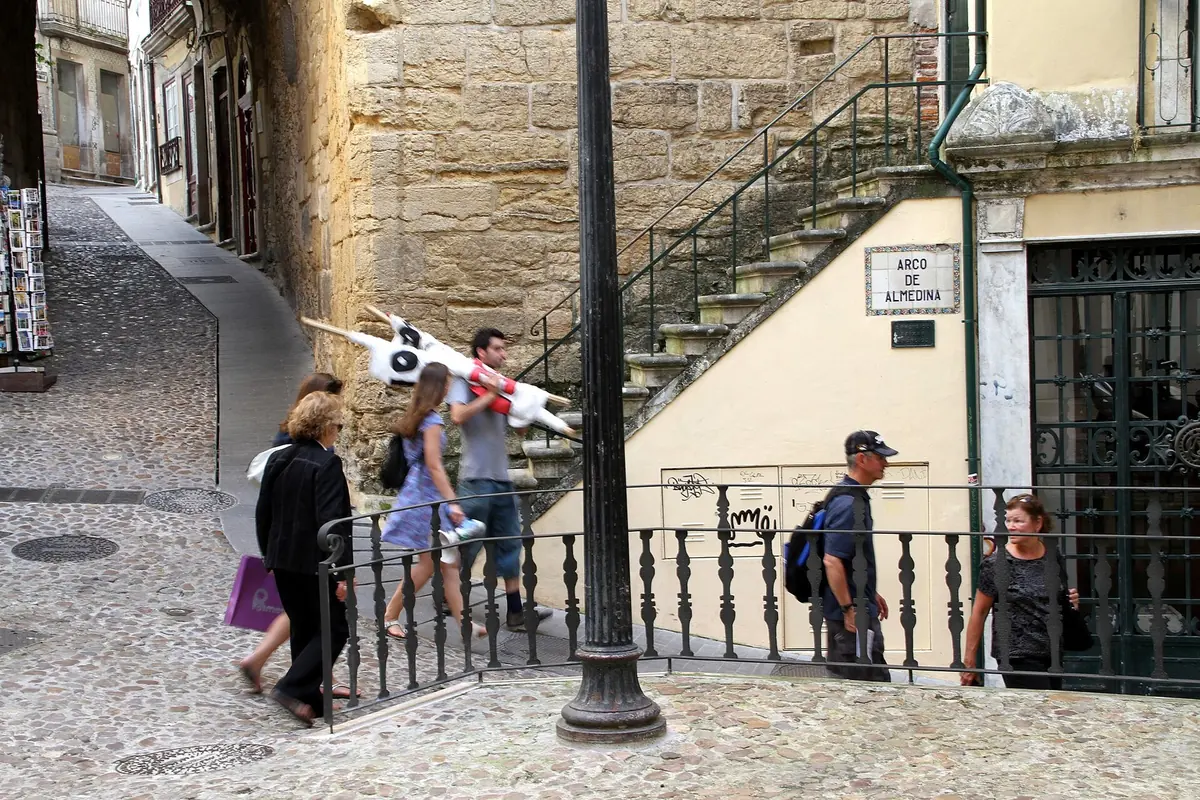

Rua Ferreira Borges is a shopping street, and then it is not. The buildings close in, a stone arch cuts across the lane with a tower above it, and through the opening you can see steps climbing away into shadow. This is the Arco de Almedina, the surviving main gate of Coimbra’s walled town, and the stepped lane beyond it is the Rua do Quebra-Costas — Back-Breaker Street. Everyone photographs the arch. Almost nobody looks up.
Above it is the Torre de Almedina, and inside the tower is a museum: the municipal Núcleo da Cidade Muralhada, the walled-city collection. It opens Tuesday to Saturday, 10:00–13:00 and 14:00–18:00, and it is closed on Sundays, Mondays and public holidays. Which means a large share of visitors physically cannot get in, and never find out it was there.
The hours are the story
Read that timetable again, because it is the single most useful thing on this page: Tuesday to Saturday, 10:00 to 13:00 and 14:00 to 18:00. Closed Sundays, Mondays and public holidays.
Now think about who comes to Coimbra. Day-trippers from Lisbon and Porto overwhelmingly travel at weekends. Sunday is the single most common day for a visitor to be in this city with free time.
On Sunday this museum is shut. On Monday it is shut. On the other five days it disappears for two hours over lunch, which is exactly when a visitor working down from the university reaches the bottom of the hill.
That is the opposite of what people assume about a landmark on a main shopping street. Everything around it is open; the thing above it is not.
So plan it, or lose it. If the tower museum matters to you, put it at 10:00 on a Tuesday to Saturday morning and work up the hill from there, rather than down.
The Sunday problem compounds across the city. Santa Cruz does not open until 13:00 on Sundays, the Sé Velha not until 11:00, and St Michael’s Chapel closes for mass from 11:45 to 14:00.
Sunday is the worst single day to attempt Coimbra, and the Almedina tower is the clearest illustration of why.
The arch itself, to be clear, is unaffected. It is a public street. You can walk through it at three in the morning if you like.
There is a structural reason behind it, and it is worth understanding rather than resenting. These are municipal museum sites staffed by council employees on council hours, not commercial attractions chasing footfall. They keep office hours because they are offices as well as museums.
The same pattern applies to all six sites the city runs, and to the Sala da Cidade, which does not open until 13:00 at all.
Once you know that, the fix is easy: treat the municipal museums as a weekday morning block rather than sprinkling them through a trip.
The gate itself
Almedina comes from the Arabic al-madína, the city, and the name is the history. This was the main gate of the walled settlement founded under Islamic rule, and the wall it pierced separated the upper town from everything below.
What survives is the gate and the tower above it, embedded in later building, with the lane running through. That is normal for a European city gate: the walls go first, the gates last, because gates are useful.
Stand in the opening and look both ways. Downhill is Rua Ferreira Borges and the commercial Baixa: flat, busy, shop windows. Uphill is the Quebra-Costas: stepped, narrow, quiet, climbing toward the cathedrals and the university.
That is the whole social geography of Coimbra in one doorway. Trade below, institutions above, a gate in between that decided who passed.
The arch is free and permanently walkable because it is a street, not a monument with a ticket desk. Nothing is fenced, nothing is charged.
It is also the best photograph in the lower town, and the light is the constraint rather than the crowd. The lane is narrow and the arch is in shadow for most of the day; early morning and the hour before sunset are when it reads.
The tower above the gate is the part that makes it legible as defence rather than decoration. A gate without a tower is a hole in a wall; a gate with a tower is a position from which the hole can be held.
Give the arch five minutes if you are passing, fifteen if you are photographing it.
And then look up at the tower, because the door to it is not on this lane — it is round on the Pátio do Castilho, which is why so many people never find it.
The wall this gate belonged to is mostly gone, which is the usual fate of urban defences once a town outgrows them. Fragments survive along the hillside, and the tower museum above is where the whole circuit is reconstructed for you.
It also helps to know what “Moorish-founded” means here in practice. The upper town was a fortified settlement under Islamic rule before it was Portuguese, and the fortress at the top of the hill — the one that became the royal palace and then the university — dates from the end of the tenth century.
So the gate, the wall and the citadel are one system, and two-thirds of it is now a World Heritage university. The arch is the surviving bit you can touch for free.
The tower museum
The Torre de Almedina houses the Núcleo da Cidade Muralhada, the walled-city section of the Museu Municipal de Coimbra.
That municipal museum is not one building. It is six separate sites, all within the historic centre: the Edifício Chiado with the Telo de Morais collection, this tower, the Torre de Anto, the Sala da Cidade in the old Santa Cruz refectory, the Edifício da Inquisição with its exhibition on the Jews of Coimbra, and a mikveh — a Jewish ritual purification bath.
Very few English-language guides mention any of that, and almost none mention the mikveh. Coimbra’s Jewish quarter is a genuinely under-told story and the city runs a museum site inside it.
In this tower, the subject is the walls themselves: how the town was enclosed, where the circuit ran, what the gates did. It is the interpretive counterpart to the arch you have just walked through.
Allow 30 to 40 minutes. It is a tower, so the visit is vertical and the rooms are small.
There is also an official virtual tour of the tower, published by the city, which is worth ten minutes if your dates fall on a Sunday or Monday and the door is shut.
The other municipal site worth knowing about is the Torre de Anto on Rua de Sobre Ribas, which holds the Núcleo da Guitarra e do Fado de Coimbra — a museum dedicated to the Coimbra guitar and Coimbra fado. Same hours: Tuesday to Saturday, 10:00–13:00 and 14:00–18:00.
Two municipal museums in two medieval towers, both on the climb between the Baixa and the Alta, both closed at the weekend’s most useful moment.
The Edifício da Inquisição and the mikveh are the two that will surprise most visitors, and their hours are on the museum platform rather than in any guidebook. Check them before you set out.
Full detail on all six sites is on the Museu Municipal de Coimbra page.
Worth flagging for anyone with a serious interest: the municipal museum’s sites are individually small and collectively substantial. Visiting three of them in a morning gives you a version of Coimbra that no single building does.
How to visit
The arch: walk through it. No ticket, no hours, no queue. It is on Rua Ferreira Borges at the foot of the Quebra-Costas climb, and you will pass it on any route between the Baixa and the Alta.
The tower museum: the entrance is on Pátio do Castilho, 3000-103 Coimbra, and the hours are Tuesday to Saturday, 10:00–13:00 and 14:00–18:00, closed Sundays, Mondays and public holidays.
The admission price is not published. The municipal museum platform lists addresses and hours for all six sites but carries no price list for any of them.
There is indirect evidence that a charge exists: the city has issued press releases announcing free-entry days across all the museum’s sites, which implies a normal rate. But I could not source that rate, and this page will not print a number somebody else guessed.
To find out before you go, call +351 239 833 771 or email [email protected]. The museum’s general contacts are +351 239 840 754 and [email protected].
No advance booking is published or appears to be needed for individuals.
Accessibility: it is a medieval tower reached from a small courtyard on a steep hillside, and no step-free route is published. The arch below is a stepped and cobbled street.
No published coordinate exists for the arch on either the Portuguese or English Wikipedia entries. Navigate to Rua Ferreira Borges or to Pátio do Castilho rather than to a dropped pin.
One practical alternative if your dates are wrong: the city’s official virtual tour of the tower is free, online and reasonably detailed. It is not a substitute for standing in the room, but it is better than a locked door and a shrug.
Municipal opening hours and prices change with council budgets rather than with the tourist season, so confirm on the museum platform before a fixed plan.
A note on the two entrances, because it confuses people. The arch is on Rua Ferreira Borges at street level; the museum door is round the corner on Pátio do Castilho, above and behind it. Looking for a ticket desk under the arch will get you nowhere.
The climb through the gate
Through the arch, the lane becomes the Rua do Quebra-Costas. It translates as Back-Breaker Street, and it is the main pedestrian route from the Baixa up to the Sé Velha.
The name is the fact. Coimbra called its principal climb Back-Breaker, in writing, and the name is still used in official documents defining the historic-centre transport zone.
If you would rather not, there is a lift. The Elevador do Mercado covers a 51-metre rise in two stages — a 20-metre vertical lift, then an inclined-plane lift to the top — between Rua Olímpio Nicolau Rui Fernandes, by the municipal market, and Rua Padre António Vieira.
It runs Monday to Saturday 07:30–21:00 and Sundays and public holidays 10:00–21:00, and any valid SMTUC transport ticket works on it. A separate single-ride fare is not published.
Worth knowing: the lift was out of service for a period and the city announced its return in January 2026. Older guides that call it permanently broken are wrong.
That 51-metre figure is the only officially published measurement of the Baixa-to-Alta climb, and it is not even the full height — the Paço das Escolas is higher again. The full account is in is Coimbra walkable.
Residents of the historic centre and the Alta can get a Passe Social Especial giving free use of the lift, which tells you who it was really built for.
Coming down, the gate does something a photograph cannot show you. You descend out of the shadowed steps, the arch frames the shopping street below, and the lower town arrives all at once. That sequence only works in one direction.
My advice, in any month with sun in it: go up by lift or by taxi, and come down through the arch. The Quebra-Costas is a much better street descending.
For the record, the Elevador do Mercado is the only lift or funicular SMTUC publishes a page for. If you read about another one, it is not currently an official service.
And the vertical figure worth pairing with it: the University Tower is 184 steps, per the University’s own visiting guidelines — though it is closed, so the number is context rather than a plan.
What to combine
Uphill through the gate: the Sé Velha, 3.00 EUR, five minutes up the steps, with the richest Romanesque carving in Portugal and not a single human figure in it.
Further up: the Sé Nova at 1.00 EUR, and the Paço das Escolas, whose courtyard is free and which stays open to 19:30 when everything below has closed.
Downhill: Santa Cruz on Praça 8 de Maio, three minutes away, with two royal tombs free in the nave and a 5.00 EUR ticket for the cloister and the high choir. It closes at 16:30.
Same street, different subject: the Torre de Anto and the rest of the Museu Municipal, including the mikveh and the Inquisition building, all on the same restricted hours.
And the river is four hundred metres downhill from the arch: the Parque Verde on both banks, the Pedro e Inês footbridge, and the Mondego riverside walk if you want flat ground after the steps.
The Alta to Baixa descent comes down through this gate, which is the right direction to meet it, and what to see in Coimbra sets the priorities for a short stay.
If you are here in the evening rather than the day, the fado venues are on the lane above: Rua do Quebra Costas numbers 7 and 12, a few doors apart, one with a 50-minute show every day of the year at 18:00.