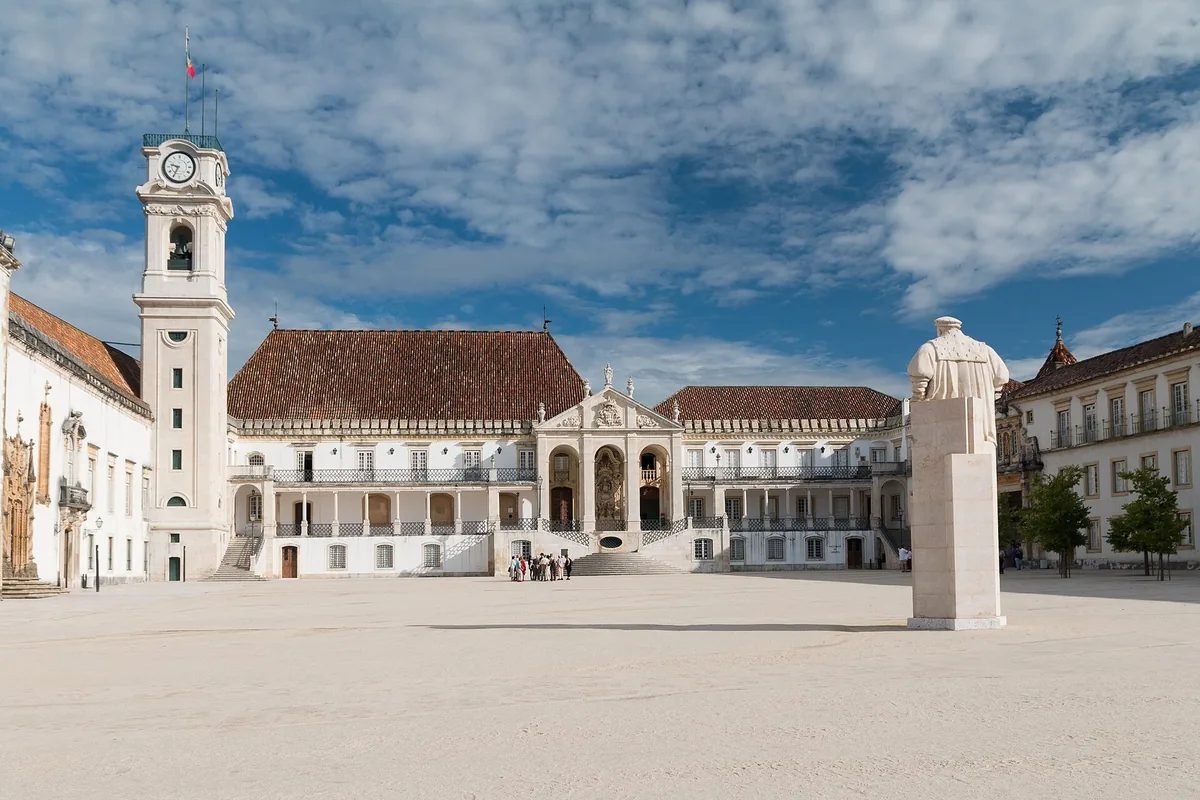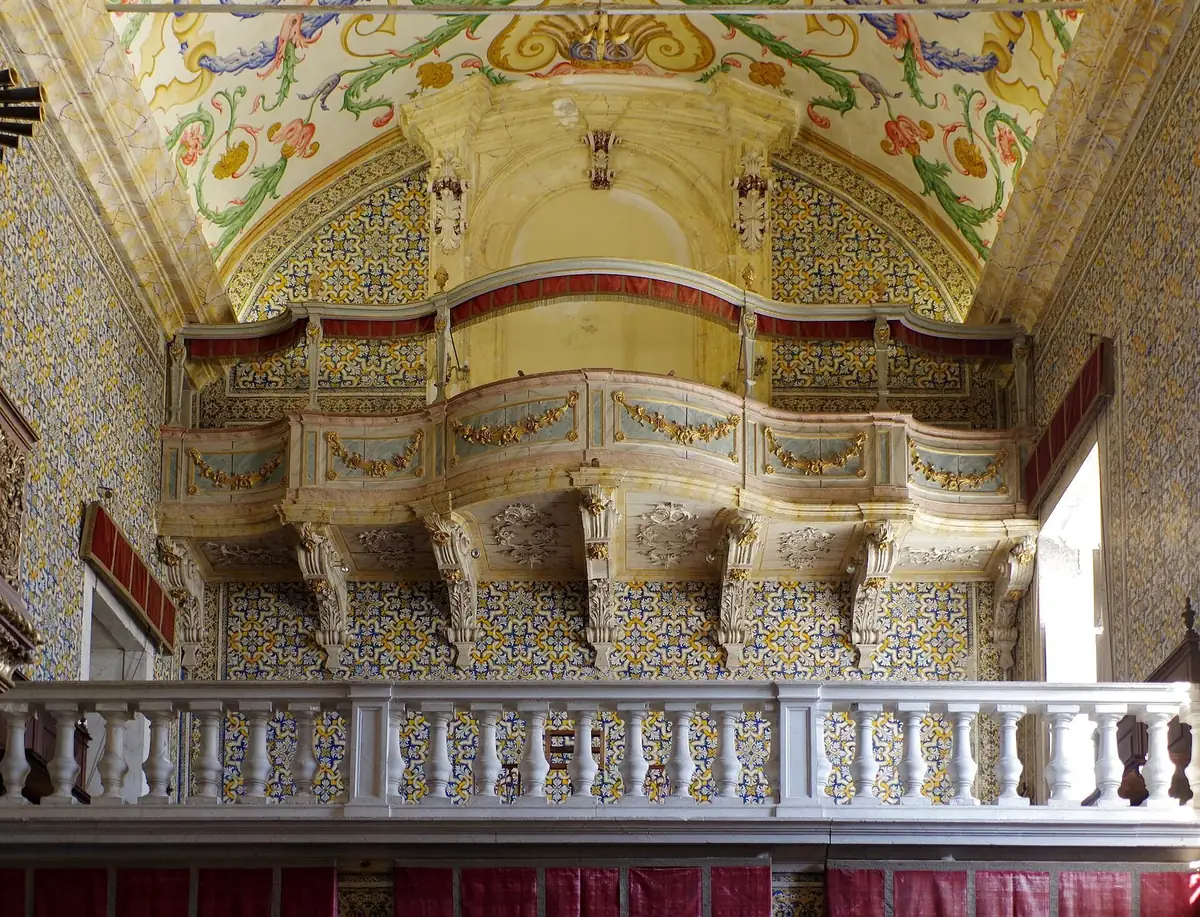

The door is easy to miss. It sits off the Paço das Escolas courtyard, low and unshowy, and half the people who have paid to be here walk past it toward the library queue. Push it open and the temperature drops, the noise stops, and the walls turn blue: tile from floor to cornice, laid in 1613, running the full length of the nave and up around the high altar, with a gilt Baroque altarpiece burning at the end of it.
This is the private oratory of the royal palace, founded in the 12th century, remodelled under King Manuel I and decorated across the seventeenth and eighteenth centuries. It is named for the Archangel Michael, protector of Afonso Henriques, whose household this was. It is still the university chapel — which is why it shuts for mass on Sunday mornings and why you should read the small stone plaque on the wall before you leave.
What to look for inside
Start with the tiles, because they set the room. The blue-and-white panels lining the high altar were laid in 1613, which puts them at the front end of the Portuguese tile tradition rather than in its Baroque flood. They are wall covering doing structural work: they unify a chapel that has been altered in every century since the twelfth, and they make one room out of four campaigns of building.
Then the altarpiece. Eighteenth-century, gilt, tall, and deliberately at odds with the cool tile below it — the gold reads as heat against the blue. Stand at the back, not the front. From the door the contrast is the design; from the altar rail you only see detail.
Look up at the ceiling and along the cornice line for the joins. This chapel was a private oratory for a royal household, then a chapel for a university that expected its rectors and its doctors to worship in it, and the fittings carry both. Nothing here was installed once and left alone.
Then find the stone plaque. It is small, it is easy to walk past, and it records the most consequential thing that ever happened in this room. The next section is about it.
Give the chapel ten minutes and you will have seen it. Give it fifteen and you will have read it. Most visitors give it ninety seconds because it is between them and the Joanina slot, and that is the mistake this page exists to prevent.
One practical note about looking at anything in here: flash is prohibited throughout the university’s visiting spaces, and tile under flash looks terrible anyway. Let the exposure run long and keep the camera still.
Notice how little of the chapel is twelfth century to the eye. The foundation is, the dedication is, and the position is — wedged against the palace it served rather than facing a square like a parish church. Everything you actually look at was applied later, by a university that kept redecorating the room it prayed in.
The Manueline remodelling under King Manuel I is the hinge. It converted a royal household’s private oratory into something an institution could use, at exactly the moment Portugal was building the fortune that paid for the gilt you see two centuries later.
There is no interpretation panel, no audio point and no leaflet in the room. The University hands you a chapel and expects you to look. That is refreshing and slightly ruthless, and it is why arriving with two or three things to find beats arriving with none.
The plaque that ended the crown
In 1646, King John IV offered the Crown of Portugal to Our Lady of the Immaculate Conception in thanksgiving. The Coimbra lentes — the lecturers — led by the Rector, swore a solemn oath to her. That oath was recorded on a stone plaque inside this chapel.
From that moment Portuguese monarchs stopped wearing a crown. Not metaphorically. The crown was given away, and no subsequent Portuguese king wore one. It sat on a cushion beside them at ceremonies instead.
Hold that against the scale of the room. Portugal had just fought its way out of sixty years of Spanish Habsburg rule; the new dynasty needed legitimacy that Madrid could not contest; and the instrument chosen was a vow to the Virgin, sworn by academics, in a chapel the size of a decent parish church.
It also tells you what the University of Coimbra was in the seventeenth century. Not a school. A body of the realm, whose formal oath was worth taking, worth recording in stone, and worth the king’s attention.
The gap in the kings’ portraits next door in the Sala dos Capelos is the other half of this story: every Portuguese monarch from Afonso Henriques to Manuel II hangs on those walls except the Philippine dynasty of 1580 to 1640. The same institution that swore the oath edited the wall.
Read the plaque, then walk thirty metres into the Great Hall and look at the empty stretch. Two rooms, one argument, made sixty years apart.
The detail people get wrong is the direction of the gesture. The crown was not surrendered to the Church as a submission. It was offered as patronage — the Virgin became Queen of Portugal, and the man on the throne governed in her name, which made him harder to depose and impossible for Madrid to delegitimise.
Coimbra’s role in it was not ceremonial padding either. The University supplied the kingdom’s canon lawyers and its theologians. An oath sworn by these men in this room was a legal instrument as much as a devotion.
How to visit
There is no chapel ticket. St Michael’s is included in all three university programmes: the 12.50 EUR University + Science Museum, the 16.50 EUR version with the Joanina Library, and the 25.00 EUR guided tour of the Palace of Schools, which covers the chapel with a guide in 1h30.
Buy at the ticket office kiosk in front of the Faculty of Medicine, or online. Online sales close 20 minutes before entry on the combined Joanina ticket and two hours before on the guided tour. Tickets are valid two days, except the Joanina slot, and there are no refunds or exchanges on any programme.
The Sunday rule matters here more than anywhere on the circuit: the chapel closes every Sunday from 11:45 to 14:00 for mass. It also closes without notice for occasional religious ceremonies, because it is a working chapel attached to a working university, and academic life here still has a liturgical calendar.
If you are visiting on a Sunday, do the chapel before 11:45 or after 14:00 and put the Royal Palace rooms in the gap. The palace does not close at midday.
Remember the one-entry-per-space rule. You cannot look in, decide to come back after the library, and be let in twice. See it properly the first time.
The guided tour departs at 11:00 and 15:00 in Portuguese and English, subject to guide availability, and can only be booked up to three months ahead. The 11:00 departure runs straight into the Sunday closure, so on Sundays take the 15:00.
A word on the guided option. At 25.00 EUR it is double the self-guided palace ticket, and for the chapel specifically it earns its money: this is a room with no signage, where almost everything worth knowing has to be told to you. Youth 6–25 pay 17.50 EUR and under-6s are free on that tour — the only reduced tiers the University publishes anywhere.
For the self-guided programmes, child, youth and senior rates exist but appear only inside the booking flow. Aggregator sites print figures for them that I could not reproduce from the University’s own pages, so ask at the kiosk rather than budgeting from a third-party table.
Practical logistics
The chapel keeps Palace of Schools hours: daily 09:00 to 19:30, last admission to the palace spaces 19:15. The ticket office kiosk runs 09:00 to 19:00 and its official GPS is 40.207938, -8.424189, which is the pin to use when the Alta’s lanes confuse your phone.
Photography is allowed here — the ban applies to the Joanina’s Noble Floor, not the chapel — but flash, tripods and selfie sticks are prohibited in all the university’s visiting spaces. Drones need prior authorisation and commercial use needs written permission.
Dress: no code is published, but this is an active chapel. If a service is starting, you will be asked to leave, and the right response is to leave.
Closures to diary: 24 and 25 December 2026, 31 December 2026 and 1 January 2027, and the movable academic days. The whole circuit shut on 24 May 2026 for Academic Week and closes again on 4 October 2026 for the Latada. The Queima das Fitas parade day closes it too, on a date that moves each year.
Getting here: the chapel is at the top of the Alta. The Elevador do Mercado covers a 51-metre rise in two stages, runs Monday to Saturday 07:30–21:00 and Sundays and public holidays 10:00–21:00, and takes any valid SMTUC transport ticket. The walkability piece has the full climb.
Accessibility: the University warns generally about stairs and narrow spaces across the circuit and publishes no step-free route for the chapel. Contact Turismo UC ahead if that decides your visit.
Where the chapel sits in a day matters more than when it opens. It is a five-minute stop attached to a two-and-a-half-hour circuit, so it works as the thing you do while waiting for a fixed Joanina slot — never as a destination in itself.
If you are counting euros, remember that the courtyard outside is free. You can stand at the balustrade above the Mondego, photograph the Via Latina and the closed clock tower, and pay nothing. The chapel is on the other side of the ticket line.
A chapel inside a university
Coimbra is unusual among European universities in that its ceremonial life never became purely secular, and this room is where you see it. Doctorates are conferred next door. Rectors are invested next door. And the chapel is thirty metres away, still consecrated, still used.
That continuity is also why the room feels lived in rather than curated. There is no glass, no ropes across the nave, no interpretation panel telling you how to feel about the tiles. The University treats it as a chapel that visitors happen to walk through.
The student world outside carries the same mix. The black capes, the faculty colours in the palace rooms, the rituals of the Latada and the Queima — they are secular festivals built on a liturgical frame, complete with processions, vestments and a calendar. The Academic Museum, included on the same ticket, unpacks all of it.
If that thread interests you more than the architecture, read why Coimbra students wear black capes before you come up here. The chapel makes more sense afterwards.
And if you want the sound rather than the stone: Coimbra fado is a serenade tradition sung by students in the streets of this quarter, documented from the sixteenth century, and it is closer to this chapel in spirit than to anything in a Lisbon tavern.
There is one more institutional echo worth catching. This university kept its own prison, under the library, until the Foro Académico privilege was revoked in 1834. A body that holds a chapel, a gaol and a throne room within fifty metres is not a campus; it is a small state, and the buildings still read that way.
Which is also why visiting hours here bend to ceremonies rather than to tourism. A doctorate, a rector’s investiture or a requiem will close a room at no notice, and the University does not treat that as a service failure.
What to combine
Everything on your own ticket, first. The Royal Palace rooms are a hundred paces away, the Sala dos Capelos is inside them, and the Science Museum spaces — Chemistry Laboratory, Cabinet of Curiosities, Mineral Gallery — are a short walk downhill and open 10:00 to 19:00, an hour less than the palace.
Off the ticket and nearby: the Sé Nova is a minute away and costs 1.00 EUR, which makes it the cheapest interior in the Alta and a natural second church. The Sé Velha, ten minutes downhill, costs 3.00 EUR and is the better building.
The Museu Nacional Machado de Castro sits between the two and has been closed since February 2026 with no published reopening date. Do not build an afternoon around it.
For a free counterweight to a morning of ticketed interiors, walk down to the Botanical Garden: 13 hectares, free access, open 09:00 to 20:00 from April to September and to 17:30 in winter. Or take the Alta to Baixa descent and end at Santa Cruz before it closes at 16:30.
If the chapel is the part of Coimbra that interests you, the pairing with real weight is Santa Cruz in the Baixa: founded in 1131, burial place of Portugal’s first two kings, and the place where St Anthony of Padua studied theology before he was Anthony of Padua. Entry is 5.00 EUR and the nave is free.
Across the river, Santa Clara-a-Nova holds Queen Isabel in a silver-and-crystal urn upstairs and her 1330 Gothic stone tomb downstairs in the coro baixo. Two tombs, one queen, 6.00 EUR, and almost nobody makes the climb.