
Everybody buys this and almost nobody uses it. The Science Museum is bundled into every standard University of Coimbra ticket, it sits a few minutes downhill from the library queue, and most visitors walk out of the Joanina and straight down to the cathedral without ever opening the door.
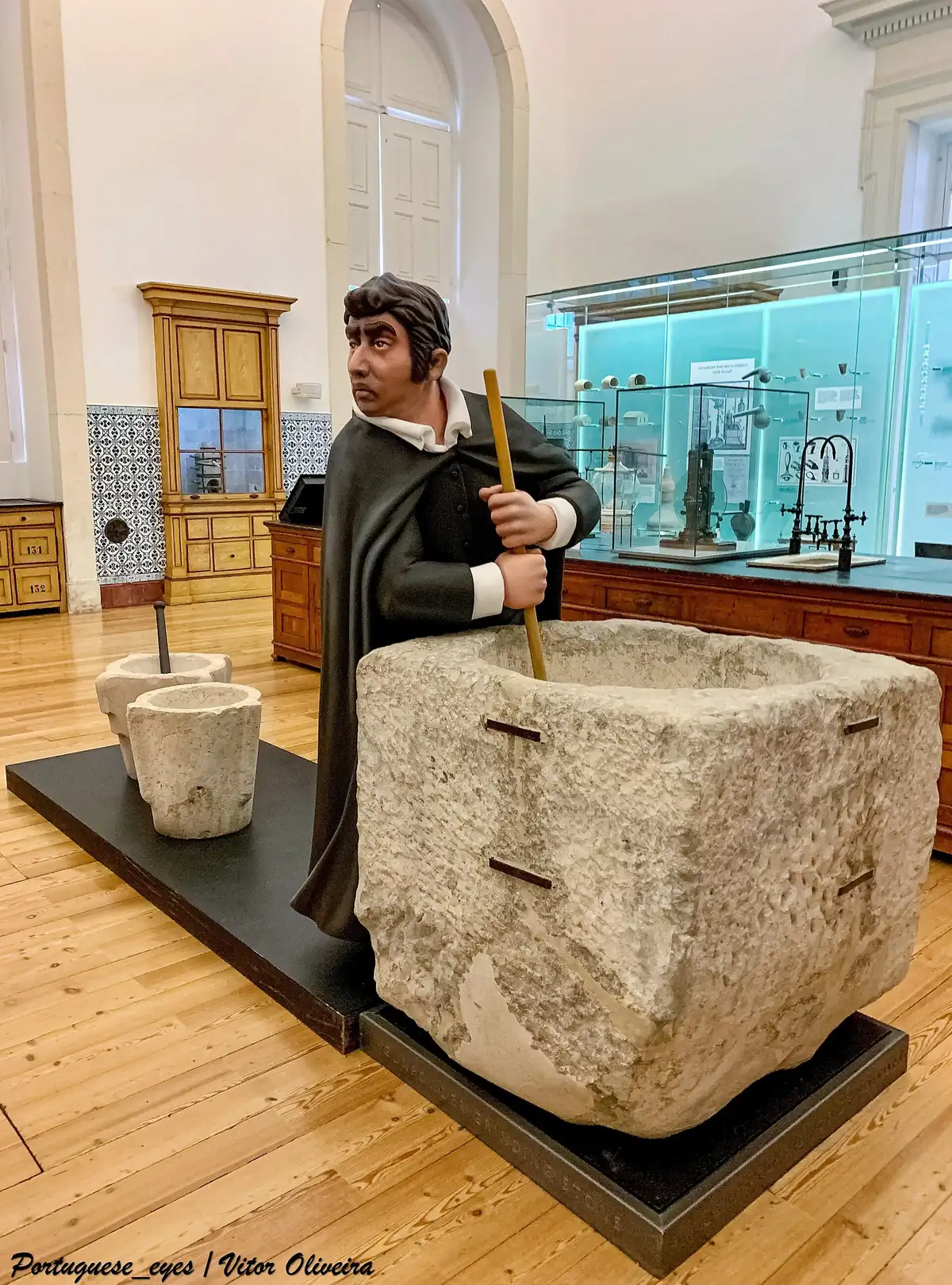
What they miss is the Laboratório Chimico — a Jesuit refectory converted into a chemistry laboratory under the Marquis of Pombal’s reforms — plus the Cabinet of Curiosities, the Mineral Gallery and the Physics Cabinet in the Colégio de Jesus alongside it. Open every day 10:00 to 19:00, last admission 18:45, and already paid for.
What to look for
The building is the first exhibit. The Laboratório Chimico was the Jesuits’ refectory before the order was expelled from Portugal in 1759, and Pombal’s reforming university turned the room where they ate into the room where chemistry was done.
That conversion is the single clearest piece of evidence for what happened to Coimbra in the 1770s. New statutes, new faculties, a new laboratory, a new botanical garden, and the buildings of a suppressed religious order repurposed to hold them.
The Cabinet of Curiosities is the room visitors enjoy most and expect least. It is the pre-modern way of organising knowledge — things collected because they were strange, before disciplines decided what belonged where.
The Mineral Gallery and the Physics Cabinet hold the university’s teaching collections: instruments bought to demonstrate, not to display, and kept because Coimbra never threw anything away.
Also inside this circuit and on the same ticket is the Museu Académico, which covers Coimbra student life — the capes, the rituals, the republics and the Queima.
The museum has also been showing an exhibition titled Éfe-Érre-Á – Momentos da Vida Académica. Confirm the dates on the museum’s own site before you build a visit around it.
With children, this is the part of the university ticket that works. Instruments, minerals, oddities and rooms you can move through at your own pace, rather than a twenty-minute silent slot in a library.
Budget an hour if you are doing the science rooms alone, and note that the university’s stated average for the Science Museum plus Exploratório programme is 3 hours.
Do not expect a modern interpretive museum. These are historic cabinets, presented close to the way the university kept them, and the pleasure is in the objects and the rooms rather than in the storytelling.
The closures nobody mentions
Two things are worth knowing before you arrive, and neither appears on the listings.
First: the Natural History Gallery of the Science Museum is closed. The university states it plainly in its own visiting rules. If a guide has sold you on the natural history collection, it is not available.
Second, and better: twice every three months the Cabinet of Curiosities and the Physics Cabinet close for disinfestation. Two days, four times a year, the rooms are fumigated.
The university’s own rule for that is precise and slightly unforgiving: if your ticket falls on one of those days you may use it on the following days, but there is no refund.
That is a remarkable thing to have to publish, and it tells you what kind of collection this is. Organic material, historic cases, a hillside building — and a maintenance regime that treats insects as the main threat.
It also rhymes with the library up the hill, where two colonies of bats have been eating the insects for two and a half centuries and staff cover the tables with leather every night.
The Alta’s collections are, in other words, engaged in a permanent low-grade war with beetles, and both institutions have chosen a solution and stuck with it.
Practically: if your dates are fixed and the Cabinet of Curiosities is the reason you are going, ask Turismo UC whether a disinfestation falls in your window.
One more scheduling quirk worth knowing: the university closes the whole circuit on its movable academic days. It shut on 24 May 2026 for Academic Week and closes again on 4 October 2026 for the Latada.
How to visit
The Science Museum is not sold on its own in the main circuit. It is bundled.
12.50 EUR buys University + Science Museum: the Royal Palace, St Michael’s Chapel, the Chemistry Laboratory, the Academic Museum, the Cabinet of Curiosities and the Mineral Gallery, with a stated average of 2h30.
16.50 EUR adds the Joanina Library on a fixed timed slot, 3 hours stated. 25.00 EUR is the guided Palace of Schools tour, which covers the palace, chapel and library with a guide and leaves the Science Museum spaces freely accessible, unguided, on the same ticket.
16.00 EUR buys Science Museum + UC Exploratório — and explicitly excludes the Palace of Schools. Read that twice before you buy it; it is the easiest mistake to make on the booking page.
Hours are every day 10:00 to 19:00, last admission 18:45. That is an hour less than the Palace of Schools, which runs to 19:30, so do the museum side earlier in the day.
The museum gift shop closes for lunch — 09:00–12:30, then 15:00–18:45 — while the palace shop runs straight through to 19:15.
Tickets are valid two days except the Joanina slot, there are no refunds or exchanges, and only one entry per space is allowed. Online sales for the Science Museum + Exploratório programme close two hours before the visit.
Reduced tiers for the self-guided programmes are not published online. The only published reduced rates anywhere are on the guided tour: 17.50 EUR for ages 6–25 and free under 6.
Buy at the ticket office kiosk in front of the Faculty of Medicine, official GPS 40.207938, -8.424189, open 09:00 to 19:00.
The last detail that saves money: the guided tour at 25.00 EUR leaves the Science Museum spaces open to you unguided on the same ticket. You are not choosing between a guide and the cabinets.
The Exploratório
The UC Exploratório is the university’s Ciência Viva science centre, and it is a different proposition from the historic cabinets — hands-on rather than behind glass.
It is included in the 16.00 EUR Science Museum + Exploratório programme, the one that excludes the Palace of Schools.
Its hours are different from everything else on the university circuit: Tuesday to Sunday, 10:00–13:00 and 14:00–18:00. Closed Mondays, and closed over lunch.
Inside are the CriaAtividade space and a 360-degree film in the Hemispherium, the centre’s digital planetarium.
Who it suits: families with children who have already done, or will refuse to do, a silent library slot. Who it does not suit: anyone whose three hours in Coimbra should be spent on the Baroque interiors.
The honest way to choose is to read the two programmes as what they are. 16.50 EUR is the heritage day. 16.00 EUR is the science day. They barely overlap.
If you want both, the university ticket is valid two days — but the two programmes are separate purchases, not a combination.
Check the Exploratório’s own site before travelling; a science centre’s programme changes more often than a chemistry laboratory’s.
What to combine
Everything else on your own ticket, first. The Sala dos Capelos with its 172 ceiling panels, St Michael’s Chapel with its 1613 tiles, and the Academic Prison if your ticket includes the library.
The Botanical Garden is free, 13 hectares, founded on Pombal’s initiative in 1772 in the same reforming push that created this laboratory, and a ten-minute walk downhill.
The Museu Nacional Machado de Castro, five minutes away beside the Sé Nova, has been closed since February 2026 with no reopening date published. That closure is exactly why the Science Museum is worth using this year.
The Sé Nova is a minute from the ticket kiosk at 1.00 EUR, open daily 09:00–18:00.
For what each university programme actually opens, compared side by side, read the guide to visiting the University of Coimbra, and for a family-shaped version of the city, Coimbra with kids.