
Nobody warns you. You have paid 16.50 EUR, you have a printed time on a ticket, you are queueing for the most photographed library in Portugal, and the door you are shown through leads down into a jail. Cold stone, a winding staircase cut for one person at a time, two cells barely wider than your shoulders, and then a vaulted passage that opens out into something built later and more orderly. This is the way in. There is no other.
The University of Coimbra kept its own prison because it governed itself. What survives beneath the Biblioteca Joanina is of medieval origin and the oldest preserved prison in Portugal — two narrow cells and a staircase from the primitive structure, plus communal cells, a visiting room, a prayer room and latrines added in 1782. Ten minutes, no extra charge, and the best sequence of rooms on the whole university ticket.
You walk through it
The University’s own booking text says it in one line: “Entrance to the Baroque Library building is through the Academic Prison.” That is not a curiosity buried in the small print. It is the physical route.
So the first thing to fix is your expectations of the visit. People arrive thinking the prison is an optional extra room signposted somewhere off the courtyard, and spend the queue looking for it. It is under your feet, and you are about to be marched through it.
The second thing to fix is your pace. The timed slot governs the library above; nothing governs how long you linger on the way in, within reason. Most visitors cross the prison in ninety seconds because they think the good part is upstairs.
They are half right. The good part is upstairs. But the contrast is the experience, and you only get it once, in one direction, at one speed.
The prison occupies the ground and middle floors of the same building as the library. Same masonry, same institution, same king’s money. A body that could imprison you and a body that could educate you were the same body, in the same building, on three floors.
That is the sentence to carry up the stairs with you when the gilding starts.
It also explains the shape of the entry rule above: fifty people every twenty minutes, in batches, because a batch is what a staircase like this can absorb.
And it explains why the University asks visitors with walking difficulties, dizziness or heart conditions to take the circuit carefully. The route in is a medieval prison stair, not a museum ramp.
There is a practical consequence for anyone with a fixed slot. If you want to see the prison properly you should treat the ten minutes before your time as part of the visit, not as dead queueing, because once the batch moves it moves as a batch.
And if you are travelling with someone who dislikes enclosed spaces, say so now rather than at the bottom of the stair. The cells are narrow, the passage is low, and there is no alternative route into the library.
What to look for
Two building phases are stacked on each other and telling them apart is the whole visit. The primitive structure gives you two narrow cells and a winding staircase. Rough, tight, unlit, and unmistakably medieval in how little it concedes to a human body.
The 1782 works, under the Pombaline reforms, gave the gaol communal cells, a visiting room, a prayer room and latrines. Wider, squarer, planned. An enlightened state applying a theory of confinement to a hole that had simply been a hole.
Walk from one into the other and you can feel the century change under your feet. A prison with a visiting room and a chapel is a prison with a philosophy; a prison with two cells and a stair is just a lockable space.
Now the detail almost nobody is shown. On the Middle Floor, the stones of the arch still carry the individual chisel marks of the masons who cut them. Each mark is a man’s signature, used to count his work so that he could be paid.
Look along the springing of the arch and you will find them: small, repeated, deliberate, nothing like tool scarring. Piecework accounting, cut into stone, still legible after centuries.
The floor was left rough and unfinished precisely because nobody was ever meant to see it. Which is why the marks survive at all — a finished surface would have taken them off.
It is the most human thing in the Paço das Escolas. Upstairs, King John V paid for a room designed to overwhelm you. Down here, a man cut a mark so the paymaster would count his stone.
Bring nothing but your eyes. This is the part of the circuit you can photograph, without flash — the ban applies to the library’s Noble Floor, not to the prison.
Compare the two phases on one specific point: light. The medieval cells have almost none, and were never meant to. The 1782 rooms are laid out so that a warder could see into them, which is a completely different theory of what a prison is for.
The prayer room is the detail that tells you most. Somebody in the 1780s decided that a person locked up by a university needed somewhere to pray, and built it into the plan.
The Foro Académico
Coimbra held the Foro Académico: the privilege of governing itself and keeping its own legislation. In practice that meant the University’s professors, staff and students were not tried and jailed alongside common criminals in the city below.
They were tried and jailed by the University, here. The privilege was not an exemption from punishment; it was a claim about jurisdiction. Coimbra was a legal island inside a Portuguese city.
It lasted until 1834, when the privilege was revoked. That is the same decade in which the Portuguese state extinguished the religious orders and took their property — the act that filled the Machado de Castro collection down the hill. The 1830s were when Portugal dismantled a lot of medieval jurisdictions at once.
Hold the geography in your head while you read that. The palace with a throne room. A chapel where an oath bound a dynasty. A library built as a vault. And a prison underneath it. Within fifty metres, a small state has all four organs of one.
It also reframes the black capes outside. Coimbra’s student traditions look theatrical to visitors, but they are the residue of a corporate body that really did have its own guard, its own law and its own gaol.
The Armoury upstairs is on the same ticket. The cells are down here. It is a complete picture and the University does not join it up for you.
If that world interests you, the Academic Museum is included on the same ticket and covers the rituals, the republics and the festivals directly. The black capes explainer is the short version.
Two centuries after the privilege was revoked, its prison is the doorway to the University’s biggest tourist attraction. Institutions rarely dispose of their own past that neatly.
It is worth saying what the privilege was not. It was not a licence to misbehave, and students were not beyond punishment. They were beyond the reach of the city’s courts, which is a very different and much older idea about who gets to judge whom.
Universities across medieval Europe held versions of the same right, and most lost it far earlier. Coimbra kept its gaol working into the nineteenth century, which is why there is something left to walk through.
How to visit
There is no prison ticket, and there is no way to see it without a library ticket. It is covered by the 16.50 EUR self-guided programme (Joanina + University + Science Museum, stated average three hours) and by the 25.00 EUR guided tour of the Palace of Schools, 1h30.
The 12.50 EUR University + Science Museum programme does not include the library building, and therefore does not include the prison. If the prison is what you came for, you have to buy the library.
Your ticket carries a fixed date and time, and that time is the moment you enter this building, not the library upstairs. Entry is limited to 50 people every 20 minutes, which is the University’s current published rule. Ignore the “ten people every five minutes” figure that circulates on aggregator pages.
Visits outside the stipulated time will not be allowed, so arrive ten minutes early. The rest of the ticket is flexible — valid two days, usable before or after — but this slot is not.
Online sales close 20 minutes before the visit for the combined ticket and two hours before for the guided tour, which can only be booked up to three months ahead because of demand.
No refunds, no exchanges, one entry per space. Those rules apply to every programme the University sells.
Reduced tiers: the guided tour publishes 17.50 EUR for ages 6–25 and free entry under 6. The self-guided programmes publish only the adult price online; child, youth and senior rates appear inside the booking flow, so ask at the kiosk rather than trusting third-party tables.
Buy at the ticket office kiosk in front of the Faculty of Medicine, official GPS 40.207938, -8.424189, open 09:00 to 19:00.
One more thing worth planning around: the last entry to this building is 19:00, half an hour before the rest of the Paço das Escolas closes. A 19:00 slot in July is a genuinely good time to come, because the coach groups have gone and the stone is still cold.
How far ahead slots sell out is not published by the University, and I will not guess a number. If your dates are fixed, buy when you book the trip and treat the slot as the fixed point the rest of the day hangs off.
Practical logistics
The library building opens with the rest of the Paço das Escolas, daily 09:00 to 19:30, with the last entry to the library building at 19:00. That last-entry time is earlier than everywhere else on the circuit, which catches people out in summer.
Wear proper shoes. The stair is original, the treads are uneven and worn, and there is no handrail in the sense you would expect in a museum.
It is cold. The building is a vault with walls 2.11 metres thick, and the lower floors hold that cold all year. Coming in from a 35-degree August afternoon, the drop is startling.
Photography is permitted here without flash. Tripods and selfie sticks are prohibited across the university’s visiting spaces, drones need authorisation, and the full ban — no photography or filming at all — applies to the Joanina’s Noble Floor upstairs.
Closure dates for the circuit: 24 and 25 December 2026, 31 December 2026 and 1 January 2027, plus movable academic days. The whole complex shut on 24 May 2026 for Academic Week and closes again on 4 October 2026 for the Latada.
Accessibility: the University publishes no step-free route into the library building, and the route in is a historic prison staircase. If that decides your visit, contact Turismo UC before booking rather than after.
Getting up to the Alta: the Elevador do Mercado covers a 51-metre rise in two stages on any valid SMTUC ticket, Monday to Saturday 07:30–21:00, Sundays and public holidays 10:00–21:00. See is Coimbra walkable.
Expect the visit to be quiet rather than staged. There is no soundtrack, no projection, no reconstructed prisoner. The University lights the space and lets you walk through it, which is the right decision and makes the ten minutes feel longer than it is.
Children generally find this the best part of the university ticket, with one caveat: it is dark, narrow and cold, and the stair needs a hand held.
What to combine
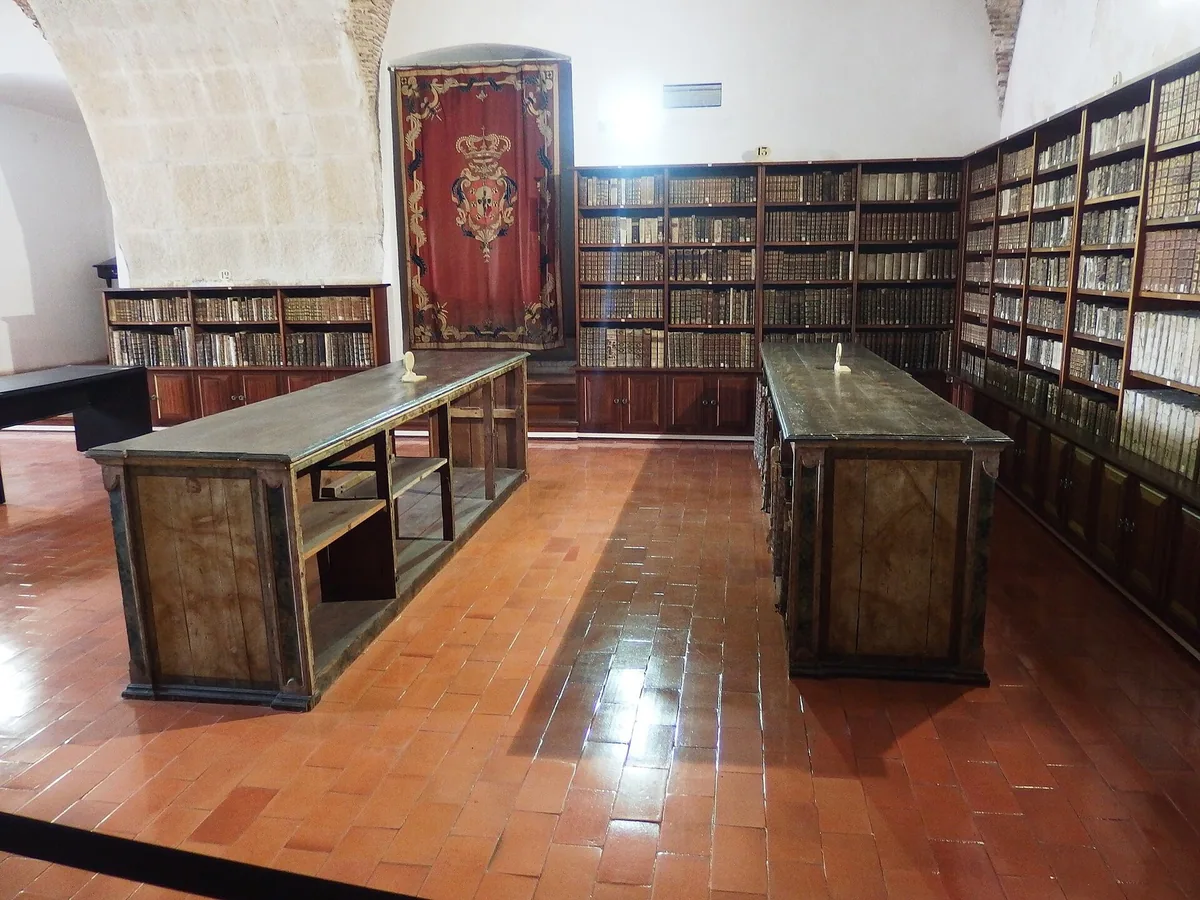
Obviously the Joanina Library, because you are already in the building and the slot has started. Twenty minutes, no photography, three halls in black, red and green, and two colonies of bats that keep the insects off 60,000 early printed books.
Then the Sala dos Capelos, five minutes away, where the University hung every Portuguese king except sixty years of Spanish ones. Prison, library, throne room, in that order, is the best hour on the ticket.
Also included and routinely wasted: St Michael’s Chapel, the Chemistry Laboratory and the rest of the Science Museum spaces, which open 10:00 to 19:00 — an hour less than the palace.
Off the ticket, downhill: the Sé Velha for 3.00 EUR, the Arco de Almedina and its tower museum — open Tuesday to Saturday only, with a 13:00 to 14:00 gap — and Santa Cruz in the Baixa for 5.00 EUR.
The Alta to Baixa descent strings all of those together in the right order, and the guide to visiting the University explains which ticket opens what.
If you want more of the city’s underside rather than its gilding, the Almedina tower and arch is the other place where Coimbra’s defensive, legal past is still standing — the main gate of the walled town, with a municipal museum inside the tower above it.
The catch there is its hours: Tuesday to Saturday, 10:00 to 13:00 and 14:00 to 18:00, closed Sundays, Mondays and public holidays. Plan it for the same afternoon as this, not for a lazy Sunday.