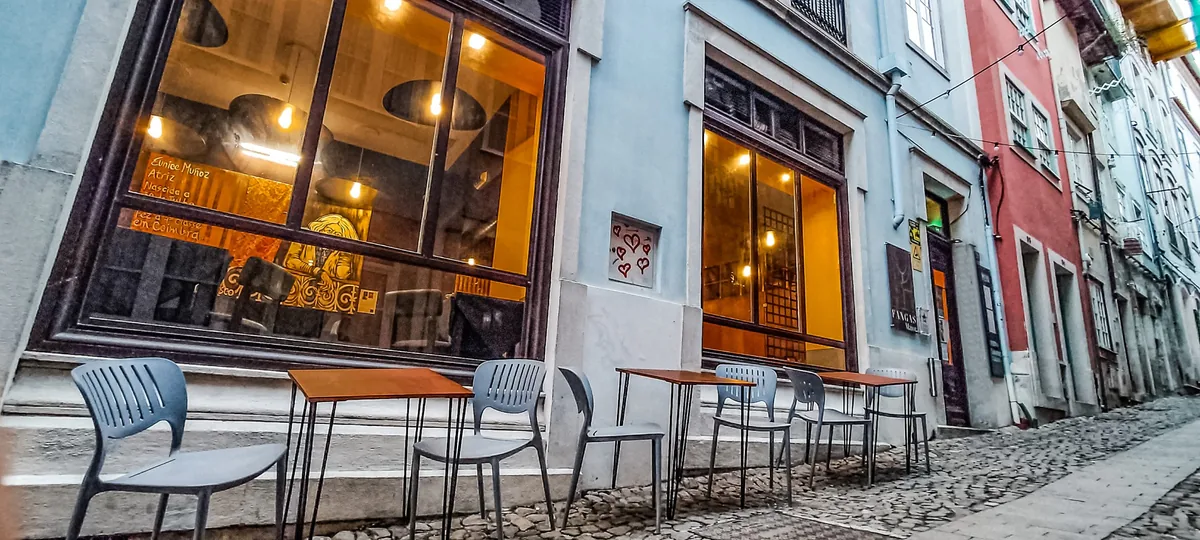

A mercearia is a grocer’s shop — the old kind, with tinned fish stacked in pyramids, jars of preserved things, cured sausage hanging up, and a smell of coffee and dried fruit that hits you at the door. A mercearia bar is that shop with a counter and some stools added, so that the things on the shelves can be opened and eaten where they stand. It is one of the best formats in Portuguese eating and one of the most recent.
Fangas is at Rua Fernandes Tomás 45–49, on the street that climbs from the lower town toward the Alta. That address, published by the local title Coimbra Coolectiva, plus the description of the place as a petiscos and grocery bar, is the complete documented record. No price band, no hours, no menu, no dish recommendation and no website were found on 15 September 2026. This page is honest about that and useful about the rest.
What a mercearia bar is
The format matters more than any individual dish, so it is worth understanding before you walk in.
The kitchen, if there is one, is small. What the counter mostly does is assemble rather than cook: boards of cheese and cured meat, tinned fish opened and served with bread and butter, a plate of olives, something pickled, perhaps one hot dish. Everything on the board is also for sale on the shelf behind you.
That is the appeal. You eat something, you like it, you buy a tin of it to take home, and the shop has made two sales. It also means the quality is unusually transparent: a mercearia bar is only as good as its buying, and the buying is on display.
Portuguese tinned fish deserves its reputation and is the thing to try if you have not. Sardines, mackerel, tuna belly, small eels, octopus in olive oil — none of it resembles what supermarket tinned fish means elsewhere, and the good producers are treated the way other countries treat small wineries.
Cheese is the other pillar. The country’s canon runs to sheep’s-milk cheeses from the Serra da Estrela, cured hard cheeses from the Alentejo, and the mixed sheep-and-goat cheeses of this district — including Queijo Rabaçal, whose protected zone lies in the south of Coimbra district, though not in the city itself.
The format is recent as a restaurant idea and ancient as a shop. Portuguese cities were full of mercearias until supermarkets emptied them out in the 1980s and 1990s; the survivors that added a counter turned a dying trade into a going concern. Eating in one is a small piece of that history as well as a good lunch.
How to order here
Since no menu is published, these are the questions that work in any room of this type.
Ask what is regional. A mercearia in Coimbra ought to be able to put a cheese from this district and a wine from the Bairrada or the Dão in front of you. If it cannot, it is a shop with stools rather than a serious one.
Ask them to open a tin you have not heard of. That is the whole point of the format and the staff in these places generally enjoy the question.
Order one board and then decide. Boards arrive larger than expected and two people ordering two boards will finish neither.
Drink what the region drinks. Bairrada sparkling wine comes from the demarcated region north of the city and is the traditional partner for cured meat and cheese in this part of Portugal. The acidity does the work that a heavy red would not.
And expect to pay per item rather than per plate. That is how a shop prices things, and with no published band it is the mechanism most likely to surprise you.
Bread and butter will appear and will be charged for, like the couvert in any Portuguese restaurant. Here it is genuinely worth keeping, because good bread is half of what a board is for.
The street it climbs
Rua Fernandes Tomás runs uphill from the Baixa toward the university quarter, which makes this a useful address in a specific way: it is on the way up and on the way down.
The Alta is thin on places to eat. Loggia, which has the best terrace view in the city, is inside a museum that has been closed since February 2026 with no confirmation that the restaurant trades. Zé Manel dos Ossos has seven tables and a queue by noon. That is most of the hill’s inventory, and it is why a bar on the approach road earns its place.
Use it as the stop between things: after the Joanina Library and before dinner, or on the way down at the end of the Alta to Baixa descent, when a board of cheese and a glass is exactly the right size of meal.
It is also a reasonable answer to the problem of eating alone. A counter with stools is a more comfortable place for one person than a dining room, and nobody in a grocery bar is counting how long you sit.
What is not published
The record here is one line long, so here is the whole of it, plainly.
Documented: the address, Rua Fernandes Tomás 45–49, from a local publication’s citywide restaurant list; and the description of the business as a petiscos and grocery bar.
Not documented: opening hours, closing day, telephone number, official website, menu, any individual price, any price band, and any dish recommendation from a named source. No rating appears on this page either, because the only ones available are aggregator scores and we do not treat those as evidence.
What this means in practice is that everything above about mercearia bars is general knowledge about the format, clearly labelled as such, and none of it is a promise about this particular counter. Walk past in the afternoon and look through the window; a grocery bar tells you almost everything about itself through its shelves.
If the door is shut, the lanes of the Baixa are downhill and dense. Nowhere on this hill is more than a few minutes from an alternative, provided the alternative is downwards.
None of this is a criticism of the business. It is a description of how little of Coimbra’s eating is documented in English, or in Portuguese for that matter, and of why a guide that invents the missing parts is worse than one that admits them.
The verdict
A good bet for a particular kind of stop, and an unwise choice for a planned dinner.
Go for a board and a glass in the late afternoon, for a solo meal at a counter, for tinned fish you cannot buy at home, or as the pause that breaks the climb to the university. On those terms this format rarely disappoints.
Do not go expecting a restaurant with a printed menu at a known price. Nothing about this address supports that expectation and the gap between a grocery bar and a dining room is wide.
And do not come looking for Coimbra specialities. The city’s own contributions are conventual sweets — arrufadas and pastéis de Santa Clara — and they come from pastelarias, not from a counter with cheese on it. What to eat in Coimbra sorts the local from the regional before you plan a single meal.