Start at 10:00 on a weekday
That is the only window that opens the Almedina tower museum, catches the cathedrals quiet, and still leaves hours before Santa Cruz closes at 16:30.

Writes the transport and planning pages, and re-reads the operators’ own notices whenever Coimbra changes how you move through it.
UpdatedCoimbra makes no sense from the bottom. The Baixa is a flat grid of shopping streets with a river behind it; the Alta is a walled hill town with a university on top; and between them is a stepped lane the city named Back-Breaker Street. Walk up it in July and you will arrive at the cathedral wondering why anyone lives here.
So do it the other way. Start in the Paço das Escolas courtyard, which is free and open daily from 09:00, and walk down. About 1.4 km, roughly 40 minutes of actual walking, and the whole shape of the city arrives in the right order: institutions, then gate, then trade, then the tombs of the two kings who started it.
Start at the balustrade, not at the ticket desk. The courtyard is free and open daily 09:00–19:30, and the terrace over the Mondego is the orientation you need before you go anywhere else. Behind you are the Via Latina colonnade, the Joanina Library facade and the clock tower — which is closed, with no reopening date published. This ground was a fortress at the end of the 10th century, the first Portuguese royal household in 1131, and a university from 1544.
Tip: If you are doing the university interiors too, do them before this walk, not during it: the 12.50 EUR circuit alone takes 2h30.
Two minutes from the ticket kiosk, on Largo da Feira do Estudante, and the cheapest interior on the route at 1.00 EUR — plus another euro for the guide booklet, which is the only interpretation in the building. A Jesuit church begun in 1598 and inaugurated in 1698, a hundred years later, whose builders were expelled from Portugal in 1759. It became the cathedral in 1772 for one reason: it was bigger than the old one. Open every day 09:00–18:00.
Tip: No seasonal timetable and no lunch closure — this is the most reliably open door on the whole descent.
Downhill from the Sé Nova, and shut. The national museum has been closed since mid-February 2026 for PRR conservation works, and no reopening date is published; in June 2026 the reported plan was a phased reopening after the summer, and as of mid-September the official notice was still up. Underneath it is the Roman cryptoporticus of Aeminium, the mid-first-century substructure of the forum, which is part of the visit route rather than a basement — and equally unreachable.
Tip: Walk past the facade and keep going. There is nothing to see from outside, and the two hours you had allocated belong to the Sé Velha instead.
The best building on the route and the cheapest serious hour in Coimbra at 3.00 EUR. A fortified Romanesque cathedral begun in 1164 under Bishop Miguel Salomão and consecrated in 1184 — not built by Afonso Henriques, and the coronation held here in 1185 was that of the second king, Sancho I. Look at the carved capitals: the richest Romanesque programme in Portugal, and containing no human figures and no biblical scenes at all. The Gothic cloister was begun in 1218 and part of the hillside was cut away to fit it.
Tip: Open 09:30 Monday to Saturday but not until 11:00 on Sundays, and mass is at 18:00 on weekdays. Do the cloister first, the nave second.
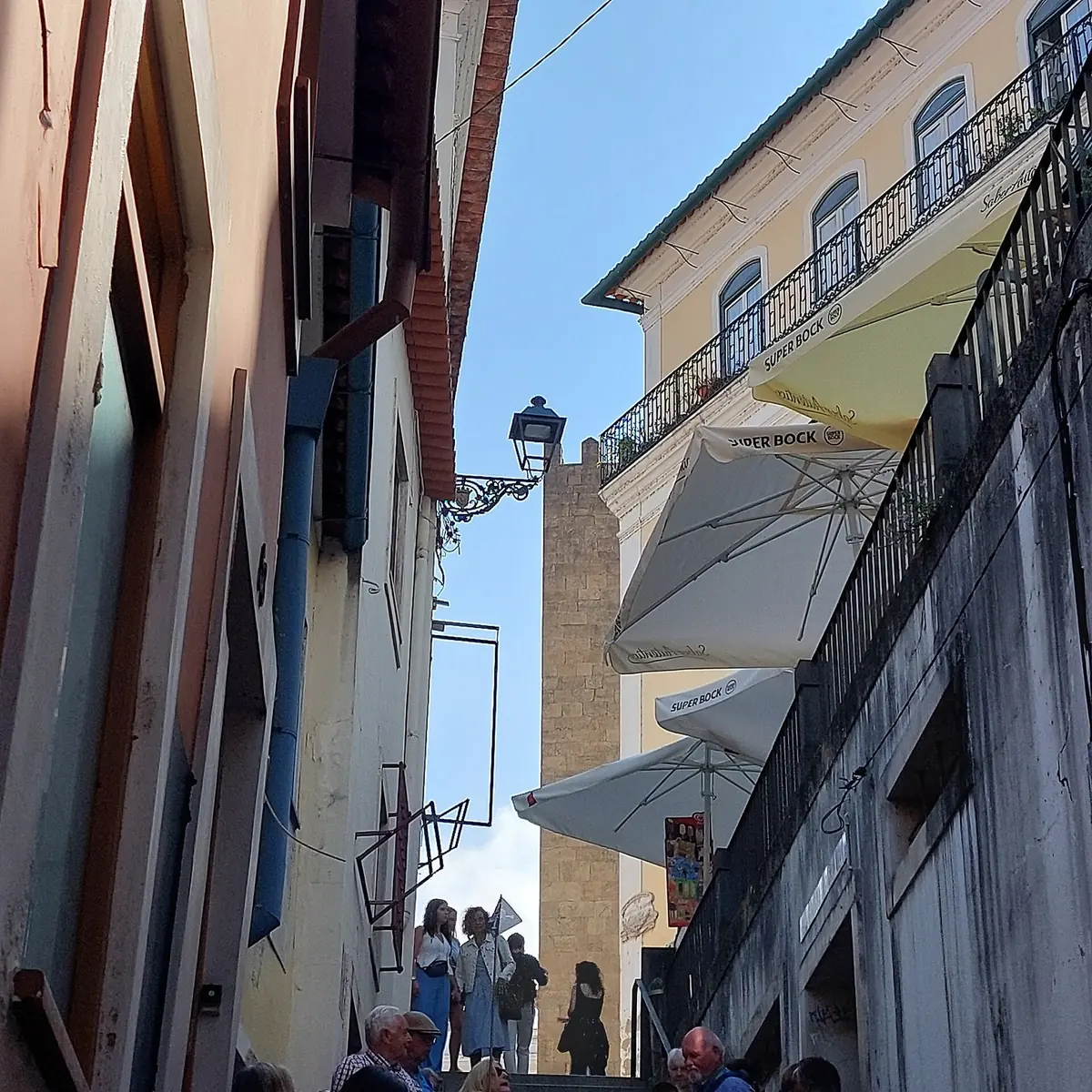
Back-Breaker Street, and the name is official enough to appear in the city transport authority’s definition of the historic-centre zone. Stepped, narrow, cobbled, and running from the cathedral square down to the town gate. Descending it is a completely different experience from climbing it, which is the entire argument for doing this walk downhill. Two fado venues sit on this lane a few doors apart, at numbers 7 and 12.
Tip: Fado ao Centro at number 7 runs a 50-minute show at 18:00 every day of the year; book ahead, because seats usually go before the day.
The surviving main gate of the walled town, free and permanently open because it is a public street. Stand in the opening and look both ways: shops below, steps above. Almedina is from the Arabic al-madína, the city. Above the arch is the Torre de Almedina, holding the municipal museum’s walled-city collection — and its entrance is round on Pátio do Castilho, not on the lane, which is why most people never find it.
Tip: The tower museum opens Tuesday to Saturday, 10:00–13:00 and 14:00–18:00, and is shut on Sundays, Mondays and public holidays. Its price is not published — ask on +351 239 833 771.
Through the gate the street flattens into Rua Ferreira Borges and opens onto Praça do Comércio, the Baixa’s working square. On one edge is the Igreja de São Tiago, a small Romanesque church and one of the oldest surviving buildings in Coimbra. No official source publishes its hours, price or an official page — the municipal monument database that used to carry them has been taken down — so try the door rather than planning around it.
Tip: Do not trust mapping-app opening hours here. They are user-generated, and for this building there is no official record to check them against.
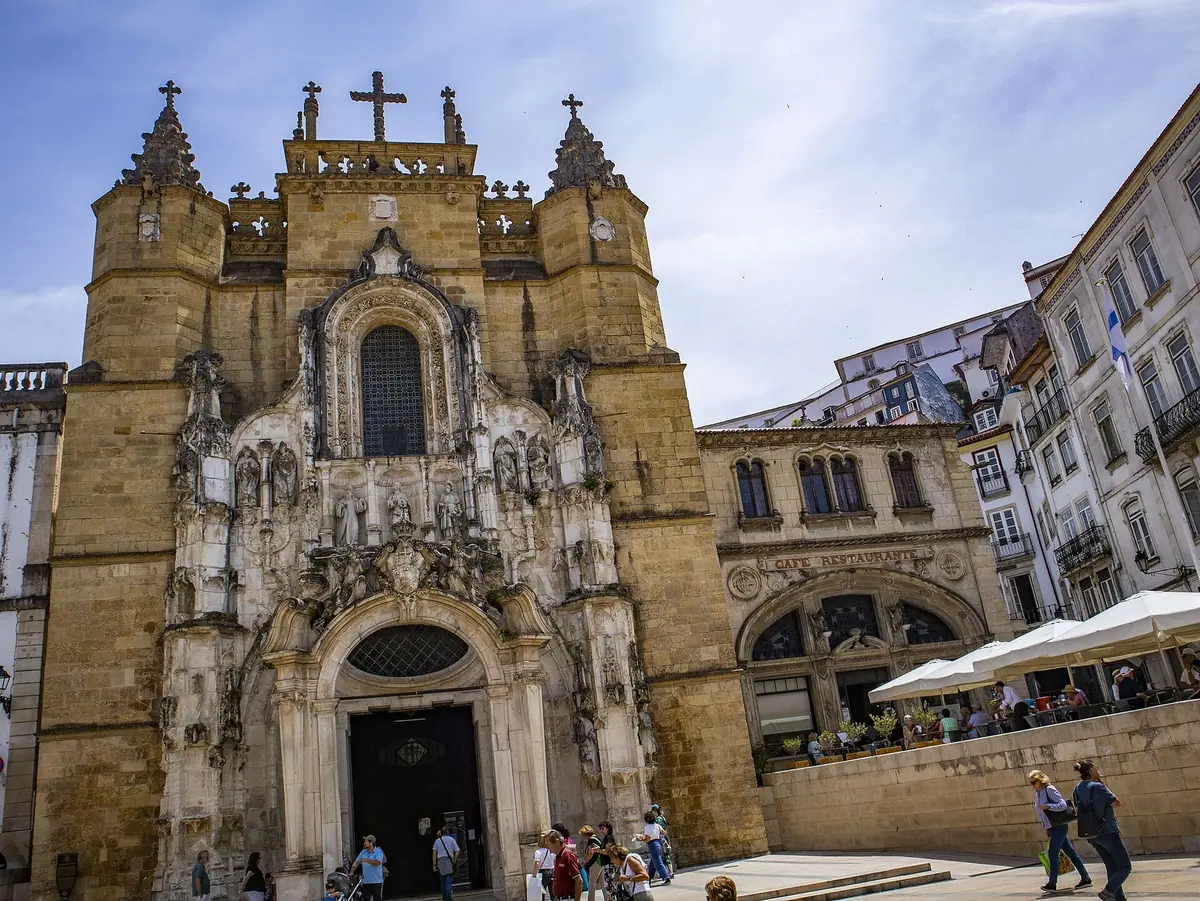
The end of the walk, on Praça 8 de Maio. Founded in 1131 and a National Pantheon: Afonso Henriques and Sancho I, Portugal’s first two kings, are in the nave, and the nave is free. The 5.00 EUR ticket buys the Cloister of Silence, the Chapter House, the sacristy paintings, the Museum of Sacred Art with the relics of St Teotónio, and the high choir stalls — the only place you see the whole length of the church at once. St Anthony of Padua studied theology here.
Tip: It closes at 16:30 Monday to Saturday and does not open until 13:00 on Sundays. This is the constraint that decides what time you start the walk.
Because of a 51-metre climb and a street called Back-Breaker.
The only officially published measurement of the Baixa-to-Alta height difference comes from the transport authority’s lift: the Elevador do Mercado rises 51 metres, in two stages — a 20-metre vertical lift, then an inclined-plane lift to the top. And that does not reach the university, which is higher again.
Walking up that in summer heat with a timed library slot to hit is a bad plan. Walking down it, with the light coming up the valley and the city opening beneath you, is one of the best hours in central Portugal.
The order also makes historical sense. The Alta is where power sat — palace, cathedral, university, gaol. The gate is where the wall divided the two towns. The Baixa is where trade happened. Walking down, you leave the institutions and arrive in the market.
And it finishes at the right place: the tombs of the two kings who made the country, on a square with a café and a bus stop.
Getting to the top without walking is easy enough. The Elevador do Mercado runs Monday to Saturday 07:30–21:00 and Sundays and public holidays 10:00–21:00, and any valid SMTUC transport ticket works on it. A separate single-ride fare is not published.
Note also that it was out of service for a period and the city announced its return in January 2026 — older guides calling it permanently broken are wrong.
Full detail on the climb, the lift and the named streets is in is Coimbra walkable.
Coimbra’s opening hours are the real route planner, and they are awkward enough to ruin a day if you ignore them.
The binding constraints, in order of how much damage they do:
Put those together and the answer is a weekday morning start at 10:00. That opens the Almedina tower, gives you the cathedrals at their quietest, and lands you at Santa Cruz with hours to spare.
Sunday is the worst day to attempt this walk. You lose the tower museum entirely, the Sé Velha until 11:00 and Santa Cruz until 13:00 — and St Michael’s Chapel up the hill closes for mass from 11:45 to 14:00.
Two more dates to avoid: the whole university circuit and Santa Cruz both close on the movable days of the Queima das Fitas and Latada parades. The university shut on 24 May 2026 and closes again on 4 October 2026.
And two things on the route are simply closed: the Machado de Castro museum since February 2026, and the University Tower with no stated reason.
The walk itself is free. The doors on it are not, and the total is smaller than people expect.
| Stop | Adult entry |
|---|---|
| Paço das Escolas courtyard | Free |
| Sé Nova | 1.00 EUR (+1.00 EUR booklet) |
| Sé Velha | 3.00 EUR |
| Torre de Almedina museum | Not published |
| Arco de Almedina | Free |
| Santa Cruz — nave | Free |
| Santa Cruz — cloister and high choir | 5.00 EUR |
So the full paid version of this descent comes to about 9 EUR, plus whatever the tower museum charges — and that is the honest gap: the Museu Municipal de Coimbra publishes addresses and hours for all six of its sites but no price list for any of them.
There is a free version too, and it is a real one: the courtyard, the arch, the Quebra-Costas, Praça do Comércio and the nave of Santa Cruz with the two royal tombs. That costs nothing at all.
If you only pay for one thing, pay the 3.00 EUR at the Sé Velha.
If you pay for two, add the 5.00 EUR at Santa Cruz — specifically for the high choir, which is the only place you get the panorama down the church, and which almost no visitor buys.
Group rates exist at both: 2.50 EUR each at the Sé Velha for groups over ten, and 3.50 EUR each at Santa Cruz for groups of twelve or more.
Sometimes you have to go up, and there are two honest ways.
The first is the Elevador do Mercado: 51 metres, two stages, Monday to Saturday 07:30–21:00 and Sundays and public holidays 10:00–21:00, on any valid SMTUC ticket. It lands you in the lower Alta, not at the university, so there is still a climb after it.
The second is the Quebra-Costas itself, taken slowly and early. In March or October it is a pleasant fifteen minutes. In August at 15:00 it is not.
If you are going up to catch a timed Joanina Library slot, build in twenty minutes more than you think you need. Entry is limited to 50 people every 20 minutes and visits outside the stipulated time are refused.
A reversed route also changes what is open. Starting at Santa Cruz at 09:30 and finishing at the Paço das Escolas works well, because the university runs to 19:30 when everything below it has closed.
That is, in fact, the better plan for an afternoon arrival: do the Baixa first, climb late, and let the university be the last thing open in the city.
Coimbra’s transport changed on 10 September 2026, when the Metrobus began serving Coimbra-B and Praça da República, so check the current picture rather than an older guide — it is in getting around Coimbra.
For a full day built around these hours, see the one-day Coimbra itinerary.
Reporter notebook
That is the only window that opens the Almedina tower museum, catches the cathedrals quiet, and still leaves hours before Santa Cruz closes at 16:30.
On Sundays you lose the tower museum, the Sé Velha until 11:00 and Santa Cruz until 13:00. Do this walk on a Tuesday to Saturday and use Sunday for the university, which opens daily at 09:00.
One euro at the Sé Nova, three at the Sé Velha, five at Santa Cruz. The courtyard, the arch and the royal tombs in the nave are all free.
The Quebra-Costas is stepped, cobbled and polished smooth in places. Descending it is easier than climbing it but harder underfoot, especially after rain.
Two hours on foot from the Baixa up through the Alta, which is the only way to understand how steep the city is.
✓ Verified GetYourGuide reviews
A multilingual host and a tuk-tuk that takes the hill for you, with hotel pick-up. Priced per group, not per person.
✓ Verified GetYourGuide reviews
About 1.4 km as walked, which is roughly 40 minutes of actual walking. With the Sé Velha, the Almedina tower museum and Santa Cruz it becomes a three-hour morning.
The route is free, and so are the university courtyard, the Arco de Almedina, Praça do Comércio and the nave of Santa Cruz with its two royal tombs. The paid version comes to about 9 EUR.
A weekday morning starting at 10:00. That opens the Almedina tower museum, which runs Tuesday to Saturday only with a 13:00–14:00 gap, and leaves plenty of time before Santa Cruz closes at 16:30.
Sunday. The Torre de Almedina museum is shut, Santa Cruz does not open until 13:00, the Sé Velha not until 11:00, and St Michael’s Chapel closes for mass from 11:45 to 14:00.
Yes, and it suits an afternoon arrival: start at Santa Cruz and finish at the Paço das Escolas, which stays open to 19:30. The Elevador do Mercado covers a 51-metre rise on any valid SMTUC ticket if you would rather not climb.
No. The core of the route is the stepped Rua do Quebra-Costas, and the medieval buildings on it publish no step-free access. The Baixa end, around Praça do Comércio and Praça 8 de Maio, is flat.
Yes — the Museu Nacional Machado de Castro has been closed since February 2026 with no reopening date, and the University Tower above the starting courtyard is closed with no reason published.