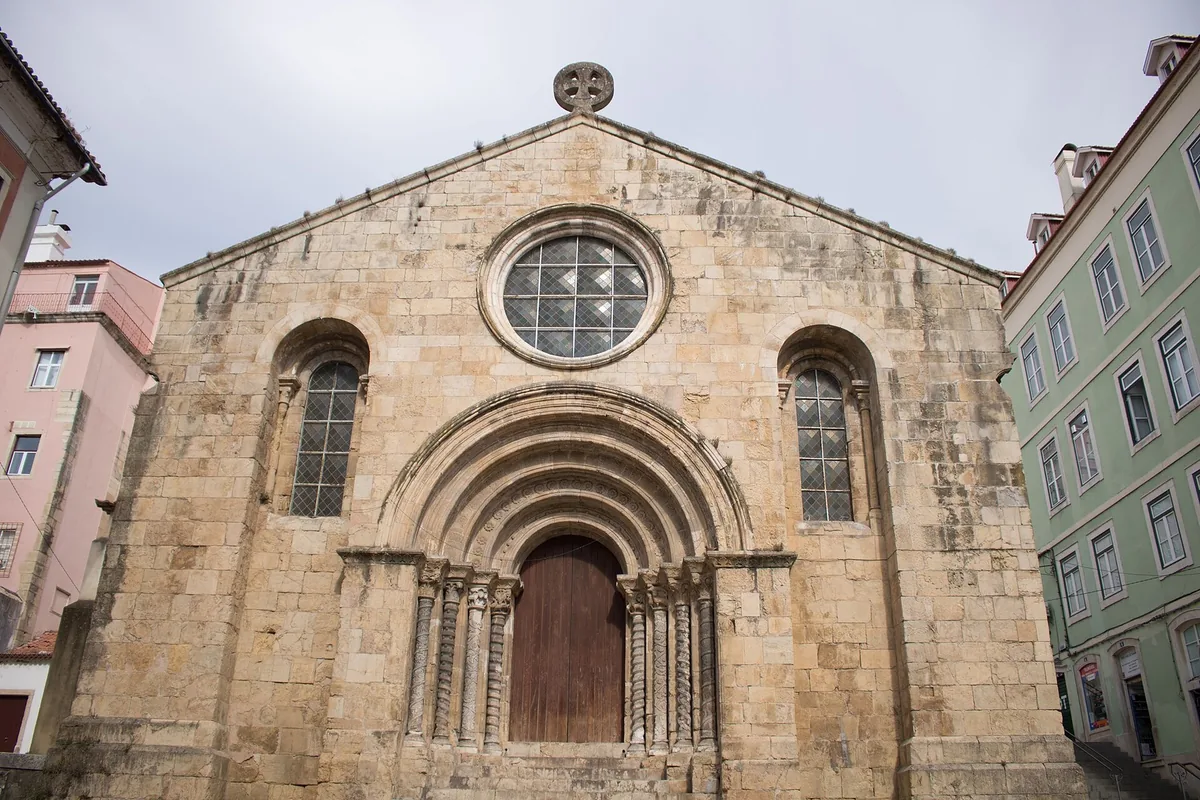

Praça do Comércio is the Baixa’s working square: shop fronts, awnings, people cutting across it with bags, a café or two, and on one edge a low stone church that is older than almost everything around it. The Igreja de São Tiago is Romanesque, small, and one of the oldest surviving buildings in Coimbra. Most visitors walk past it on their way somewhere else.
This page is shorter on numbers than the rest of this site, and deliberately so. No official source publishes this church’s opening hours, its admission price, or an official page for it. The municipal monument database that used to carry that information has been taken down. Rather than repeat a figure somebody invented, here is exactly what is known, what is not, and how to see it anyway.
What is published, and what is not
Start with the gap, because it is the honest headline.
Opening hours: not published. No parish page and no municipal page carries them. The Câmara Municipal de Coimbra used to run a monuments database at cm-coimbra.pt that held this sort of record. Those URLs now 302-redirect to the city tourism portal’s homepage, and the old records are gone.
Admission: not published. No source lists a price. In practice it appears to function as a working parish church rather than a ticketed monument, but I could not verify that from an official source, so this page does not assert it.
Official page: none found. The Unidade Pastoral Aeminium runs the parish pages for the Sé Velha, the Sé Nova, Santa Cruz, Nossa Senhora de Lurdes and São Bartolomeu. São Tiago is not among them, and whether it falls under that unit is not stated.
Coordinates: not published. Neither the Portuguese nor the English Wikipedia article carries a coordinate for it. It stands on Praça do Comércio, which is easy enough to find, and this page does not print a fabricated pin.
That is an unusual amount of missing information for a listed medieval building on a city’s main commercial square, and it is worth understanding why it happens. Portuguese municipalities have been consolidating their heritage content into tourism portals, and in the process a lot of granular monument data has simply disappeared from the web.
Which means the sites most confident about this church — the ones quoting exact hours and a price — are working from cached versions of pages that no longer exist, or from nothing at all.
If you find current, official information, it will be at the door or on the phone, not in a search result. That is not a satisfying answer and it is the accurate one.
It is worth saying what this page is not doing. It is not implying the church is inaccessible, neglected or unimportant. It is saying that the information a traveller needs in order to plan — a time, a price, a phone number — is not on the public record.
Those are different claims, and travel guides collapse them constantly. A missing web page is a fact about the web, not about a building.
The rule applied across this site is simple: a figure appears here only if an official source publishes it, and where none does, the gap is printed as a gap.
What it is
A small Romanesque church, on Praça do Comércio in the Baixa, and one of the oldest surviving buildings in Coimbra.
That sentence carries more than it looks. Romanesque in Portugal means, broadly, the twelfth and early thirteenth centuries — the period in which the kingdom was being made and Coimbra was its working capital.
The buildings that survive from that moment in this city can be counted on two hands, and most of them are up the hill in the Alta, on land the Church and the Crown held. São Tiago is down here, on the flat, in the merchants’ town.
That location is the interesting thing about it. The Baixa was the commercial quarter outside the walled upper town, and a Romanesque church in it is evidence of how early and how substantially that lower settlement existed.
The dedication points the same way. São Tiago is St James, the pilgrim saint of Compostela, and churches with that dedication tend to sit on routes and in trading places rather than in cloistered ones.
What the building looks like now is a low, thick-walled stone church wedged into a square of nineteenth- and twentieth-century shopfronts. The contrast is abrupt and it is the best reason to stop.
Beyond that, this page will not pretend to more. Detailed accounts of its portals, capitals and restoration history circulate, but none that I can trace to an official source, and a guide that invents architectural detail is worse than a guide that admits a gap.
What can be said with confidence is the relationship. Coimbra’s twelfth century produced a cathedral behind walls and a parish church on a market square, and the second kind is much rarer to find still standing in a Portuguese city centre.
Go and look at it. It takes fifteen minutes, it is on your route through the Baixa anyway, and the building itself is not in dispute.
For context on how thin the medieval record is in the lower town: the Baixa has been rebuilt repeatedly, it sits on a flood plain, and its street pattern has been reworked more than once. Survivals here are accidents rather than policy.
The Alta survived better because it was walled, institutional and built on rock. That is the short answer to why the university quarter is a World Heritage site and the shopping streets below it are not.
The square it stands on
Praça do Comércio is the Baixa’s central square and it is not a monument plaza. It is where people shop.
That matters for how you experience the church. There is no approach, no forecourt, no framing view — you come round a corner and it is there, at pavement level, with a shop on either side.
Coimbra’s lower town has always worked like this. The Baixa is commercial, flat, dense and busy, and its medieval fabric survives in fragments between later buildings rather than as a preserved quarter.
The Alta above is the opposite: university, cathedrals, palace, walls, and a street called Back-Breaker that links the two. The city splits cleanly into the place where things were decided and the place where things were sold.
The gate between them is the Arco de Almedina, five minutes from this square, and walking through it is the clearest way to feel the division.
Around Praça do Comércio you also get the Baixa’s food. This is the quarter for leitão da Bairrada, the region’s roast suckling pig, and for the pastry counters that sell arrufadas and pastéis de Santa Clara.
Two minutes north, Praça 8 de Maio has Santa Cruz and its two royal tombs, which are free to see in the nave.
The square also holds the Baixa’s rhythm, which is worth ten minutes of sitting. Shops open late morning, lunch runs long, and the whole quarter empties into the streets again around seven when the university lets out above it.
So the honest advice about São Tiago is: do not make a journey for it, but do not walk past it either. It is on the way to everything.
If you are staying in the Baixa, this is your square whether you like it or not. It sits between the river and the climb, most bus stops and the main shopping streets feed into it, and you will cross it several times a day.
Romanesque in Coimbra
If the architecture is what brought you here, the building that will actually reward a visit is up the hill.
The Sé Velha is the only Portuguese Romanesque cathedral of the Reconquest era to survive relatively intact. Construction began in 1164 under Bishop Miguel Salomão, it was consecrated in 1184, and in 1185 Sancho I — the second king, not the first — was crowned there.
Its carved capitals are the thing to see: the richest Romanesque iconographic programme in Portugal, and containing no human figures and no biblical scenes at all, probably because they were carved by Mozarabic artists settled in Coimbra.
Entry is 3.00 EUR, it opens at 09:30 Monday to Saturday, and it is a ten-minute walk uphill from Praça do Comércio through the Almedina gate.
Seeing both on the same morning is the right way to use São Tiago. The cathedral gives you the period at full strength and with an information desk; the little church on the shopping square gives you the same century at parish scale, embedded in a working town.
The Gothic follow-on is in the cathedral too: its cloister was begun in 1218, one of the earliest Gothic works in Portugal, and part of the hillside had to be cut away to fit it.
Beyond those two, Coimbra’s medieval fabric is mostly walls and gates rather than buildings. The Torre de Almedina above the arch houses the municipal museum’s display on the walled city, Tuesday to Saturday only.
And Santa Cruz, founded in 1131, is medieval in origin but sixteenth-century in fabric — rebuilt to a plan by Diogo de Boitaca, which is why it looks nothing like its founding date.
One more thing the Sé Velha gives you that this church cannot: a published timetable. Summer weekdays and Saturdays 09:30–18:30, Sundays 11:00–18:00; winter 09:30–17:30 and Sundays 11:00–17:00. You can plan a morning around it.
Its design is attributed to Master Robert, a French architect who was running the Lisbon cathedral site at the same time and came to Coimbra periodically — two of Portugal’s earliest cathedrals under one hand.
How to visit
With no published hours, the method is straightforward: walk past and try the door. It is on Praça do Comércio, you will cross that square several times in any Coimbra visit, and it costs you nothing to check.
Go in the morning if you can. Small Portuguese churches that open at all tend to open around services and in the earlier part of the day, and the Baixa is quieter before the shops fill.
If it is locked, it is locked. Do not build a return trip around it; build a glance into a route you were walking anyway.
Treat it as a working church if the door is open: quiet, covered shoulders, no flash, and leave if a service begins.
Do not trust mapping-app hours for this one. They are user-generated, they are not maintained by the parish, and for a building with no official page they are guesses with a confident interface.
If you want certainty before travelling, the practical route is to contact the Unidade Pastoral Aeminium, which covers the Sé Velha, Sé Nova, Santa Cruz, Nossa Senhora de Lurdes and São Bartoloméu, and ask whether São Tiago falls under it. They may or may not be the right office, which is itself part of the problem.
The Coimbra tourism portal is the other place to ask, and the tourist office in the city can usually tell you what is open today — which is, in this case, more reliable than anything online.
If you do get inside and the door carries a printed timetable, that is the authoritative source for this building. Photograph it. It is more than the internet currently has.
We will update this page when an official source publishes hours or a price. Until then, the gap stays visible rather than filled.
There is a broader lesson here for visiting Coimbra in general. This is a city where opening hours are unusually awkward and unusually badly published: a monastery that shuts at 16:30, a tower museum closed Sundays and Mondays with a two-hour lunch gap, a chapel closed midday on Sundays, and two headline sights closed outright.
The practical information guide collects all of it in one place, and it is worth ten minutes before you set out for the day.
What to combine
Two minutes away, Santa Cruz on Praça 8 de Maio: the tombs of Afonso Henriques and Sancho I, free in the nave, with a 5.00 EUR ticket for the Cloister of Silence, the sacristy, the Museum of Sacred Art and the high choir. It closes at 16:30 Monday to Saturday and opens at 13:00 on Sundays.
Five minutes uphill, the Arco de Almedina, the main gate of the walled town, with the municipal museum in the tower above — Tuesday to Saturday, 10:00–13:00 and 14:00–18:00, closed Sundays, Mondays and holidays.
Ten minutes uphill, the Sé Velha at 3.00 EUR, and beyond it the Paço das Escolas, open until 19:30 when the whole Baixa has shut.
Downhill, four hundred metres, the river: the Parque Verde on both banks, the Pedro e Inês footbridge and the Mondego riverside walk.
For the route that takes in all of the above in the right direction, the Alta to Baixa descent finishes on these squares, and what to see in Coimbra ranks what is worth your limited hours.
And if the Baixa is where you are eating, the square is surrounded by it. The best restaurants guide covers the neighbourhood properly, from the roast suckling pig houses to the student canteens.