Cross back at the last light
Afternoon light comes up the valley and hits the Alta face-on. Head west over the footbridge early in the walk and return east at the end, with the hill lit in front of you.

Writes the transport and planning pages, and re-reads the operators’ own notices whenever Coimbra changes how you move through it.
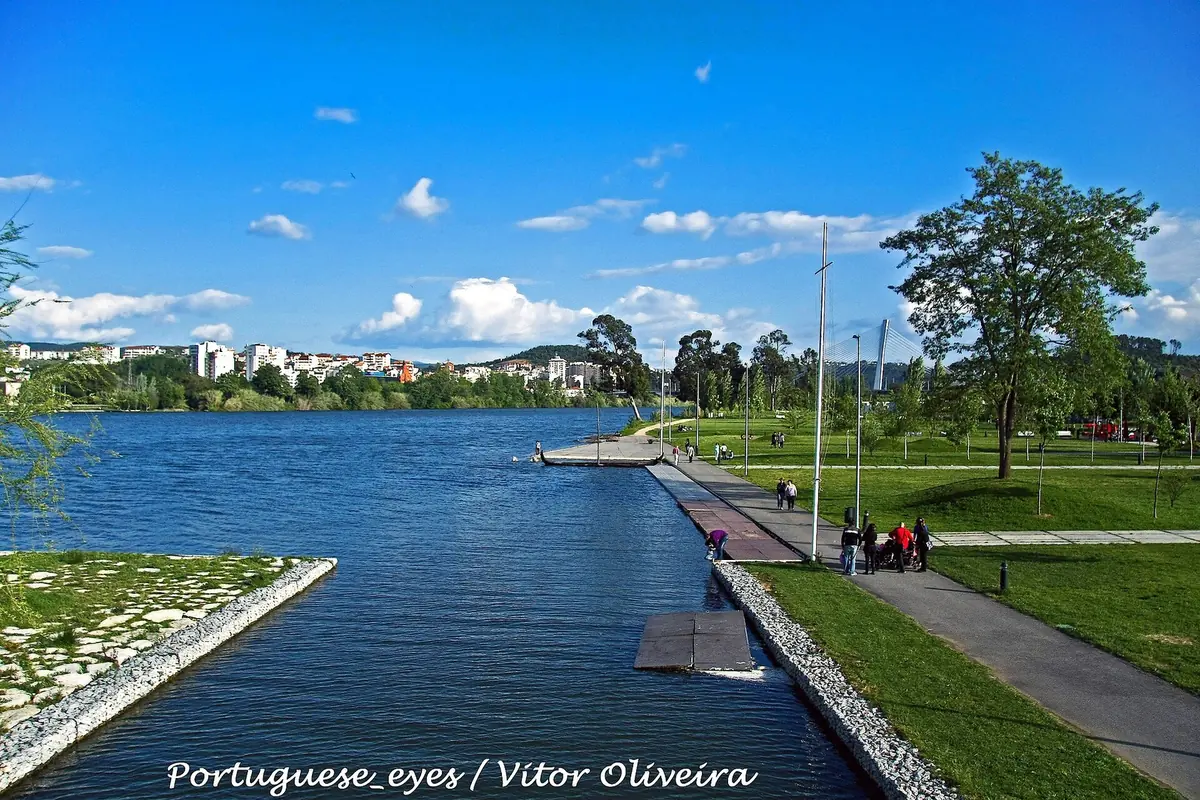
UpdatedEvery other route in Coimbra is a climb. This one is not. The Mondego runs wide and flat past the foot of the Baixa, with parkland on both banks and a footbridge between them, and from the left bank you get the thing no street in the city can give you: the whole of the Alta stacked above the water, university on top, in one view.
About 3.5 km as a loop, roughly 90 minutes of walking, and free from end to end. It also takes you to the left bank’s attractions — Portugal dos Pequenitos, the Quinta das Lágrimas gardens, the hill monastery where Queen Isabel is buried twice — and past one that is firmly closed.
Start where the Baixa meets the river, beside the central Coimbra station — the one called Estação Nova, and no longer connected by rail to Coimbra-B. That link was permanently deactivated on 12 January 2025 and the corridor became a busway; a free road transfer runs for CP passengers instead. If you arrived by train and were told to wait for a shuttle train, that service ended.
Tip: SIT bus line 209 stops here at Coimbra (Portagem), which makes this the easiest place to start or abandon the walk.
The riverside park below the Baixa, running downstream along the water. It is an unenclosed public park, so there is no gate and no ticket — although, to be accurate, no official page publishes its hours or states its admission, because the municipal parks pages now redirect to the city tourism homepage. Flat, paved and the best surface in Coimbra for a pushchair or a wheelchair.
Tip: This is where locals run, cycle and sit in the evening. It is the one part of the city with no monuments in it and it is worth twenty minutes for that reason.
The pedestrian bridge linking the two halves of the Parque Verde, and the reason this walk works as a loop. Stop in the middle. Looking upstream you get the Alta in full: the Baixa roofs on the flat, the hill behind them, the university and its closed clock tower on the skyline. It is the composition every photograph of Coimbra is trying to be.
Tip: Late afternoon light comes up the valley and hits the hill face-on. Cross westwards early in the walk and eastwards at the end.
On the Rossio de Santa Clara, and the one attraction in Coimbra designed for children. Scale models of Portuguese monuments, regional house types and Portuguese architecture overseas, built from the 1940s by the Fundação Bissaya Barreto. Adults 14–64 pay 14.95 EUR, ages 3–13 pay 9.95 EUR, under-3s are free, and a family ticket for two adults and two children is 39.95 EUR. Open 10:00–19:00 from March to mid-October.
Tip: The park states a minimum visit time of 90 minutes, so treat it as a detour from this walk rather than a stop on it.
The fourteenth-century Gothic monastery founded by Queen Isabel, abandoned to the river’s floods in 1677 and excavated out of the silt in the 1990s. It has been closed since 20 October 2025 for PRR works on the interpretation centre and the external areas, budgeted at 1,539,932.88 EUR plus VAT, and no reopening date is published. The most recent floods, officially recorded, were in December 2019.
Tip: Search results surface a government page headed “Reabertura” — it is dated 22 June 2023 and refers to an earlier reopening entirely. Check the state ticketing portal instead.
The gardens where Inês de Castro was killed in 1355. A simple ticket is 3.50 EUR, reduced 2.00 EUR for under-15s and over-65s, family 7.00 EUR, open Tuesday to Sunday 10:00–19:00 in summer and 10:00–17:00 in winter, closed Mondays. The Fonte das Lágrimas is not a carved stone fountain, whatever the postcards imply: the foundation’s own text says the water comes straight out of the rock.
Tip: The springs predate the legend. Queen Isabel asked the friars of Santa Cruz for this land in 1326 to pipe water to her convent, 500 metres away.
The optional climb, and the best thing on the left bank. Where the nuns went in 1677 when the river finally beat them, carrying Queen Isabel’s 1330 Gothic stone tomb up the hill with them. It is in the lower choir; her body is above in a silver-and-crystal urn. Entry 6.00 EUR, 3.00 EUR for ages 12–18 and groups of six or more, free under 12. Open daily from 08:30.
Tip: No visits during services — Thursday 18:00, Saturday 16:30, Sunday 11:00. The ridge outside gives you the free view back over the whole city.
Come back along the left-bank park and cross by the road bridge into Largo da Portagem, or retrace the footbridge if you want the view twice. Either way you finish at the foot of the Baixa, a few minutes from Praça do Comércio and ten from Praça 8 de Maio.
Tip: If you have any energy left, Santa Cruz on Praça 8 de Maio has two royal tombs you can see for nothing — but it closes at 16:30.
Coimbra is a hill town that describes itself badly from inside. Walk the Alta and you get lanes and walls; walk the Baixa and you get shopfronts and a slope you cannot see the top of.
From the left bank you get the diagram. River, flat strip of Baixa, steep hillside, walled upper town, university on the summit. Everything the city has done for a thousand years is legible in one elevation.
That is the argument for this walk even if you never enter a single building on it. Ninety minutes, no ticket, and the rest of your visit makes more sense afterwards.
It is also the only genuinely flat route in Coimbra. The Parque Verde runs along both banks, paved and level, and the footbridge is a level crossing between them — which matters in a city where the alternative is a 51-metre climb and a street called Back-Breaker.
For anyone with a pushchair, a wheelchair or knees that have already done the Alta to Baixa descent, this is the route to keep in reserve.
The river is not incidental to the city’s history either. The Mondego drowned a monastery over three centuries, and the nuns of Santa Clara-a-Velha gave up and moved uphill in 1677 rather than keep arguing with it.
The official record notes that the most recent floods there were in December 2019. This is a river that is still trying.
Walk the left bank with that in mind and the flat ground stops looking like parkland and starts looking like a flood plain, which is what it is.
One thing on this route is closed and it is worth knowing before you cross.
Santa Clara-a-Velha has been closed since 20 October 2025 for PRR-funded works on the interpretation centre, the Casa do Paço and the external areas, budgeted at 1,539,932.88 EUR plus VAT. As of 15 September 2026 the state ticketing portal still showed the closure notice, and no reopening date is published.
There is a trap attached. Searching for it surfaces an official-looking page headed “Reabertura do Mosteiro de Santa Clara-a-Velha” — but that article is dated 22 June 2023 and refers to an earlier reopening entirely. Several aggregator guides have republished it as current.
The test is always the date, and the reliable check is the state ticketing portal: if the monument were open, it would be selling tickets.
What is open on this bank: Portugal dos Pequenitos every day but Christmas, the Quinta das Lágrimas gardens Tuesday to Sunday, and Santa Clara-a-Nova daily from 08:30 with no closing day.
Of those three, Santa Clara-a-Nova is the substitute I would make for the closed monastery. It is the same story, one hill later, with the queen’s original 1330 tomb in the lower choir.
On the other bank, the Machado de Castro museum has been closed since February 2026 and the University Tower is closed with no reason published. Three headline sights, one year.
Which is, bluntly, part of why a free riverside walk earns more of your time in Coimbra this year than it normally would.
The walk is free and the parks are unenclosed, so there are no opening hours to work around on the route itself. Be aware, though, that no official page publishes hours for the Parque Verde do Mondego — the municipal pages that used to carry them now redirect to the city tourism homepage.
The attractions on the route do have hours, and the tight one is the Quinta das Lágrimas, closed Mondays, 10:00–19:00 from 16 March to 15 October and 10:00–17:00 the rest of the year.
Buses: SIT line 209 stops at Coimbra (Portagem) at the park’s edge, and line 207 stops at Casa do Sal (Parque ECOVIA Jardim). Fares are not published on the timetable pages, so buy at the point of travel.
Coimbra’s transport changed on 10 September 2026, when the Metrobus began running to Coimbra-B and Praça da República. Weekday services went from 291 to 452, with average frequencies of 5 minutes at peak and 7.5 off-peak. Any guide written before this month describes a different system — see getting around Coimbra.
The other thing that changed, permanently: there is no longer a train between Coimbra-B and the central Coimbra station. The link was deactivated on 12 January 2025 and a free road transfer for CP passengers replaced it.
Shade is limited on the open stretches of the park, and there is very little of it on the left bank in the middle of the day. Carry water in summer.
Food is thin on the left bank. Eat in the Baixa before you cross, or plan to eat when you come back.
Allow 90 minutes for the loop alone, or half a day if you are taking in Portugal dos Pequenitos and the gardens.
The short version, 45 minutes. Largo da Portagem, downstream along the right bank, over the Pedro e Inês footbridge, back along the left bank and across by the road bridge. No tickets, no detours, and it still gives you the view.
With children. Do the short loop first, then Portugal dos Pequenitos as the main event — minimum 90 minutes stated by the park, 14.95 EUR adults and 9.95 EUR for ages 3 to 13. Santa Clara-a-Nova is free under 12 if you want a second stop.
With the queens. Quinta das Lágrimas for the springs Queen Isabel asked for in 1326, then the climb to Santa Clara-a-Nova for her two tombs. It is the best thematic morning on this bank and almost nobody does it.
On the water instead. The Mondego is also worked by kayak operators and a river cruise, which put you in the middle of the view rather than beside it.
At the end of the day. Start at 17:00 in summer, take the footbridge westwards, and time the return crossing for the last light on the Alta. Then walk up into the Baixa for dinner.
If you want the hill instead, the Alta to Baixa descent is the companion route and runs the other way — downhill, through the town gate, ending at the royal tombs.
And for a whole day that uses both, the two-day Coimbra itinerary puts the river on the second afternoon.
Reporter notebook
Afternoon light comes up the valley and hits the Alta face-on. Head west over the footbridge early in the walk and return east at the end, with the hill lit in front of you.
The Quinta das Lágrimas gardens are closed on Mondays. Santa Clara-a-Nova opens daily from 08:30 and Portugal dos Pequenitos every day but Christmas, so Monday is still walkable.
The riverside park has limited shade and the left bank is thin on places to eat. Eat in the Baixa before you cross, and carry water from May to September.
Paved, level and crossed by a pedestrian bridge, this is the route to keep for the day your legs have finished with the Alta — or for a pushchair or wheelchair.
Fifty minutes on the Mondego looking back at the hill, which is the one view of Coimbra you cannot get by walking.
✓ Verified GetYourGuide reviews
An hour on a silent electric boat under the bridges. Rated higher than the diesel cruise, on a smaller sample.
✓ Verified GetYourGuide reviews
About 3.5 km as a loop over both banks, roughly 90 minutes of walking. A shorter 45-minute version simply crosses the Pedro e Inês footbridge and returns by the road bridge.
Yes. The riverside parks are unenclosed public space with no gate or ticket, although no official page publishes their hours or states admission. Only the attractions on the left bank are ticketed.
It is the most accessible route in Coimbra: flat, paved, with a level footbridge between the two banks. The optional climb to Santa Clara-a-Nova is not, and no step-free access is published there.
No. It has been closed since 20 October 2025 for PRR works with no reopening date published. Ignore the government page headed “Reabertura” — it is dated 22 June 2023 and refers to an earlier reopening.
Late afternoon. The light comes up the valley onto the Alta, so cross west early and return east at the end with the hill lit in front of you. In summer, start around 17:00.
Largo da Portagem, at the foot of the Baixa beside the central Coimbra station. SIT bus line 209 stops there. Note that there is no longer a train between Coimbra-B and the central station — that link was deactivated in January 2025.
Yes, and Portugal dos Pequenitos on the left bank is the one attraction in the city built for them. The park states a minimum visit of 90 minutes, so treat it as a detour rather than a stop.