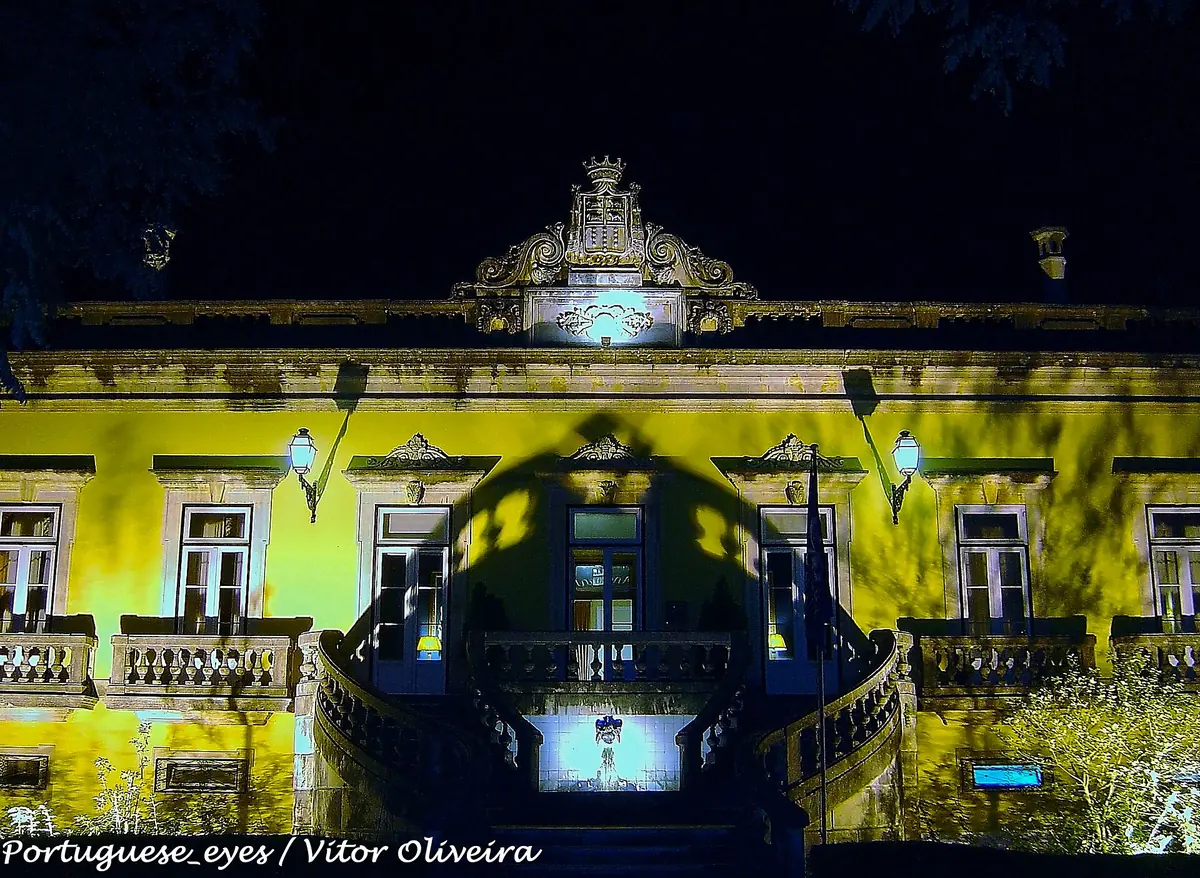

You do not arrive at Quinta das Lágrimas so much as leave the city to get to it. Over the bridge, along the left bank, through gates, and then a drive through grounds until an eighteenth-century palace front resolves out of the trees. The traffic noise stops about halfway up. By the time you are standing at the door, the university hill is a silhouette on the far side of the water and no longer your problem.
This is the grand hotel of Coimbra: five stars, a member of Small Luxury Hotels of the World, in grounds the hotel describes as twelve acres of gardens, on the Santa Clara bank. It has a spa, golf, and in Arcadas the most ambitious kitchen in the city. It also trades hard on a fourteenth-century love story, and it is worth being clear about where the history ends and the marketing begins.
The estate
The building is an eighteenth-century palace, and the grounds are the reason to be here rather than in the Baixa. Twelve acres is the hotel’s own figure and it feels right: enough for the noise of the city to disappear, enough for the kitchen to grow things.
That last part is not decorative. The hotel states that Arcadas works with herbs from the chef’s garden and with oranges, lemons, avocados, raspberries and wild watercress grown on the estate. That is a venue claim rather than an independently verified one, but it is plausible on a property of this size and it explains what appears on the plate.
The spa and the golf are the other two pillars, and together with the grounds they tell you what kind of stay this is. You are buying a destination, not a base. If your plan is to be out of the door at 09:00 every morning and back at midnight, you are paying for facilities you will never see.
The other consequence of the setting is silence. Coimbra’s historic quarters are noisy in a specific way — students, term-time serenades, the Latada and the Queima das Fitas taking over whole nights — and Julie Dawn Fox warns that the Alta in particular can be loud during term. None of that reaches across the river.
The legend, and what is actually verified
The estate is bound up with the story of Pedro and Inês de Castro: the fourteenth-century Portuguese prince, his Galician lover, her murder in Coimbra on his father’s orders, and his posthumous insistence that she be crowned queen. It is the founding tragedy of Portuguese literature and it is attached to this ground.
The hotel frames it romantically, as it is entitled to. What we could not confirm is the specific landmark usually attached to the site: the Fonte dos Amores or Fonte das Lágrimas — the fountain of the lovers, or of tears, which gives the property its name. It was not named on the hotel’s English homepage when we read it on 15 September 2026.
So: the legend is real and ancient, the association with this estate is long-standing, and the fountain’s exact status and location on the grounds is something to ask about at reception rather than something we will assert. If you are coming for the story, ask before you wander.
For the other half of the same history, cross back over the river: Santa Clara-a-Velha and Santa Clara-a-Nova hold the medieval and baroque layers of this bank, though the former has been closed since October 2025.
Who should stay here
Stay here if you are driving. The left bank is the easier side of Coimbra for parking and car access, and the historic centre is the opposite: stepped lanes, awkward parking, and a hill between you and everything.
Stay here for an occasion. Anniversaries, a stop on a longer Portuguese trip, a couple of days that are about the hotel rather than the monuments. The spa and the dining room are the argument.
Do not stay here for convenience. You are across the Mondego from the Joanina Library and the university, and while the walk to the lower town is flat and manageable, the walk back at night is long and unlit. Budget for taxis.
Do not stay here if you want the city at your door. There is no restaurant cluster on this bank, no student nightlife and no fado within walking distance. For that, the Alta or the Baixa — see where to stay in Coimbra.
The restaurant, and a correction
Arcadas, downstairs, is the reason a lot of people book this hotel, and it is where the internet gets Coimbra most wrong.
We are not printing a Michelin star for Arcadas. Older headlines refer to one. The hotel’s own current restaurant page mentions no Michelin status at all, citing only an undated placement in La Liste’s 500 best restaurants in the world. Michelin’s own Coimbra pages would not load when we tried. A star that the restaurant does not claim and the guide will not confirm is not a fact.
The chef is contested too. One named food writer gives Chef Victor Dias; a third-party listing refers to the restaurant “by Albano Lourenço”; the hotel’s page named nobody. We would rather report the disagreement than pick a side.
None of which is an argument against eating there. It is the most serious kitchen within reach of Coimbra, it pours a house wine called Pedro & Inês blending Alfrocheiro and Touriga Nacional, and its service times are not published — so book by telephone and ask.
What is not published
No room rate appears on this page. We did not seek rates and we will not invent them; a five-star Small Luxury Hotels property in its own grounds prices accordingly, and the number changes by season and by night. Get it from the hotel or from a booking channel on the day you book.
Also not published in anything we read: check-in and check-out times, the number of rooms, the spa treatment list and prices, green fees, and whether the spa and restaurant are open to non-residents.
The telephone number is +351 239 802 380 and it is the answer to all of the above. For a property at this level, one call settles more than an hour of searching.
What is certain: the address is Rua António Augusto Gonçalves, the category is five stars, the affiliation is Small Luxury Hotels of the World, and the building is an eighteenth-century palace with a serious restaurant in it. That is a lot more than most Coimbra hotels publish about themselves.