
You do not walk into the Joanina. You are let in, in a batch of fifty, through a door in a prison. The air changes first: cool, dry, faintly resinous, the smell of oak and old paper held at a constant by walls two metres eleven centimetres thick. Then the light drops and the three halls open ahead of you in black, red and green, tier on tier of gilded shelving under painted ceilings, with King John V looking down from a Domenico Duprà portrait at the far end. Nobody talks much. There is not time to.
The building was finished in 1728 and served as the University Library from 1777 until the first half of the twentieth century. It holds roughly 60,000 volumes printed between the fifteenth and eighteenth centuries. It is still a working library: an average of 750 works are requested from it each year. And for about two and a half centuries it has been defended, at night, by bats.
What to look for inside
The three halls of the Noble Floor are not decorated alike. Each has its own background colour — black, red, green — and the gilding, the lacquer and the painted ceilings were set against those grounds deliberately. Stand at the entrance of each hall and look down its length before you look up. The perspective is the design.
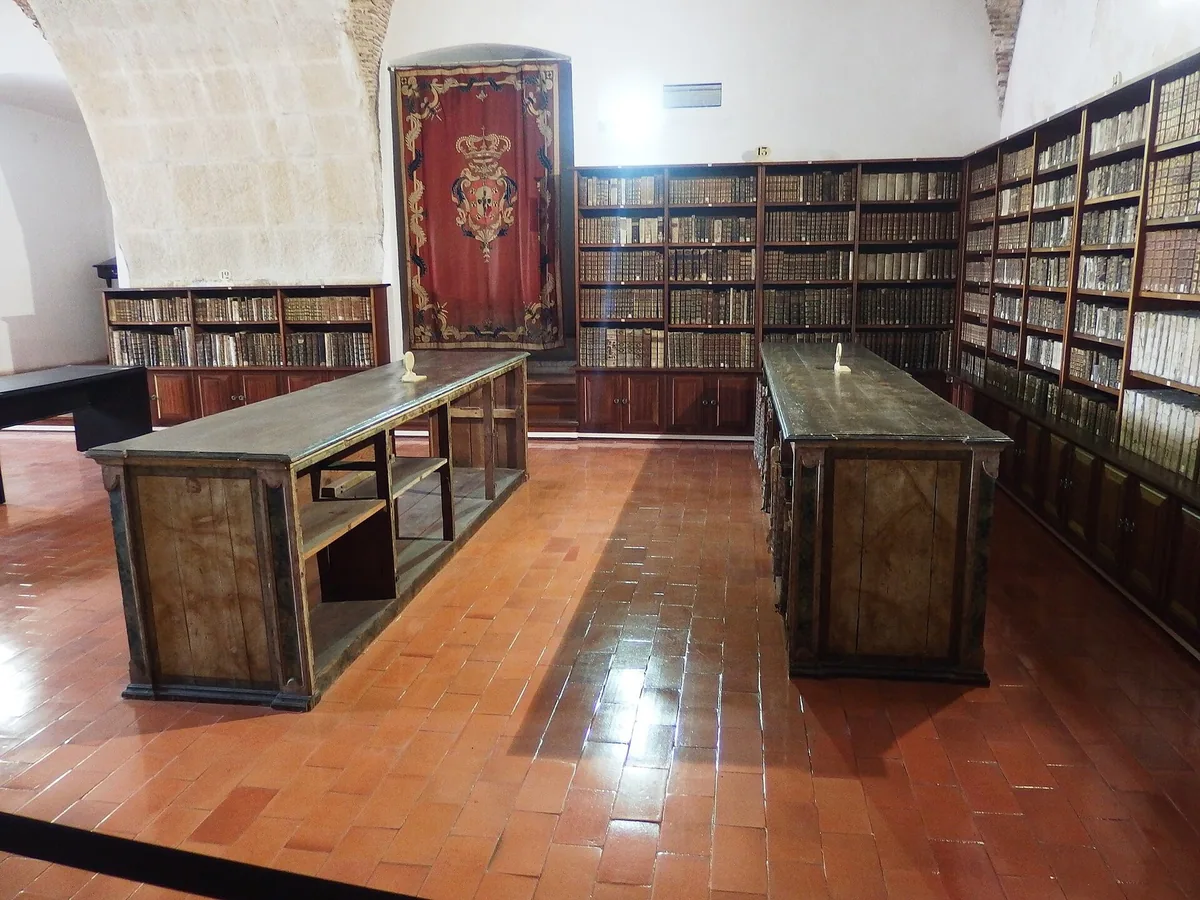
The shelves are oak, and the choice was technical rather than decorative. Oak is dense, it lasts, and it gives off an odour that repels insects. In a room holding 60,000 early printed books on the edge of a river valley, that is structural engineering dressed as furniture.
So are the walls. At 2.11 metres thick they hold the interior at a stable temperature and humidity without a single machine. The Joanina is a vault built to preserve books that happens to be the finest Baroque interior in Portugal, and the order of those two facts matters.
Then the bats. Two colonies live in the library and eat the insects that would otherwise eat the collection. Every evening the staff cover the six tropical-hardwood tables with leather “towels” so the droppings land on hide rather than on the tabletops. You will probably not see a bat at 11:00 on a Tuesday. You will see the leather, folded, and now you know what it is for.
Look for the portrait of King John V, who paid for the building and gave it his name, dominating the Noble Floor. The room was designed around him.
The six reading tables are tropical hardwood, and they are the reason the leather exists. Look at their proportions: they are working furniture in a room that reads as a throne hall, which tells you what this place was for. It was the University Library from 1777 until the first half of the twentieth century, and it never stopped being a library.
The three halls are not sequential rooms so much as one long hall divided by arches, and the division is what makes the perspective work: each arch frames the next ground colour and tricks the eye into reading more depth than there is. Baroque libraries do this. This one does it best.
It still is not a museum piece. An average of 750 works are requested from the collection every year, by people who need them. Somewhere behind the gilding there is a reading room and a request slip.
The collection is roughly 60,000 volumes printed between the fifteenth and eighteenth centuries — theology, canon law, medicine, philosophy, the shape of what a European university thought worth keeping before the Enlightenment rearranged the shelves.
The way in is a prison
This is the thing almost every visitor misses until they are standing in it. The university’s own booking text is blunt: “Entrance to the Baroque Library building is through the Academic Prison.”
The Academic Prison occupies the ground and middle floors of the same building. It is of medieval origin and it is the oldest preserved prison in Portugal. You queue for your slot, you go down, and you walk through two narrow cells and a winding staircase from the primitive structure, then through the communal cells, visiting room, prayer room and latrines added in 1782 under the Pombaline reforms.
Give it five minutes rather than two. On the Middle Floor, the stones of the arch still carry the individual chisel marks of the masons who cut them — each man’s signature, used to count his work so he could be paid. The floor was left rough and unfinished because nobody was ever meant to see it.
Coimbra could hold its own prisoners because it held the Foro Académico, the privilege of governing itself and keeping its own legislation, which kept students, staff and professors out of the common gaol. That privilege was revoked in 1834. The cells outlasted it by two centuries and are now the vestibule of the most photographed room in Portugal that you are not allowed to photograph.
What survives is two distinct building phases stacked on each other. The primitive structure gives you the two narrow cells and the winding staircase. The 1782 works gave the gaol its communal cells, a visiting room, a prayer room and latrines — the Pombaline state applying its idea of order to a medieval hole.
It reframes the library. The most opulent room in Portuguese Baroque sits directly above a jail, in the same masonry, funded by the same king, built by the same institution, for the same reason: the University of Coimbra governed itself, and a self-governing body needs both a library and a prison.
How to visit
There is no Joanina-only ticket, and there never has been. The library is sold inside a combined university programme, and the two that include it are the self-guided Joanina + University + Science Museum at 16.50 EUR (the university’s own stated average is three hours) and the guided Palace of Schools tour at 25.00 EUR, which runs 1h30 and covers the Joanina, the Royal Palace and St Michael’s Chapel with a guide.
Now the rule that guides get wrong. Entry to the library building is limited to 50 people every 20 minutes. That is the university’s current published text. The figure you will see repeated on aggregator pages — ten people every five minutes — does not match it. Fifty and twenty are the numbers to plan around.
The date and time printed on your ticket is the time you enter the library building, and only that. Everything else on the ticket can be visited before or after. But a visit outside the stipulated time will not be allowed, and the ticket is otherwise valid for two days — the Joanina is the one element pinned to a moment.
Book first, plan around it: pick the Joanina slot, then hang the rest of the day off it. Online sales close 20 minutes before the visit for the combined ticket and two hours before for the guided tour, which can only be sold up to three months ahead “due to the large influx of bookings”. There are no exchanges and no refunds on any programme, and only one entry per space.
How far ahead slots actually sell out is not published by the university, and no honest number exists for it. If your dates are fixed, buy when you book the trip.
If the Joanina slots for your date are gone, the fallback worth knowing is the University + Science Museum programme at 12.50 EUR, 2h30, which covers everything on the 16.50 EUR ticket except the library itself. It is not a consolation prize — the Sala dos Capelos alone justifies it — but be clear with yourself that you are buying a campus, not a library.
Do not buy the 16.00 EUR Science Museum + UC Exploratório programme expecting to get in here. It explicitly excludes the Palace of Schools.
One more rule that catches people: only one entry per space is allowed. You cannot step out of the Joanina, take a call in the courtyard and go back in. Whatever you meant to see, see it the first time.
The photography rule
Photography and filming are prohibited on the Noble Floor of the Joanina. This is the single rule most visitors break, or try to, and it is worth reading twice: the gilded halls that brought you here are the part you cannot photograph.
You may photograph the rest of the circuit. Flash is banned everywhere in the visiting spaces, as are tripods and selfie sticks. Drones need prior authorisation, and any commercial or academic use of images does too.
Plan for it rather than resent it. Twenty minutes with no camera in your hand is a different, better visit, and the postcards in the Palace of Schools shop — open 09:00 to 19:15 — are shot by people with permission and lighting.
Other house rules while you are inside: no animals except service dogs, no smoking, no eating or drinking. The university also asks visitors with walking difficulties, dizziness or heart conditions to take the stairs carefully, which is fair warning in a building whose circulation is largely original.
The ban is not decorative squeamishness. The Noble Floor is a controlled environment held stable by mass and habit rather than machinery, and the university manages the flow of fifty people every twenty minutes through it. A room where everybody stops to frame a shot is a room where the slot collapses.
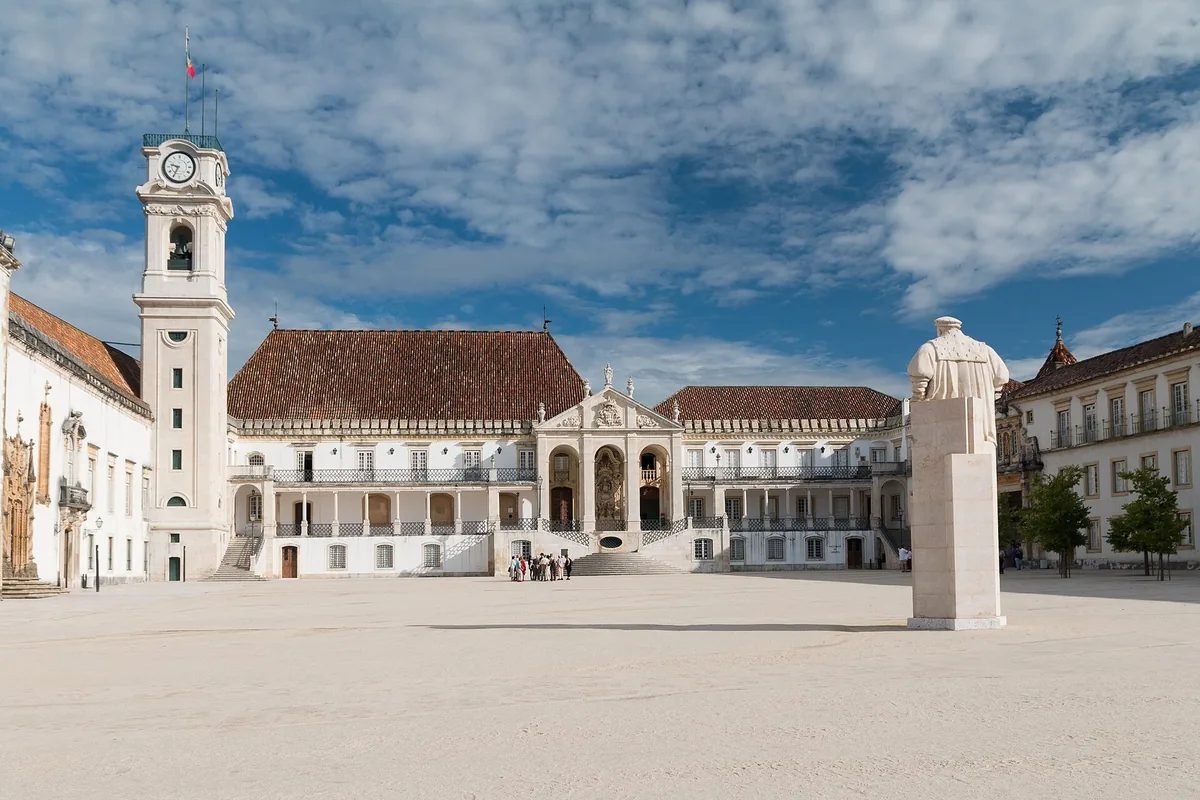
If you want a photograph of the outside, the Paço das Escolas courtyard is open, free to walk into, and photographable. The library facade, the Via Latina colonnade and the closed clock tower above it all sit within a few metres of each other.
Practical logistics
The Palace of Schools is open every day 09:00 to 19:30. Last entrance to the Joanina is 19:00; last admission to the other spaces is 19:15. The ticket office kiosk, in front of the Faculty of Medicine, runs 09:00 to 19:00, and its official GPS is 40.207938, -8.424189 — useful, because the Alta defeats most map pins.
The guided tour leaves from that same kiosk at 11:00 and 15:00 in Portuguese and English, subject to guide availability.
Closure dates published for this cycle: 24 and 25 December 2026, 31 December 2026 and 1 January 2027, and the two movable academic days. The university shut the whole circuit on 24 May 2026 for Academic Week and closes again on 4 October 2026 for the Latada. If you are booking for late May or early October, check the university’s own information page before you book anything else — the Queima das Fitas is big enough to close a World Heritage site.
Getting up here is the other half of the logistics. The Joanina sits at the top of the Alta, and the climb from the Baixa is real; the Elevador do Mercado rises 51 metres in two stages and runs Monday to Saturday 07:30–21:00, Sundays and public holidays 10:00–21:00. Use it, and arrive at your slot without a shirt full of sweat.
Two shop hours worth knowing, because they differ: the Palace of Schools gift shop runs 09:00 to 19:15, while the museum gift shop closes for lunch, 09:00–12:30 and 15:00–18:45.
One more closure that affects the same ticket: St Michael’s Chapel shuts every Sunday from 11:45 to 14:00 for mass. And twice every three months the Cabinet of Curiosities and Physics Cabinet close for disinfestation; if your ticket falls on one of those days you may use it on following days, but you will not get money back.
Tickets are valid two days, which is the quiet kindness in the whole structure. Do the library and the palace on one afternoon, and the Science Museum side on the next morning when you are fresh.
What to combine
Your 16.50 EUR ticket is not a library ticket, it is a campus ticket, and people routinely waste two-thirds of it. It also covers the Royal Palace, St Michael’s Chapel, the Sala dos Capelos inside the palace circuit, the Chemistry Laboratory and the rest of the Science Museum spaces, plus the Academic Museum, the Cabinet of Curiosities and the Mineral Gallery.
Watch the hours mismatch: the Science Museum spaces open at 10:00 and close at 19:00, an hour earlier than the Palace. If your Joanina slot is late afternoon, do the museum side first.
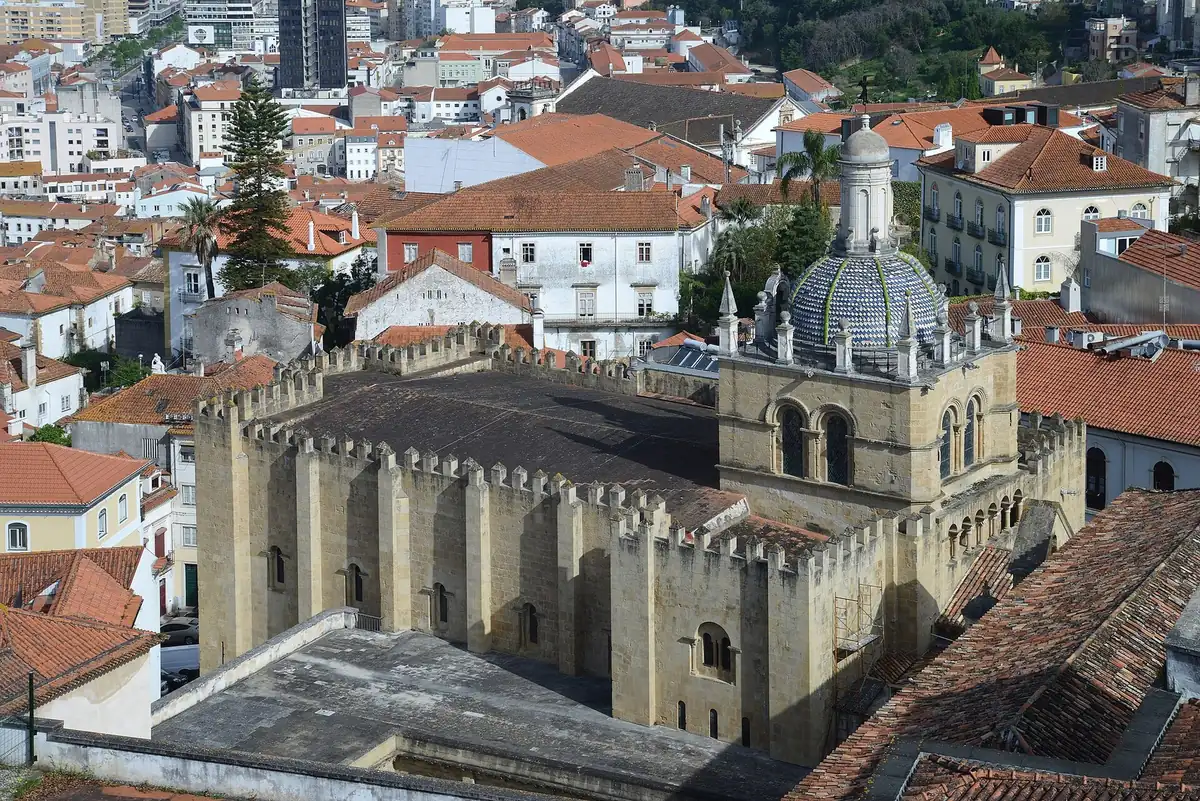
The University Tower is closed and not currently sold, so do not build the day around the view from it. Instead, walk ten minutes downhill to the free Botanical Garden, 13 hectares and part of the same 2013 UNESCO inscription, or start the Alta to Baixa descent and be at the Sé Velha in a quarter of an hour.
If you want the whole ticket explained before you buy, the guide to visiting the University of Coimbra sets the programmes side by side.
Two of the city’s big draws are shut, and knowing that saves a wasted walk. The Museu Nacional Machado de Castro, five minutes away beside the Sé Nova, has been closed since February 2026, and Santa Clara-a-Velha across the river has been closed since October 2025. Neither publishes a reopening date.
What is open and cheap: the Sé Nova is a one-minute walk from the ticket kiosk and costs 1.00 EUR, the lowest-priced interior in the Alta.