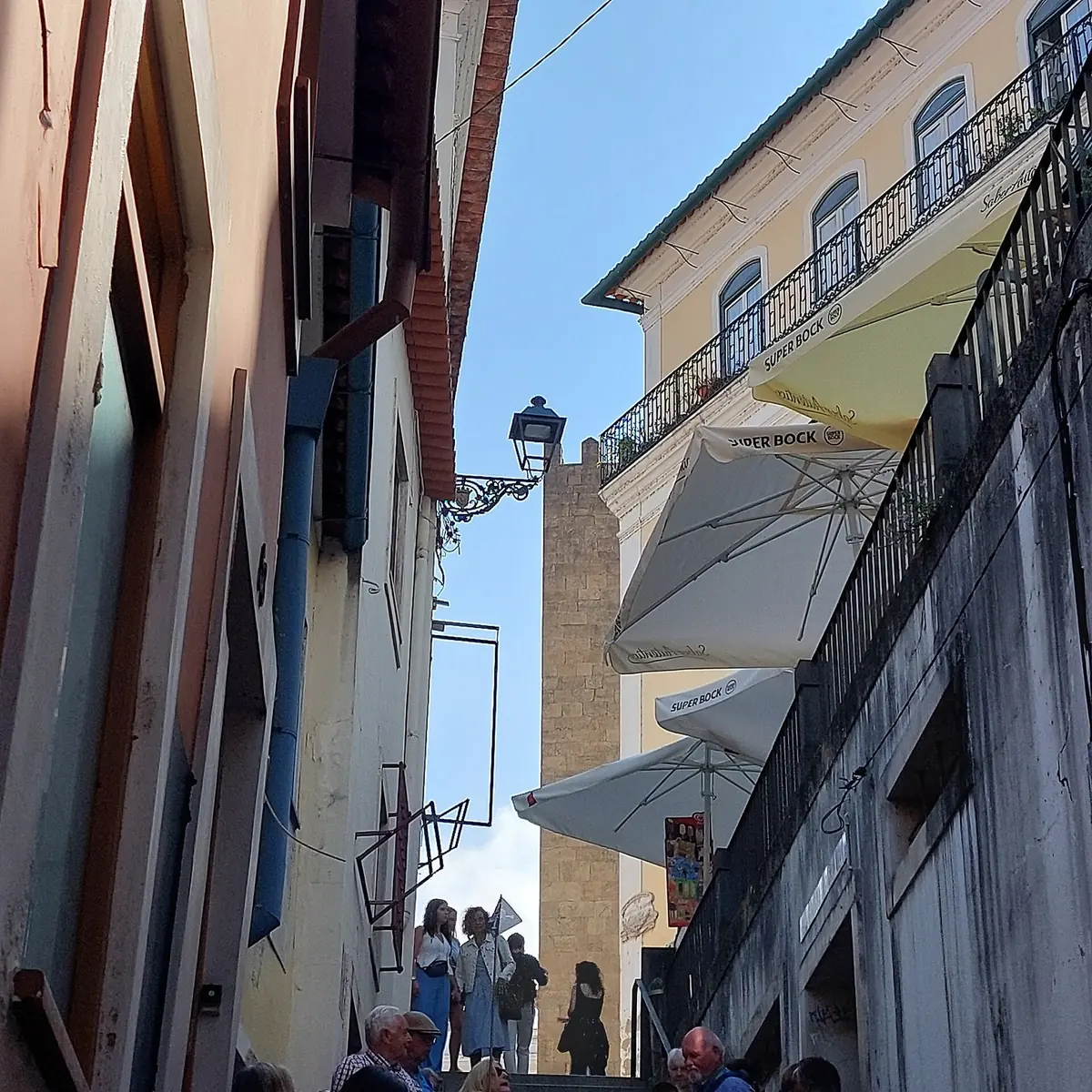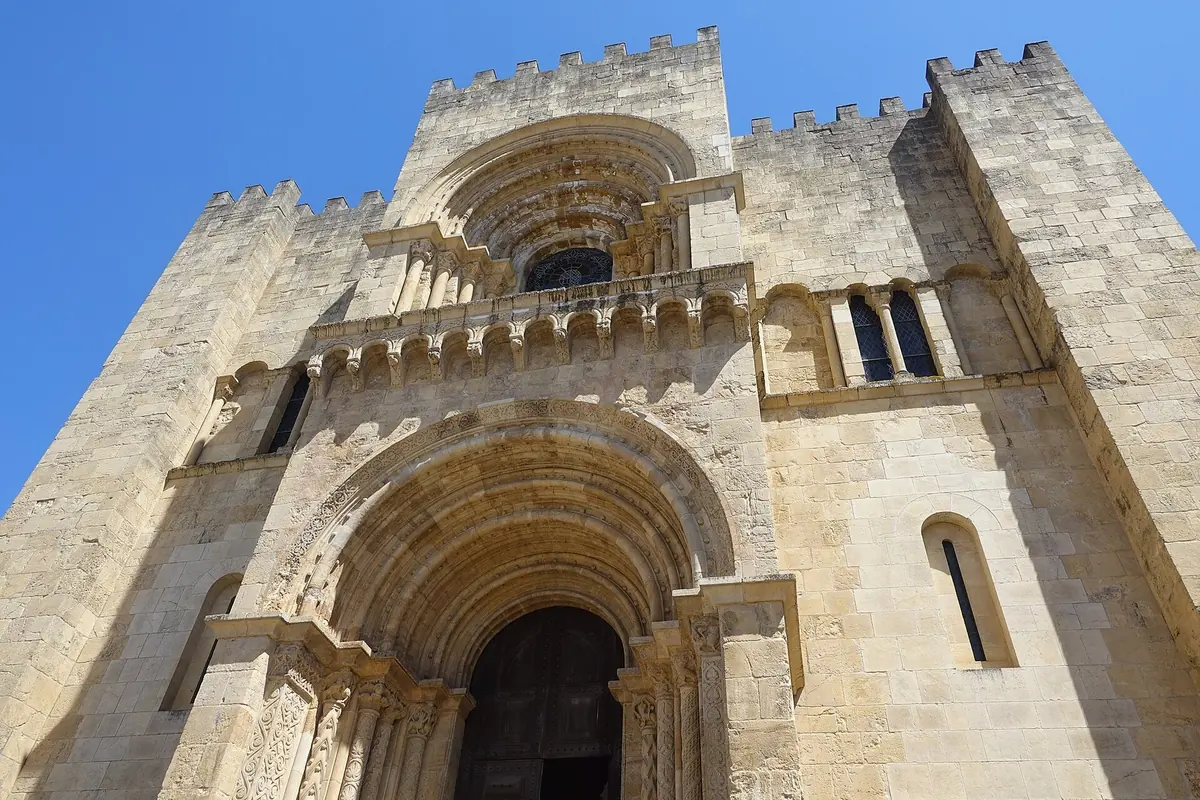

It does not look like a cathedral. It looks like a keep. Blunt walls, a crenellated parapet, arrow-slit windows high up, a west front with a doorway and a gallery punched into it and almost nothing else. You come up the stepped lane of the Quebra-Costas, the square opens on your right, and the building sits there looking as though it expects trouble. It did. This was a frontier town in the twelfth century, and the cathedral was built like one.
Inside, the surprise is the carving. More than two hundred capitals run round the nave and aisles in what has been called the richest iconographic programme of the Romanesque in Portugal — and there is not a single human figure among them, and not one biblical scene. Construction began in 1164, it was consecrated in 1184, and entry costs 3.00 EUR. It is the best value in the Alta.
The coronation myth
Here is the correction, and it is worth making early because you will hear the wrong version on the square outside. Guides routinely say the Sé Velha was built by Afonso Henriques, Portugal’s first king, and that he was crowned in it.
The parish’s own history says otherwise. Construction began in 1164, under Bishop Miguel Salomão. The cathedral was consecrated in 1184. And in 1185 the coronation held here was that of the second king, Sancho I. Afonso Henriques was already dead.
None of that diminishes the building. It sharpens it. A cathedral begun under a bishop rather than a king, in a city forty years into being Portuguese, is a different kind of statement from a royal monument — it is the Church staking its own claim on a frontier.
The design is attributed to Master Robert, a Frenchman who was running the Lisbon cathedral site at the same time and came to Coimbra periodically. That is worth a moment: two of Portugal’s earliest cathedrals, one architect, commuting.
It also explains a family resemblance. If you have seen Lisbon’s Sé and found this one familiar, you are not imagining it.
The other claim you will see printed is that this is the only Portuguese Romanesque cathedral of the Reconquest period to survive relatively intact. That one holds up, and it is the reason art historians come here rather than to the larger, later church up the hill.
Where the myth comes from is easy enough to guess. Afonso Henriques took Coimbra as his capital, his palace is three hundred metres uphill, and a first king is a better story than a bishop with a building programme.
But if you want the room where a Portuguese king was actually proclaimed, it is the Sala dos Capelos in the university, in 1385. Two different kings, two different rooms, and the dates matter.
Carry the right version in with you. It changes what you look at: not a royal trophy, but a bishop’s cathedral built to last a siege.
The date range also explains the building’s stubborn plainness. Twenty years from foundation to consecration is fast for a cathedral, and a fast cathedral on a contested frontier gets thick walls and small windows rather than a sculpted west front.
And it survived because the bishops later moved out. In 1772 the seat went uphill to the bigger Jesuit church, which spared this one two centuries of fashionable improvement.
What to look for inside
Go to the capitals first, and give them twenty minutes. They are the reason this building matters, and almost nobody looks at them properly because they sit above head height and the eye goes to the altarpiece instead.
What you will find carved on them: interlace, palmettes, geometric knotwork, stylised animals, vegetal forms that repeat and invert. What you will not find: people. No apostles, no saints, no Nativity, no Last Judgement, no biblical narrative at all.
For a twelfth-century cathedral that is extraordinary. Romanesque sculpture elsewhere in Europe is a picture Bible for people who could not read one. Here the carving refuses the entire genre.
The explanation offered is that the work was probably done by Mozarabic artists settled in Coimbra — Christians formed under Islamic rule, working in a visual language where figurative religious imagery was not the default.
So the cathedral of a Reconquest frontier city was decorated by craftsmen carrying the aesthetic of the culture it had just been taken from. Stand under one of the nave capitals and that is what you are looking at.
Work slowly along one aisle rather than trying to see them all. The programme is dense enough that twenty minutes on ten capitals beats five minutes on a hundred.
Then the Porta Especiosa on the north side, which is a different building altogether: Renaissance, refined, figurative, the work of João de Ruão and Nicolau de Chanterenne. Two of the sixteenth century’s best sculptors in Portugal, grafted onto a fortress.
The contrast is the point of the north wall. Rough Romanesque mass, then a Renaissance doorway inserted into it like a quotation in another language.
Inside, note how little light there is and how thick the piers are. This is a building carrying a stone vault and a defensive parapet over the same walls, and the darkness is structural, not atmospheric.
Thirty to forty-five minutes covers the church and the cloister comfortably. An hour if the capitals get you.
One more thing to seek out: the font and the choir stalls are not here. Both were carried up the hill to the Sé Nova when the seat moved in 1772, which is worth knowing before you spend ten minutes looking for them.
The gilded main altarpiece is the obvious focal point and the one most visitors photograph first. Look at it, then turn your back on it, because everything unusual in this building is behind you and above your head.
The cloister
The Gothic cloister was begun in 1218, which makes it one of the earliest Gothic works in Portugal. Fifty-odd years after the nave, and a different century of thinking about weight and light.
The engineering detail is the one to carry with you: part of the hillside had to be cut away to fit it. The Alta is a steep site, the cathedral sits on a slope, and a square cloister needs flat ground that did not exist.
So they made it. In 1218, by hand. Go and stand in the corner nearest the hill and look at how the ground rises immediately beyond the wall, and the scale of that decision lands.
It also tells you what the cathedral chapter thought of itself. Cutting a hill to build a cloister is not a modest act.
Architecturally, the transition is legible from the arcade. Pointed arches, lighter supports, real openings — everything the Romanesque nave next door refuses. Walk from one into the other and the shift is physical.
It is also the calmest place in the Alta. The nave carries visitors and the square carries the Quebra-Costas traffic; the cloister carries almost nobody.
Photographers: the light here changes fast and the best of it is mid-morning on the east side. The nave interior is dark enough to need a steady hand.
Give it fifteen minutes of the thirty to forty-five you are spending on the whole site. Most people give it three.
There is also a practical reason to start here. The cloister is outdoors, so it is the part of the visit that is hostage to weather and to light, and the nave will be exactly as dark in an hour as it is now.
If it is raining, reverse that advice and take the capitals first. The arcade shelters you on three sides but the garth does not.
How to visit
Entry is 3.00 EUR per person, or 2.50 EUR each for groups over ten. No pre-booking, no timed slots, no queueing system — you walk up and pay at the door. After the University’s 16.50 EUR programme, it feels like a rounding error.
Hours run on a summer and winter timetable. June to September: weekdays and Saturdays 09:30–18:30, Sundays 11:00–18:00. October to May: weekdays and Saturdays 09:30–17:30, Sundays 11:00–17:00. Religious holidays 11:00–17:30, civil holidays 09:30–17:30.
The Sunday shift matters. An 11:00 opening on Sundays wrecks the standard plan of doing the cathedrals before the churches in the Baixa close, and Sunday is already the worst day for a one-day Coimbra.
This is a working church, so tourist visiting stops for mass: Monday to Friday 18:00, Saturday 19:00, Sunday 10:00. Plan around them rather than turning up at 17:55 in winter.
Dress as you would for any active church — covered shoulders, nothing that reads as beachwear. Nobody will lecture you, and you should not need them to.
Accessibility is the honest weak point. This is a twelfth-century building on a slope reached by stepped lanes, and no step-free route is published. The approach itself, up the Quebra-Costas, is stairs.
Getting here: it sits halfway down the climb between the university and the Baixa, on the Alta to Baixa descent. Coming up from below, the Arco de Almedina is the gate at the bottom of the lane.
The lane is called Rua do Quebra-Costas — Back-Breaker Street — and the name is not decorative. If you would rather not climb it, the Elevador do Mercado covers a 51-metre rise on any valid SMTUC ticket and runs Monday to Saturday 07:30–21:00, Sundays and public holidays 10:00–21:00.
Prices and hours at Portuguese monuments are revised in January and again at the summer changeover, so re-check the parish page before a tight schedule.
Budget context, since most people arrive here after the university: 16.50 EUR at the Paço das Escolas, 3.00 EUR here, 1.00 EUR at the Sé Nova and 5.00 EUR at Santa Cruz adds up to about 25 EUR for the four ticketed interiors that matter in central Coimbra.
The steps and the serenade
Once a year this square becomes the most important place in Coimbra, and it has nothing to do with the cathedral’s liturgy.
The Queima das Fitas, the student festival the city council calls the largest in Europe, opens with the Serenata Monumental on the steps of the Sé Velha. It begins after midnight strikes twelve: the first chords of the guitars, then the students’ voices, from the cathedral staircase.
Thousands stand in the square and in the lanes below in silence. In 2026 there were new access and security arrangements, including a fenced enclosure by the monument — a sign of how many people now come.
The music is Coimbra fado, which is not Lisbon fado. It grew out of the university, it is a serenade rather than a tavern lament, and its guitar — the teardrop-shaped Guitarra Portuguesa de Coimbra — is tuned a whole tone lower. That is why it sounds darker.
Students have been singing in these streets since the sixteenth century, and the themes are longing for a woman, for the city, and for the university itself.
The planning warning is real. The festival runs eight days in May, one for each faculty, and on parade day both the Santa Cruz monastery and the entire university circuit close. 2026 ran 22–30 May; 2027 dates are not yet published, so do not assume a fixed week.
If you are here at any other time of year and want the music, Fado ao Centro is a hundred metres down the same stepped lane, at Rua do Quebra Costas 7, with a 50-minute show daily at 18:00.
Which gives the square a nice symmetry: a Romanesque cathedral with no human figures carved on it, and once a year a thousand people on its steps at midnight.
The rest of the year the steps are simply a good place to sit. They face west across the square, they catch the late light, and the lane below carries a steady traffic of students, deliveries and people regretting their choice of shoes.
What to combine
Uphill, five minutes: the Sé Nova, which took the bishop’s seat from here in 1772 simply because it was bigger. Entry 1.00 EUR, open daily 09:00–18:00, and it holds the choir stalls and the Gothic-Manueline font carried up from this church.
Beside it, the Museu Nacional Machado de Castro and its Roman cryptoporticus — closed since February 2026, with no reopening date published. Do not plan around it.
Downhill, five minutes: the Arco de Almedina, the main gate of the walled town, with the municipal museum in the tower above it. Note the hours — Tuesday to Saturday, 10:00–13:00 and 14:00–18:00, closed Sundays and Mondays.
Then Santa Cruz on Praça 8 de Maio, where Afonso Henriques actually is: founded 1131, burial place of the first two kings, 5.00 EUR, closing at 16:30 Monday to Saturday and not opening until 13:00 on Sundays.
The Alta to Baixa descent links all four in the right order and the right direction — downhill. For the shortlist of what is worth paying for this year, read what to see in Coimbra.
If you would rather hear the city than climb it, the two fado venues on this lane are a few doors apart — number 7 and number 12 of Rua do Quebra Costas — and one of them gives free seats to Coimbra bachelor’s and master’s students, two a day, because the music is about them.