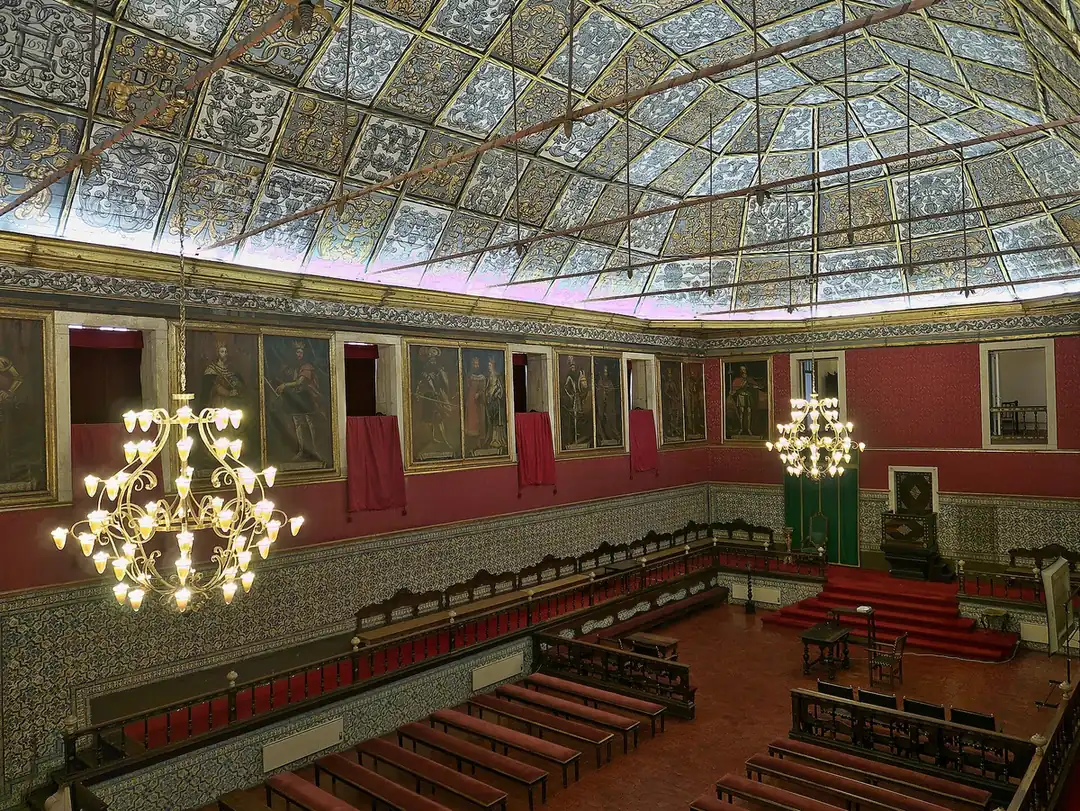

You come in off the courtyard and the room simply opens: long, high, dark-panelled, hung with red, a line of severe painted faces running the length of both walls at head height and above them a ceiling that will keep you there for ten minutes. This was the throne room of Portugal’s first dynasty. It is now the hall where the University of Coimbra confers its doctorates and invests its rectors, and it has never stopped being used for either purpose.
Two things make it the best room on the university ticket. The ceiling carries 172 painted panels of grotesque motifs — sea monsters, mermaids, Indians, twisting plants. And the walls carry a portrait of every Portuguese king from Afonso Henriques to Manuel II, with one gap left deliberately open. Sixty years of kings are missing, and the reason is the whole story of the building.
What to look for inside
Look up first and stay there. The wooden ceiling is divided into 172 panels, and the subjects are not saints or coats of arms. They are grotesques: sea monsters, mermaids, figures the period called Indians, and plants that coil into shapes no plant makes.
That vocabulary is deliberate and it dates the room. Grotesque ornament came out of Renaissance Italy and arrived in Portugal on the back of a maritime empire, which is why the monsters share a ceiling with people from the other side of the world.
Walk the length of the room once before you examine anything. The panels are meant to be read in sequence from below, the way a coffered ceiling forces you to move to see it, and standing still under one panel tells you nothing.
Then drop your eyes to the walls. The royal portraits run as a continuous band, which turns the room into a timeline you can walk. Start at the Afonso Henriques end and work forward and you are walking eight centuries in about fifteen paces.
Look at the furniture too. This is a working ceremonial hall, not a period reconstruction: benches for the faculties, a raised place for the rector, and space in the middle for a candidate to stand and be examined in public.
The red is doing work as well. Textile hangings in a stone and timber room absorb sound, and a room designed for oral examination and public disputation has to be a room you can be heard in.
Fifteen to twenty minutes is the honest time here. It is one room, and it has no signage, so if you want the detail explained rather than described, the 25.00 EUR guided tour is the version that tells you what you are looking at.
Before you leave, step into the Private Examination Room next door. It holds portraits of 38 rectors, each captioned with the exact years, months and days he served, and its ceiling is dated 1701. Full account on the Paço das Escolas page.
The hall is also the reason the black capes outside make sense. Everything a Coimbra student does ceremonially — the ranks, the colours, the processions — points at this room, because this is where the degree is finally conferred.
There is one more thing to notice, and it is absence rather than object. No ropes, no glass, no plexiglass barriers, no tickets taped to a lectern. The University lets you walk into its most important room and trusts you not to touch anything.
The kings and the gap
The portrait band runs from Afonso Henriques, who made Portugal in the twelfth century, to Manuel II, who lost the throne in 1910. Every monarch in between is on the wall. Except three.
Between 1580 and 1640 Portugal was ruled from Madrid by the Spanish Habsburgs — the Philippine dynasty. Those sixty years are not represented. The kings who reigned over Portugal in that period are simply not hung here.
This is not an oversight and it is not damage. It is an editorial decision made by an institution that has been curating a wall of kings for centuries, and it is the most political thing in the Paço das Escolas.
Stand where the gap falls and think about what the room is for. Every doctorate conferred in this hall has been conferred under a version of Portuguese history in which the union with Spain did not happen. That is a claim, restated at every ceremony, in silence.
It also pairs with the plaque next door. In 1646, six years after the restoration of independence, King John IV offered the Crown of Portugal to Our Lady of the Immaculate Conception, and the Coimbra lecturers swore an oath recorded in stone inside St Michael’s Chapel. Portuguese kings stopped wearing a crown from that moment.
Two rooms, thirty metres apart, both making the same argument about legitimacy in the years after 1640: one by what it added, one by what it left out.
Most visitors walk past both without being told. If you take one thing from this page into the room with you, take the gap — and count the faces.
Guides differ on how to describe the omission, and the University’s own text is matter-of-fact about it: the Philippine dynasty is missing. That is the sourced statement, and it needs no embellishment.
If you want the gap in one sentence to carry round the Alta: this hall shows Portugal as an unbroken line of Portuguese kings, and the unbroken line is an argument, not a record.
The room that made a king
Before the University moved in, this was the throne room of the royal palace, and the most consequential thing that happened in it happened in 1385: King John I was proclaimed here.
The context matters. The old dynasty had ended without a clear heir, Castile had a claim, and the Portuguese Cortes met at Coimbra and chose a Master of Avis instead. The kingdom survived as an independent state because of a decision taken in this room.
Which gives the missing Philippine portraits an extra edge. The hall in which Portugal chose a king rather than accept a Castilian one is the hall that declines to display the Castilian kings it later got.
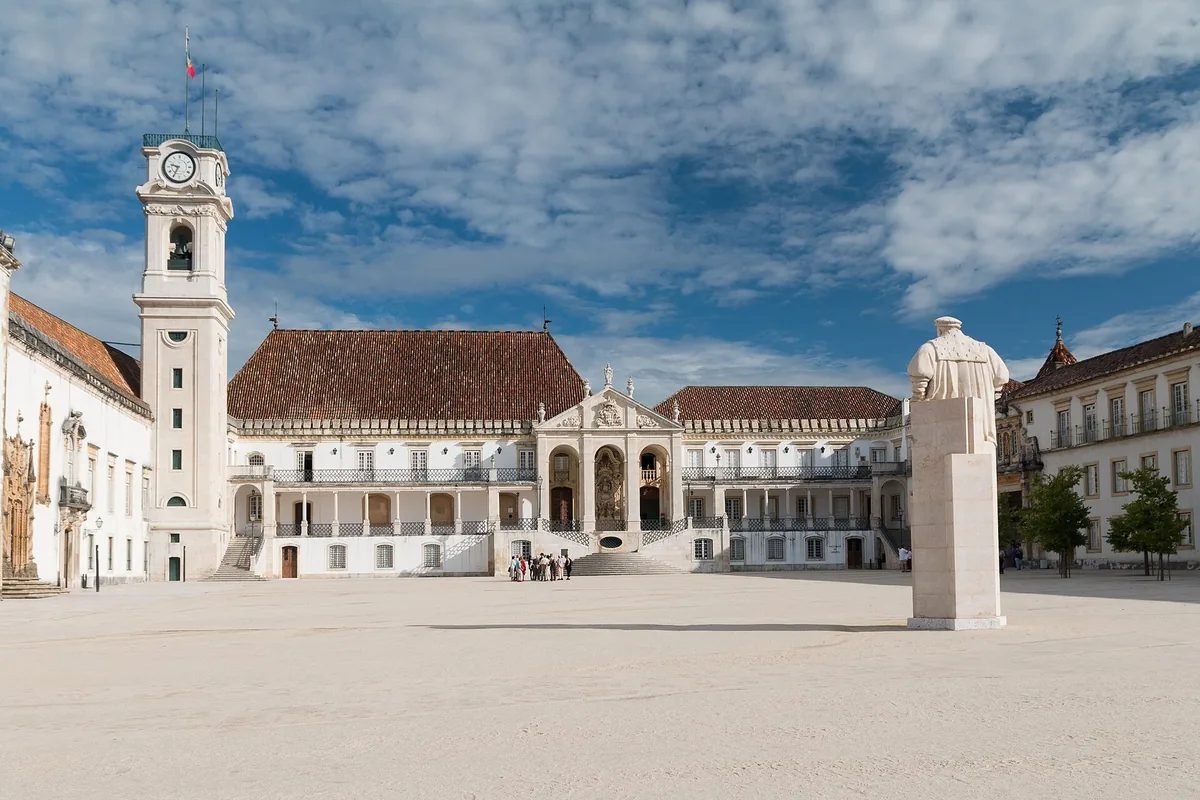
The building around it had already changed hands twice by then. It began as a fortress at the end of the tenth century, seat of the city’s governor under Islamic rule, and became the first Portuguese royal household in 1131, the residence of Afonso Henriques.
The University took it permanently in 1544, and the throne room became the Great Hall of Acts. A room built for a king was handed to a body of scholars, who kept the throne-room grammar and changed what it was for.
You can still see the grammar in how a Coimbra doctorate works. The candidate stands, the faculty sits in rank, the rector presides, the ceremony is public and the vocabulary is regal. Nobody rewrote it for the modern era.
That is the argument for paying to come in. The room is not a set piece about a vanished monarchy; it is the continuing use of monarchical furniture by an institution that outlived the monarchy by more than a century.
And it is still booked. Which is why it closes without notice, and why the University asks nothing more than your understanding when it does.
The throne-room lineage also explains the acoustics and the proportions. Audience halls are long because a hierarchy needs distance, and this one still seats a hierarchy — faculties in rank, rector raised, candidate exposed in the middle.
How to visit
There is no Sala dos Capelos ticket. The hall is part of the Royal Palace circuit, and three programmes include it: 12.50 EUR for University + Science Museum, 16.50 EUR for the same with the Joanina Library on a timed slot, and 25.00 EUR for the 1h30 guided tour.
If you have to choose one room in Coimbra, choose this one, and take the 12.50 EUR ticket without agonising over the library. The Joanina is the scarce thing; the Sala dos Capelos is the substantial one.
The University’s stated average for the 12.50 EUR programme is 2h30, covering the palace rooms, the chapel and the Science Museum spaces. The hall itself is fifteen to twenty minutes of that.
Tickets are valid two days — only the Joanina is pinned to a printed time — and there are no refunds or exchanges on any programme. Online sales close 20 minutes before entry for the combined ticket and two hours before for the guided tour.
The guided tour leaves the ticket office kiosk at 11:00 and 15:00 in Portuguese and English, subject to guide availability, and can only be booked up to three months ahead because of demand.
Published reduced rates: the guided tour charges 17.50 EUR for ages 6–25 and nothing under 6. For the self-guided programmes, reduced tiers exist only inside the booking flow, so do not budget from figures printed on aggregator sites.
One rule that bites: only one entry per space. If the hall is shut for a ceremony when you arrive and reopens an hour later, you have not used your entry — but you cannot look in twice by choice.
Buy at the kiosk in front of the Faculty of Medicine, or online in advance. The kiosk handles every programme at one counter and backs up badly in July.
If you are travelling with children, one honest note: this is a room of portraits and panelling with nothing to touch and no labels. The Cabinet of Curiosities on the same ticket is where children actually stop, and the Academic Museum is where teenagers do.
Practical logistics
Hours follow the Palace of Schools: daily 09:00 to 19:30, last admission to the spaces 19:15. The ticket office runs 09:00 to 19:00, official GPS 40.207938, -8.424189.
The closure that catches people here is not a date on a calendar. The hall closes without notice for academic ceremonies, because it is in use. Doctorates, investitures and formal acts take precedence over visitors, and nobody will offer you a refund for it.
Term time raises the odds, and so does the end of an academic year. If this room is the reason you came, put it early in your visit so you have a second chance on the ticket’s second day.
Photography is allowed without flash; tripods and selfie sticks are prohibited across the university’s visiting spaces. The camera ban applies only to the Joanina’s Noble Floor.
Diary closures for the wider circuit: 24 and 25 December 2026, 31 December 2026 and 1 January 2027, plus movable academic days. The complex shut on 24 May 2026 for Academic Week and closes again on 4 October 2026 for the Latada, and the Queima das Fitas parade day closes it on a date that moves each year.
Getting up: the Elevador do Mercado climbs 51 metres in two stages, Monday to Saturday 07:30–21:00 and Sundays and public holidays 10:00–21:00, on any valid SMTUC ticket. The walkability piece has the rest.
Accessibility: the University warns about stairs and narrow areas across the circuit and publishes no step-free route to the palace rooms. Ask Turismo UC before booking if that is decisive.
A last note on timing within the day. Coach groups tend to hit the palace rooms in the middle of the morning after the first Joanina slots. Either be here at 09:00 or leave the palace until after 16:00, when the pattern reverses.
And carry a layer. The palace rooms are stone and timber above a river valley, and the hall stays cold well into June.
What to combine
Do the Private Examination Room immediately afterwards while the scale of the big hall is still in your eye. It is small, dark and far more revealing: 38 rectors captioned with the days they served, and an examination that was taken at dusk, in private, until Pombal abolished it.
Then St Michael’s Chapel, thirty metres away, for the 1613 tiles and the plaque about the crown — remembering it closes on Sundays from 11:45 to 14:00.
On the same ticket and routinely skipped: the Academic Museum, which explains the capes, the rituals and the student republics, and the Science Museum spaces in the Pombaline Chemistry Laboratory. Both open 10:00 to 19:00, an hour less than the palace.
Off the ticket: Santa Cruz in the Baixa holds the tombs of the first two kings whose portraits open the wall in here. Entry 5.00 EUR, and it closes at 16:30 Monday to Saturday.
For the whole ticket compared programme by programme, read the guide to visiting the University of Coimbra, and for a route that links this room to the cathedral and the Baixa, take the Alta to Baixa descent.
If your day has room for one more ceremonial space, cross the river to Santa Clara-a-Nova, where Queen Isabel lies in a silver-and-crystal urn upstairs and in her original 1330 stone tomb in the lower choir. Entry 6.00 EUR, under 12 free, and no visits during services.
Or stay put and finish the ticket properly. A 16.50 EUR programme covers the library, the palace, the chapel, the Chemistry Laboratory, the Academic Museum, the Cabinet of Curiosities and the Mineral Gallery. Most people use about half of it.