
You have already paid for this and you almost certainly will not go. The Museu Académico is included in every standard University of Coimbra ticket, it takes thirty to forty-five minutes, and it is the one room in the city that explains the thing you have been looking at all day: the black capes crossing the courtyard, the ribbons in faculty colours, the parades that close national monuments.
It also gets mislisted constantly. Guides print it as a separate paid attraction with its own admission, which is wrong — no standalone ticket is sold. It is bundled, it opens every day 10:00 to 19:00 with last admission at 18:45, and it is one of the emptiest rooms in the Alta.
It is already in your ticket
Four programmes include it. The 12.50 EUR University + Science Museum, the 16.50 EUR version with the Joanina Library, the 16.00 EUR Science Museum + UC Exploratório, and the 25.00 EUR guided tour of the Palace of Schools.
Access is free on presentation of your ticket. There is no upgrade, no supplement and no separate queue.
Which makes the mislisting doubly annoying. If you have read somewhere that the Academic Museum costs a few euros, that source is not describing anything the University sells.
The practical effect is that visitors either skip it because they think it is an extra cost, or skip it because nobody told them it was there. Both are avoidable.
It sits inside the Science Museum circuit, a short walk downhill from the Paço das Escolas, and keeps the same hours as the other museum spaces: 10:00 to 19:00, last admission 18:45. That is an hour earlier than the palace, which runs to 19:30.
Thirty to forty-five minutes is the realistic time. It is not a large museum and it does not pretend to be.
My honest ranking: see the library, see the Sala dos Capelos, then come here. It will change how the rest of the city reads on your walk back down.
What it covers
The subject is Coimbra student life and academic tradition: the traje académico, the rituals, the repúblicas, and the Queima.
Start with the traje — the black suit and long black cape. It is not fancy dress and it is not a graduation gown. It is worn in the street, in term, by students going about their day, and it is the uniform the whole festival calendar is built around.
The fitas are the faculty-coloured ribbons students carry, and they are what gets burned. Queima das Fitas means the burning of the ribbons.
The festival runs eight days in May, one for each of the University’s eight faculties, and the Câmara Municipal de Coimbra calls it the largest student festival in all of Europe. The 2026 edition ran 22–30 May.
The city council also gives the best one-line explanation of what it means: for finalists it is goodbye to the university and to student life; for freshers it is formal initiation into the Academia. The same eight days mean opposite things depending on which end of a degree you are at.
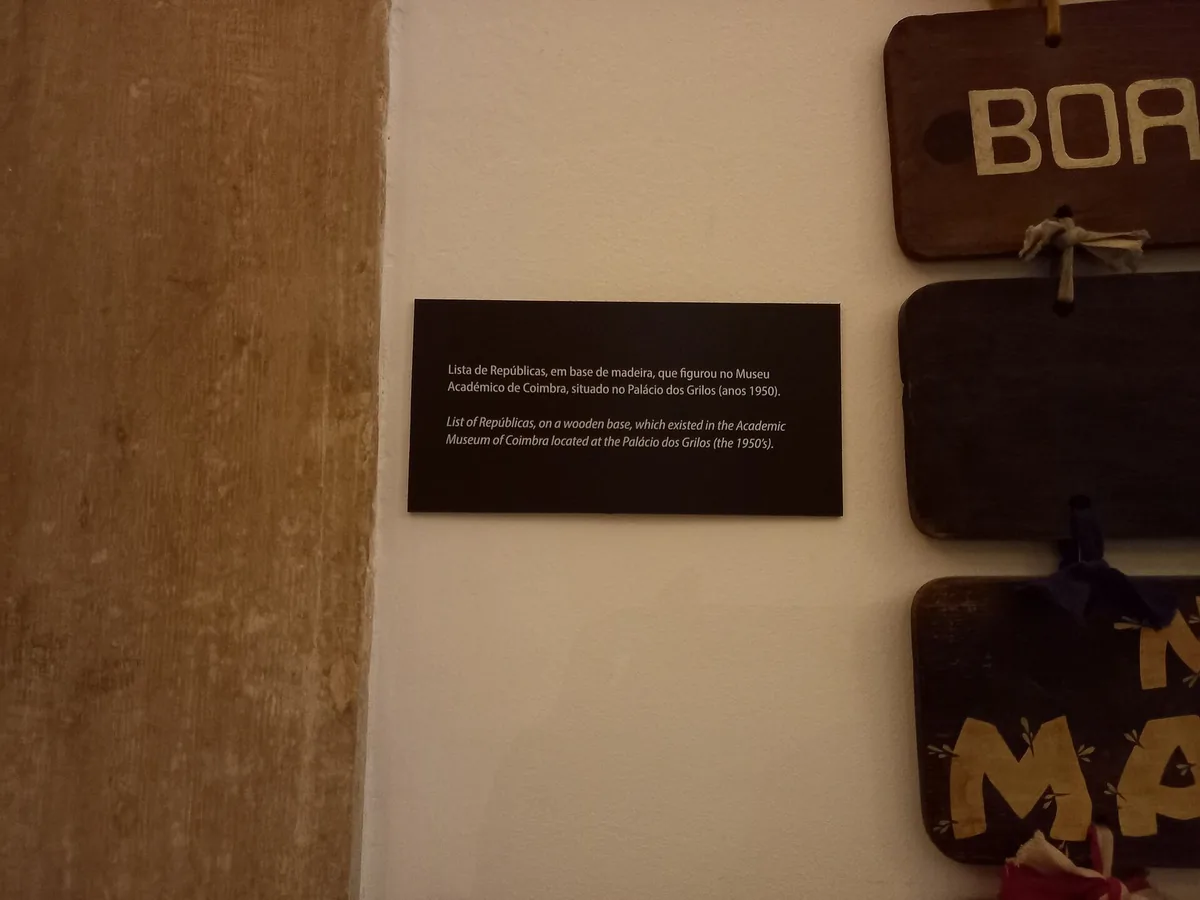
The repúblicas are the student houses, self-governing and inherited between cohorts, and they are the part of Coimbra’s student culture that has no equivalent in most countries.
All of this connects to the music. Fado de Coimbra is a serenade tradition sung by students, standing, outdoors — documented in these streets since the 16th century — and its subjects are longing for a woman, for the city and for the Academia itself.
The museum is where the objects behind all of that are kept. The Museu da Ciência has also been showing an exhibition on the same subject, Éfe-Érre-Á – Momentos da Vida Académica; confirm its dates on the museum’s own site.
The colours nobody can verify
Here is a gap worth knowing about, because you will find the missing information published confidently elsewhere.
Every faculty at Coimbra has a colour. The ribbons are in faculty colours, the parade floats are decorated in faculty colours, and the Royal Palace has rooms in faculty colours.
The University confirms exactly one of them: the Yellow Room is yellow in honour of the Faculty of Medicine, and its own text says the other rooms, each a different colour, represent the other faculties.
The full colour-to-faculty mapping is not published by the University or, as far as I can find, by the Associação Académica. The complete lists that circulate online — law red, letters dark blue, and so on — may well be right, but nobody official has put them in writing where I can check them.
So this page confirms Medicine is yellow and stops there. If you want the rest, ask in this museum or at the Associação Académica; both are better sources than a search result.
There is a second widely repeated claim worth the same treatment: that Coimbra fado audiences cough instead of clapping. I cannot find it stated by any official source. Ask a performer at a venue and attribute the answer to them.
Neither gap is a reason to distrust the tradition. They are a reason to distrust the internet’s confidence about it, which is a different thing.
How to visit
Buy any of the standard university programmes at the ticket office kiosk in front of the Faculty of Medicine, official GPS 40.207938, -8.424189, open 09:00 to 19:00, or online in advance.
Tickets are valid two days — only the Joanina slot is fixed to a printed time — so this museum is an easy second-morning addition if your first day ran out.
There are no refunds or exchanges on any programme, and only one entry per space.
Hours: every day 10:00–19:00, last admission 18:45. The museum gift shop nearby closes for lunch, 09:00–12:30 and 15:00–18:45.
Closure dates for the whole university circuit: 24 and 25 December 2026, 31 December 2026 and 1 January 2027, plus the movable academic days. The circuit shut on 24 May 2026 for Academic Week and closes again on 4 October 2026 for the Latada.
There is a real irony in that: the museum about student festivals closes for the student festivals. If you have come specifically for this subject, do not book parade week.
Reduced tiers for the self-guided programmes are not published online; the guided tour publishes 17.50 EUR for ages 6–25 and free under 6.
For the whole ticket structure compared programme by programme, read the guide to visiting the University of Coimbra.
What to combine
The Science Museum spaces are the same circuit and the same ticket: the Pombaline Chemistry Laboratory, the Cabinet of Curiosities and the Mineral Gallery. Its Natural History Gallery is closed.
Uphill, the Sala dos Capelos is where the degrees this whole culture leads up to are actually conferred, under 172 carved ceiling panels.
For the music, Fado ao Centro runs a 50-minute Coimbra fado show every day of the year at 18:00, 16.00 EUR for adults and free for Coimbra bachelor’s and master’s students, two a day.
For the verses, Penedo da Saudade is the clifftop garden east of the Alta where generations of students have left poems on the rock. Free, and no official hours are published, so go in daylight.
And for the written background: why the students wear black capes, and the Queima das Fitas guide for what the eight days actually involve.