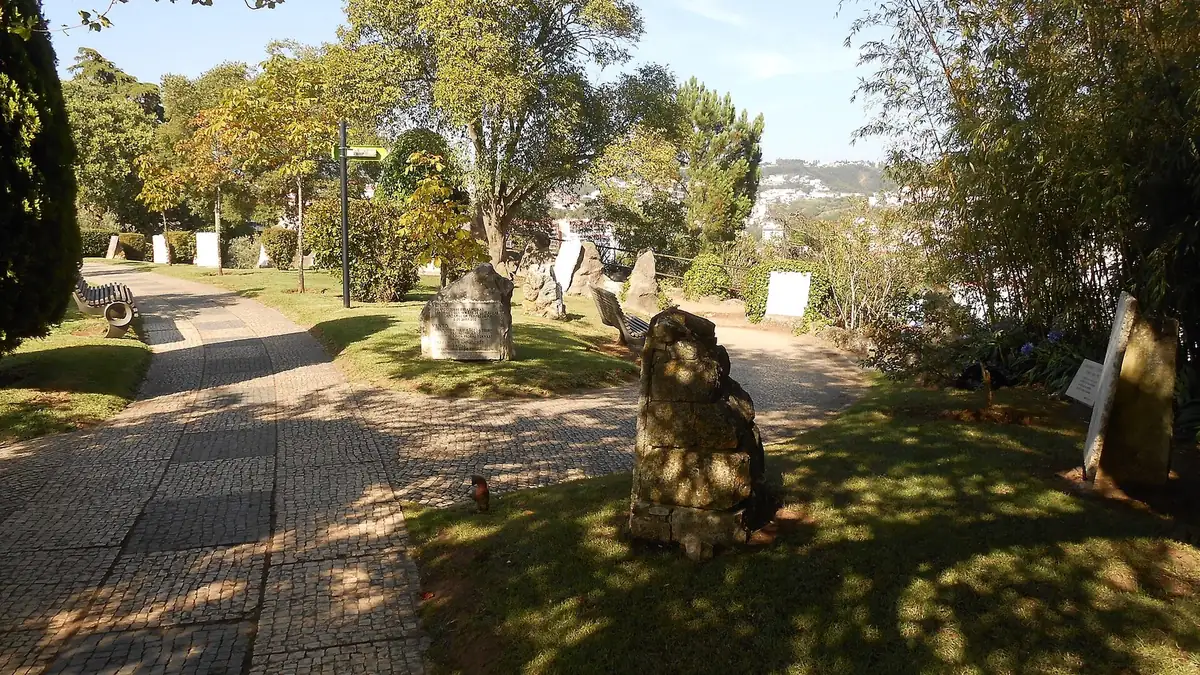

You climb away from the university, east, past faculty buildings and student flats, and the streets run out at a rock. The ground drops, the city rearranges itself below, and set into the stone faces and along the paths are plaques and carved lines: poems, fragments, names, dates. Generations of Coimbra students have been leaving verses here, which is why the place has a second name — the Jardim dos Poetas, the garden of the poets.
It is free, it is unenclosed, and it is about thirty minutes of your life. It is also the only place in Coimbra where the thing the students sing about is written down on the landscape. If you have been wondering what saudade actually means to people here rather than in a phrasebook, this is where to stand.
What is published, and what is not
Straight answer first, because it affects your plans. No official source publishes opening hours for the Penedo da Saudade.
The Câmara Municipal de Coimbra used to keep a parks-and-gardens page for it. That URL now 302-redirects to the city tourism portal’s homepage, and the record has gone with it. There is no replacement.
Which means the hours you will see in mapping apps — usually “open 24 hours” — are user-generated, not official. Somebody typed them in. They may be right. Nobody has confirmed them.
Same story with the price. It is an unenclosed municipal garden, so in practice it is free, and I have never heard of anyone being charged. But no formal statement to that effect is published, so this page says “free, unenclosed” rather than quoting a policy that does not exist online.
No official page for the garden exists either. If you want confirmation of anything here, the Câmara Municipal de Coimbra is the body to ask directly.
So the practical guidance is the honest one: go in daylight. A cliff-edge garden on the eastern side of a hill, reached through residential streets, is not somewhere to feel your way around after dark on the strength of an app.
That is not a safety warning about Coimbra, which is a calm university city. It is a warning about unlit drops and unpublished hours.
It is worth saying plainly that this garden is not a ticketed attraction and never has been. Nobody is managing your visit, nobody will tell you where to go, and the compensation for the missing information is that there is nothing to queue for.
Morning is best in any case. The garden faces the city, it is quiet on a weekday, and the light on the plaques is legible before the sun gets high.
This pattern is not unique to the garden. The same municipal reorganisation took down the records for the Parque Verde do Mondego and for several city churches, and nothing has replaced them.
So when a Coimbra guide gives you confident hours for a municipal park, ask where they came from. In most cases the honest answer is a cached page from several years ago.
What is verified for this site is small and worth stating: it is a clifftop garden east of the centre, its rock faces and plaques carry verses left by generations of Coimbra students, and its coordinates are 40.2052, -8.4148.
The verses
The garden’s subject is student writing, and the medium is the rock.
Plaques and inscriptions are set into the cliff faces and along the paths, carrying verses left by generations who passed through the University of Coimbra. Some are formal and dated; some are worn to the point of illegibility; some are recent.
Read a few properly rather than photographing all of them. The pleasure here is cumulative and slow, and the place has no signage telling you what to feel.
What you are looking at is an unusually literal version of something the whole city does. Coimbra’s student culture is built on inherited forms — the capes, the rituals, the songs, the republics — and every cohort adds to them without redesigning them.
A garden where students leave poems for the next students is the same instinct, made permanent.
It also explains the name. Penedo da Saudade is the crag of saudade, and saudade is the word Portuguese uses for longing for something absent — a person, a place, a version of your life that has ended.
For a Coimbra student, the thing that ends is the city and the Academia, not just a degree. That is what the songs are about, and it is what the verses on this rock are about.
If that sounds sentimental, stand here in late May when the Queima das Fitas is on. The same eight days mean farewell to the finalists and formal initiation to the freshers — the city council says exactly that — and this garden is where the first group comes to be quiet.
Coimbra is unusual among university cities in how much of its student tradition is public and physical rather than private and social. The capes are worn in the street, the songs are sung on cathedral steps, the parades close national monuments, and the poems are on a cliff.
Bring nothing. Read three or four. Go.
There is no curation here in the museum sense. Nobody has selected the best poems, translated them, or explained who wrote what. That absence is the character of the place.
It also means you will get more out of it if you read Portuguese, or if you are willing to sit with a translation app and one or two inscriptions rather than skimming the lot.
Saudade and the song
The music that goes with this place is fado de Coimbra, and it is not the fado you have heard about.
Lisbon fado came out of the urban poor and is sung sitting, indoors, as lament. Coimbra fado came out of the university, where the learned and the popular shared songs and stories from the start, and Turismo Centro de Portugal defines it as a serenade fado and a street fado — sung standing, outdoors, to someone.
Its lyrics come from poets who passed through the Academia, and the recurring subjects are longing for a woman, for the city, and for the university itself. Those are the three themes on the plaques in this garden, in the same order.
The instrument is different too. The Guitarra Portuguesa de Coimbra is teardrop-shaped and, in the musicians’ own phrase, tuned one tone lower than the Lisbon guitar. That is why Coimbra fado sounds darker, and it is a fact almost no guide carries.
Students have been singing in these streets since the 16th century. Augusto Hilário, author of the Fado Hilário, is the figure credited with immortalising the form, and over time it grew into the broader Canção de Coimbra.
The performance is described by the same official source as a solemn event, which is worth knowing before you attend one expecting a night out.
Where to hear it: Fado ao Centro on Rua do Quebra Costas runs a show every day of the year at 18:00, about 50 minutes, 16.00 EUR for adults and 9.00 EUR for ages 7–17, with a glass of port included. Advance booking is advised because seats are usually gone on the day.
The detail I like best: Coimbra bachelor’s and master’s students get in free, two a day, on production of a student card. The music is about them, and the venue lets them in for nothing.
And one caution. You will read that Coimbra audiences cough instead of clapping. It may be true; I cannot find it stated by any official source, so treat it as something to ask a performer rather than a rule to follow.
One more piece of geography that makes the tradition concrete: two of the fado venues sit on the same 120-metre stretch of the Rua do Quebra Costas, at numbers 7 and 12. The 18:00 show and a later one are a few doors apart on Back-Breaker Street.
And the city runs a museum about the instrument. The Torre de Anto on Rua de Sobre Ribas houses the Núcleo da Guitarra e do Fado de Coimbra, Tuesday to Saturday, 10:00–13:00 and 14:00–18:00 — part of the Museu Municipal and almost never listed in English.
How to visit
The garden sits east of the Alta, above Rua do Brasil, around Rua Antero de Quental. It is a walk from the university rather than from the Baixa, and it is uphill from almost everywhere.
Allow fifteen to twenty minutes on foot from the Paço das Escolas, more if you are coming up from the river. It is residential streets the whole way, not a signposted tourist route.
There is no gate, no desk, no ticket and no leaflet. You arrive, you walk in, you read.
The garden has no facilities of any kind — no toilets, no water fountain, no bench-side kiosk. Treat it as a viewpoint with poems rather than as a park with services.
Thirty minutes covers it comfortably. An hour if you sit, which is a good use of an hour.
Go in daylight, for the reasons above. Morning light is best on the inscriptions.
Wear something with grip. It is a rock garden on a slope, and Coimbra’s paving is uneven almost everywhere.
Accessibility is poor and unpublished. The approach is uphill and the garden itself is terraced around rock faces. No accessible route is documented.
Coimbra’s transport changed on 10 September 2026, when the Metrobus began running to Coimbra-B and Praça da República, so check the city’s live mobility information rather than an older guide — the current picture is in getting around Coimbra.
And take nothing for granted about hours. If the light is going, come back tomorrow morning.
Combine it with the walk rather than treating it as a destination. From here you can drop back down into the Alta, pick up the Alta to Baixa descent and be at the cathedral within twenty minutes.
There is no food up here. Eat before you climb, or plan to eat in the Baixa afterwards.
When to come
Term time, if you want the place to mean anything. Coimbra empties in August and the student city goes with it.
Spring and autumn are the seasons. The garden is exposed, the summer sun is hard on an east-facing slope with limited shade, and winter afternoons here are short.
Weekday mornings are the quietest. This is not a coach-tour stop — it is off the standard circuit entirely — so “busy” here means a handful of people.
Late May is the most charged time of year, when the Queima das Fitas runs for eight days, one per faculty. The 2026 edition was 22–30 May. 2027 dates are not yet published, so do not assume a fixed week.
Early October brings the Latada, the freshers’ counterpart, and it closes the whole university tourist circuit for a day — 4 October in 2026.
If you are here for either, know what it does to the rest of your plans: the university circuit shuts, and Santa Cruz closes on both parade days too.
August is the exception to everything above. The students are gone, the city is hot, the garden has no shade worth the name, and the whole point of the place is somewhere else for a month.
The quietest and most beautiful version of this garden is a Tuesday morning in October with the term under way and nobody else about.
The loudest version is the night of the Serenata, when the students are down on the steps of the Sé Velha instead and this hillside is empty.
One more seasonal note: rain makes the rock slick and the paths uncertain, and there is very little shelter. This is a fair-weather half hour rather than a wet-afternoon option.
What to combine
Downhill, fifteen minutes, the university: the Paço das Escolas, whose courtyard is free, and the Joanina Library on its fixed timed slot.
Also on that ticket and directly relevant to this garden: the Museu Académico, which covers the capes, the rituals, the republics and the Queima, and is included at no extra cost in the standard university programmes.
For the view rather than the verses, note that the University Tower is closed with no reopening date. This garden and the courtyard balustrade are the free alternatives.
For the music, Fado ao Centro at 18:00 on Rua do Quebra Costas, or àCapella at 21:30 on Largo da Vitória — its prices are not published anywhere, so ask before you sit down.
Downhill and east of here the city thins out into residential Coimbra, which is worth a wander if you have time and no agenda. It is the part of the city that has no monuments in it and tells you most about what living here is like.
And for the background reading that makes this whole hillside legible, why the students wear black capes and the Coimbra fado guide.
If you want more green and less climbing, the Botanical Garden is free, 13 hectares, part of the 2013 UNESCO inscription, and open to 20:00 from April to September. It is the largest free thing in Coimbra by a wide margin.