
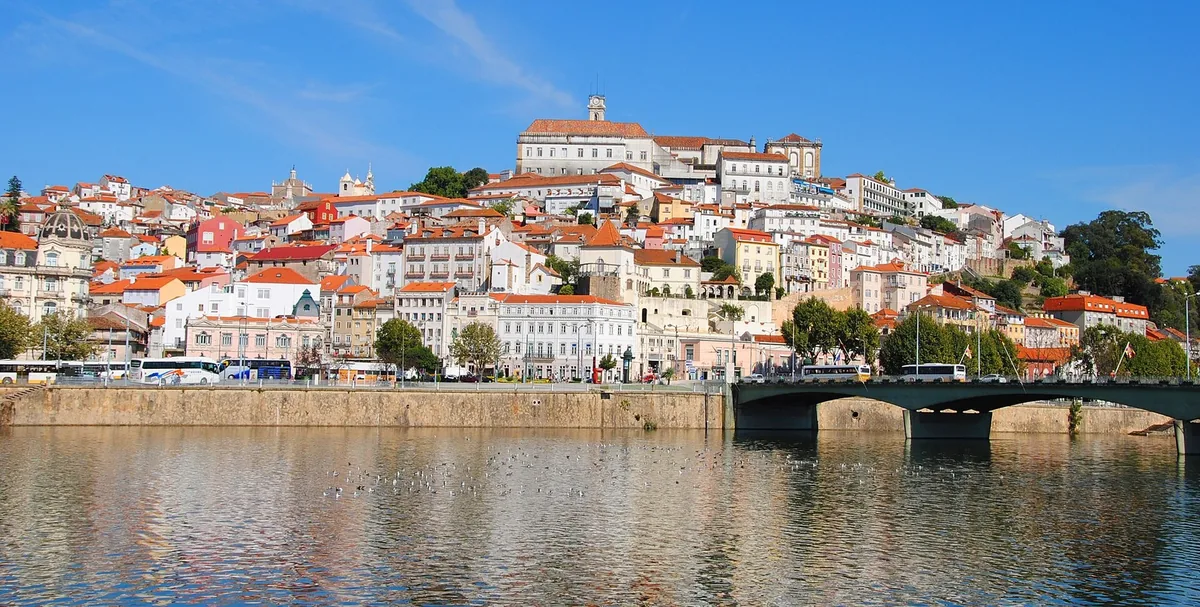
Coimbra’s historic city is two neighbourhoods stacked on top of each other. The Baixa is the flat lower town by the river, full of restaurants and shops. The Alta is the university hill above it, which holds the UNESCO inscription, the Joanina Library and the Old Cathedral.
Nothing in either is more than a short walk from anything else in plan view. Between them is a 51-metre climb. Choosing where to sleep in Coimbra is not a choice about location; it is a choice about which direction you want to walk when you are tired.
Alta: atmosphere, and the stairs that come with it
Sleep here and you wake up inside the World Heritage site. The university, the Old Cathedral and the Almedina gate are on the doorstep, and the quarter empties beautifully once the day groups leave. The trade-off is precise and worth stating the way a resident would: you will do less uphill walking while sightseeing and more of it every time you go down to eat and come back.
The best-placed budget bed in the city is up here. Serenata Hostel sits at Largo da Sé Velha 21–23, on the Old Cathedral square itself, in a restored early-twentieth-century building that was previously a maternity institute and then the city’s music conservatory. It has private rooms and suites as well as dorms.
For the view rather than the price, Sapientia Boutique Hotel on Rua José Falcão has a rooftop the hotel says gives 360-degree views over the university courtyard and the tower. Treat the hotel’s claim to be the only such viewpoint in Coimbra as marketing; the rooftop itself is real.
Two honest warnings. The Alta is noisy in university term, which is most of the academic year. And parking up here is awkward by every account we trust.
Baixa: the flat, practical choice
This is the right answer for most first visits, and particularly for anyone travelling with children, a suitcase or a knee. The lower town is flat, it holds the densest run of restaurant addresses in the city — Rua da Sota, Rua das Azeiteiras, Rua Direita, Praça do Comércio — and it puts you at the bottom of the lift rather than the top of the steps.
Hotel Astória is the landmark: a flat-iron building on the riverfront avenue, designed in 1919 by Adães Bermudes, interior by Francisco de Oliveira Ferreira in 1924, opened in 1926. Note the correction while you are here — it is routinely called Art Deco and the operator’s own history calls it Art Nouveau, which the dates support.
Also in the Baixa: Pharmacia GuestHouse, which kept the fittings of the pharmacy it used to be; CBR Boutique Hotel, whose design takes its cue from the Joanina Library; and Hotel Mondego with a rooftop terrace. We could not source addresses or star ratings for those three from an official page, so check their own sites before booking.
Santa Clara and the riverside
Across the Mondego is the quieter, greener option, and it is the one that makes sense if you are driving: easier parking and easier car access than anything in the centre. You give up atmosphere and gain a bridge.
Quinta das Lágrimas is the destination hotel here — an eighteenth-century palace, five stars, a member of Small Luxury Hotels of the World, with grounds the hotel describes as twelve acres, a spa and the Arcadas restaurant. The estate is the one where Inês de Castro was murdered in 1355, and the gardens are visitable separately.
On the riverside nearer the centre, Vila Galé Coimbra is the four-star at scale: 229 bedrooms, an indoor and an outdoor pool, a spa, two restaurants and a kids’ club. It is the least characterful bed in this guide and the easiest one to travel to with a family.
This bank also puts you next to Portugal dos Pequenitos, which matters if you are travelling with children. Note that Santa Clara-a-Velha, the other reason to be over here, has been closed since October 2025.
When you have to book early
Two dates in the year are not negotiable, and both are student festivals rather than anything in a normal travel calendar.
The Queima das Fitas runs eight days in May and is described by the city council as the largest student festival in Europe; the 2026 edition ran 22–30 May. The Latada is its autumn counterpart, straddling late September and early October — the 2025 edition ran 29 September to 5 October. On the parade days of both, the university’s entire tourist circuit and the Santa Cruz monastery close completely.
2027 Queima dates and the 2026 Latada dates were not published when this page was written. That is a real gap and we are not going to invent a pattern from it. If you are booking for late May or the first week of October, check the university’s own closure list before you pay for anything.
The other date to know is 4 July, Coimbra’s municipal holiday and the feast of the Rainha Santa Isabel, which closes some state monuments outright.