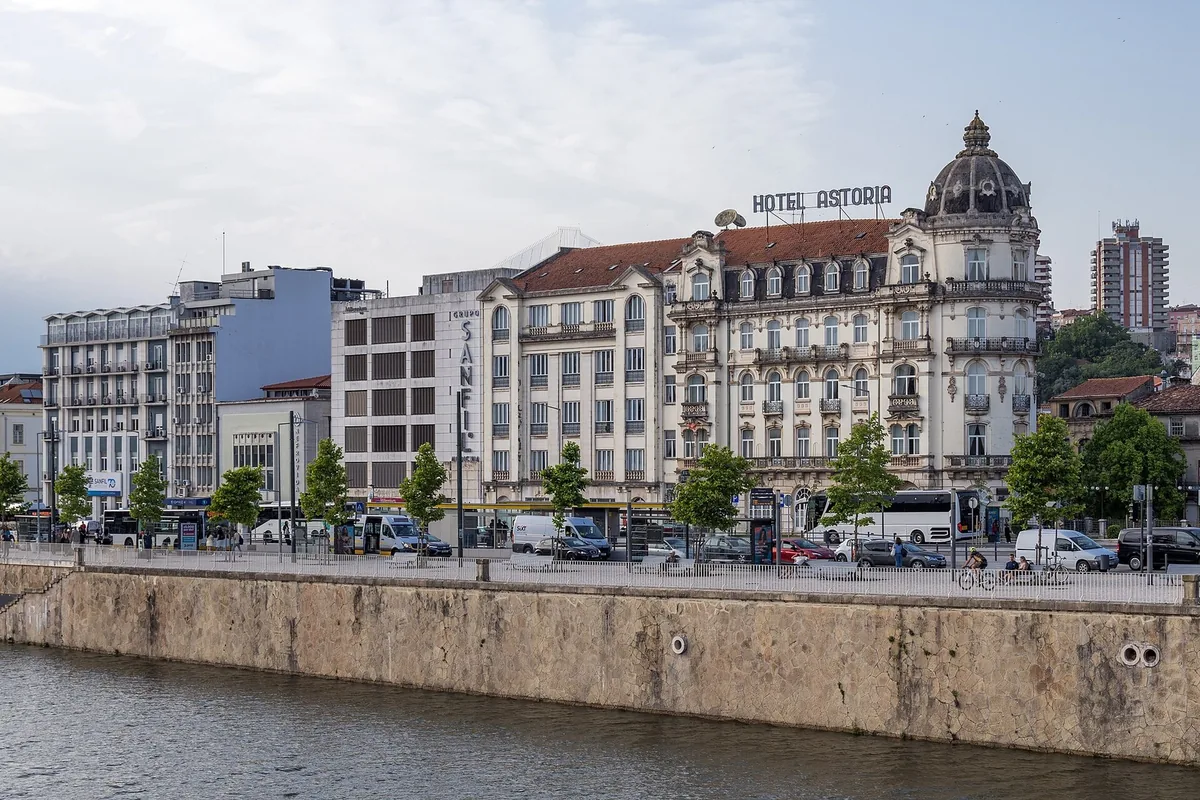

The Astória sits where the riverfront avenue meets the corner of the lower town, and it is shaped by that corner: a flat-iron block, curved at the prow, with the Mondego on one side and the Baixa behind it. Inside the lobby there is stained glass, subway tile, pale wood and wrought iron, and dark wooden furnishings and marble that the operator states are original. It is the most photographed hotel front in Coimbra and almost everyone mislabels it.
The dates: the building was designed in 1919 by the architect Adães Bermudes, the interior hotel design was carried out in 1924 by Francisco de Oliveira Ferreira, and it opened in 1926. The operator, Almeida Hotels, describes the style as Parisian Art Nouveau with eclectic Art Nouveau detailing. Not art deco. The dates support the operator, and this page follows the operator.
Art Nouveau, not art deco
This is a small correction that matters, because it is repeated everywhere and it changes what you are looking at.
Art Nouveau is the movement of curves, whiplash lines, botanical motifs, stained glass and wrought iron, roughly 1890 to 1914 in its heartland and running later at the European periphery. Art deco is the movement that replaced it: geometry, stepped forms, chrome, speed, from the mid-1920s onward.
A building designed in 1919, fitted out in 1924 and opened in 1926 sits exactly on the seam, which is why the confusion persists. But the operator’s own history page says Art Nouveau, the lobby elements it lists — stained glass, wrought iron, pale wood — are Art Nouveau vocabulary, and the design date of 1919 precedes deco entirely.
Look for the curves rather than the angles and you will see it. Then walk next door: the operator links the building with the adjacent Banco de Portugal, also by Bermudes, and the two read as one project by one hand.
It matters beyond pedantry because of what it tells you about the city in 1919. Coimbra was building a modern hotel on its riverfront at the moment Portugal was inventing itself as a republic, in the style of Paris rather than of Lisbon, next to a national bank branch by the same architect. The Astória is a small piece of civic ambition, not just a nice frontage.
What the operator claims
One claim is worth flagging as a claim. Almeida Hotels states that the Astória was the first hotel in Portugal to offer in-room telephones at opening. That is the operator’s own assertion and we have not independently verified it.
It is plausible. A 1926 grand hotel on a provincial riverfront, built by a serious architect for a city with a national university, is exactly the kind of project that would have bought the newest thing available. But “first in Portugal” is a superlative, and superlatives are where guides go wrong.
Several things the hotel is well known for are also simply not published. Its star rating is not on the history page. The restaurant is not named. No notable guests are listed, despite the hotel’s long-standing reputation for having hosted them. Those are gaps in the record rather than absences in the building.
We flag them because the pattern repeats across Coimbra. The city’s landmark businesses document their history carefully and their operations barely at all — the same is true of Café Santa Cruz, which publishes a century of dates and no opening hours.
The location, and why it is the practical choice
Avenida Emídio Navarro runs along the river at the foot of the lower town, which puts the Astória on flat ground within a couple of minutes of everything in the Baixa.
That is the whole argument for this address over the hill. The shopping spine of Rua Ferreira Borges starts at Largo da Portagem beside you; the restaurant lanes are five minutes; the bridge to Santa Clara is at the end of the block; and the Coimbra-A station is at the river end of the same quarter.
The climb to the Alta is still a climb, but you can hand most of it to the Elevador do Mercado, which rises 51 metres in two stages and runs Monday to Saturday 07:30–21:00 and Sundays and holidays 10:00–21:00.
If knees, luggage, children or a short stay are factors, this quarter is the right answer and this is its landmark building. The full comparison is in where to stay in Coimbra.
What is not published
No room rate appears on this page. We did not seek rates and we do not invent them. Get the current figure from the hotel on +351 239 853 020 or from a booking channel on the day.
Also missing from everything we read: the star rating, the number of rooms, check-in and check-out times, the name of the restaurant, whether breakfast is included, and the parking arrangements — which matter on a busy riverfront avenue.
What is unusually well documented, by contrast, is the building itself: architect, design year, interior designer, opening year, style, lobby materials and the link to the neighbouring bank. For a Portuguese hotel that is a rich record, and it is the reason to choose this one over a comparable modern room.
You are, in the end, booking a 1926 interior. Ask for a room in the original part of the building when you reserve, because that is the thing you came for and nobody publishes which rooms it applies to.