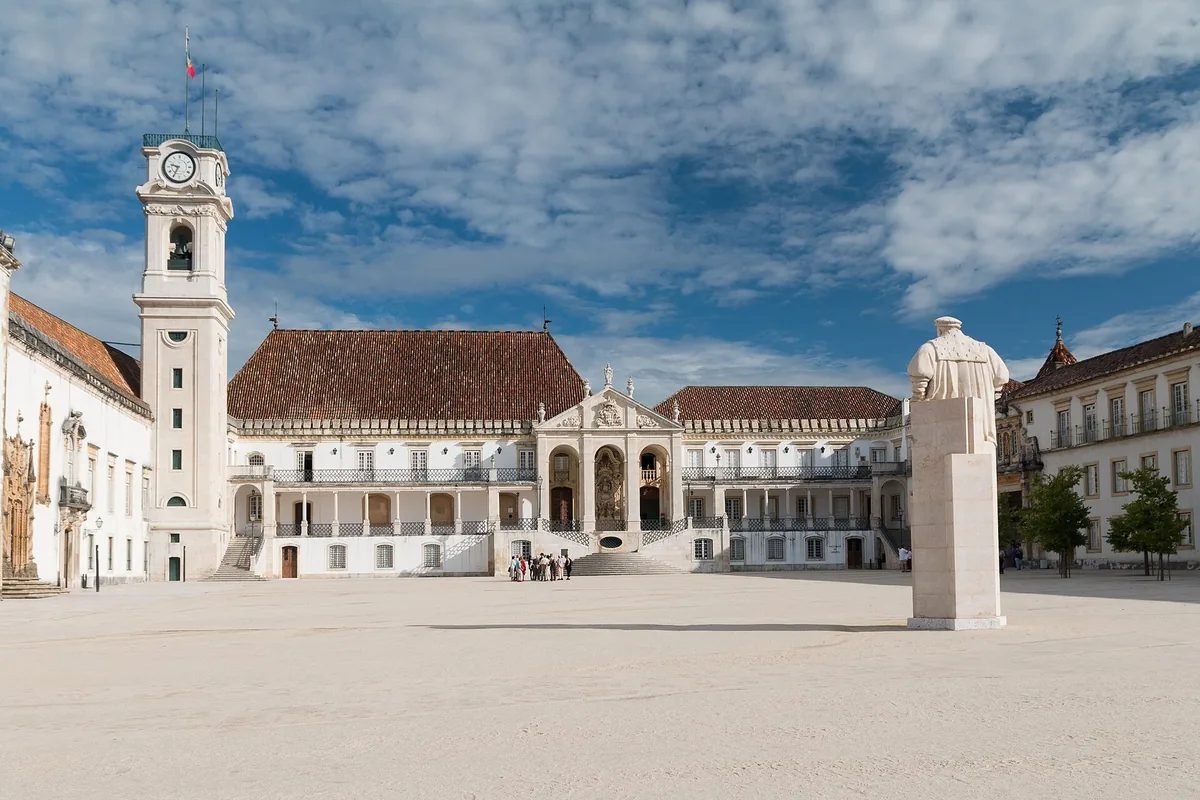
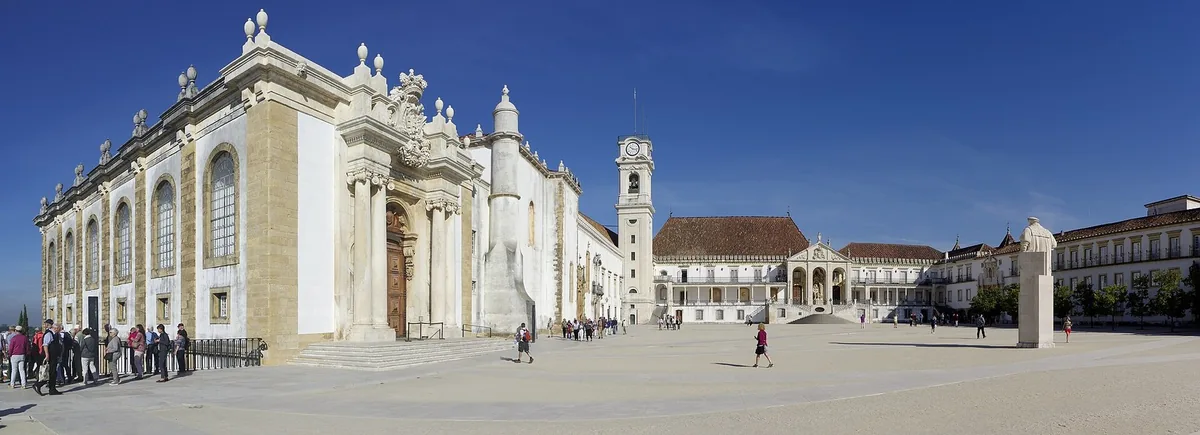
The courtyard is free. You can walk up through the Alta, through the arch, and stand in the Paço das Escolas with the Via Latina colonnade on one side and the clock tower above you, and it costs nothing. Most people who photograph the University of Coimbra have done exactly that and no more.
Everything behind the doors is ticketed, and the ticketing is the part that confuses visitors, because it is not organised the way you expect. There is no Joanina Library ticket. There never has been. The library is sold inside combined programmes, and Turismo UC currently runs six of them, priced from 10.00 to 25.00 EUR, all valid through 31 December 2026.
This page sets out what each one opens, which of them are traps, and the single rule that governs the whole day: the time printed on your ticket is the time you enter the library building, and a visit outside that time will not be allowed.
The six programmes
All of these are sold by Turismo UC. Prices are the published adult rate.
| Programme | Adult | Stated duration |
|---|---|---|
| Joanina Library + University + Science Museum | 16.50 EUR | 3h |
| University + Science Museum (no Joanina) | 12.50 EUR | 2h30 |
| Guided Tour to the Palace of Schools | 25.00 EUR | 1h30 |
| Science Museum + UC Exploratório | 16.00 EUR | 3h |
| Guided Tour to the Botanical Garden | 10.00 EUR | 1h30 |
| Guided Tour to the Botanical Garden Greenhouse | 10.00 EUR | 1h |
Most visitors want the 16.50 EUR programme. It is the only self-guided ticket that includes the Joanina Library, and the university’s own stated average for it is three hours across two days if you want to split it.
The 25.00 EUR guided tour is a different product, not a premium version. It is 1h30 with a guide covering the Joanina, the Royal Palace and St Michael’s Chapel; the Science Museum spaces are not guided but remain freely accessible on the same ticket. It leaves from the ticket kiosk at 11:00 and 15:00 in Portuguese and English, subject to guide availability, and it can only be booked up to three months ahead “due to the large influx of bookings”. It publishes the only reduced tiers the university shows online: youth 6–25 at 17.50 EUR, under 6 free.
The 16.00 EUR Science Museum + Exploratório programme is the trap. It costs almost the same as the 16.50 EUR ticket and it explicitly excludes the Palace of Schools. Buy it by mistake and you have paid full price for everything except the reason you came. The Exploratório also keeps different hours — Tuesday to Sunday, 10:00–13:00 and 14:00–18:00.
And a gap we will not fill. Reduced tiers for the self-guided 16.50, 12.50 and 16.00 EUR programmes are not published on the public pages; they appear only inside the booking flow. Figures circulating on aggregator sites could not be reproduced from the university, so we are not printing them. Start a booking, or email [email protected].
What the ticket actually opens
People routinely buy the 16.50 EUR ticket, see the library, and leave with two-thirds of it unused. This is what is on it.
The Royal Palace circuit. The Paço das Escolas is three linked spaces: the Armoury with its adjoining Yellow Room, lined in yellow silk in honour of the Faculty of Medicine; the Great Hall of Acts; and the Private Examination Room. The building began at the end of the tenth century as a fortress for the city’s governor under Islamic rule, became the first Portuguese royal household in 1131 under Afonso Henriques, and passed to the University permanently in 1544. Three regimes in one doorway.
The Sala dos Capelos, the Great Hall of Acts, is the former throne room and the ceremonial hall where doctorates are still conferred. Its wooden ceiling carries 172 panels of grotesque motifs, and its walls carry portraits of every Portuguese king from Afonso Henriques to Manuel II with one deliberate omission: the Philippine dynasty of 1580–1640 is simply absent. Sixty years of Spanish Habsburg kings, not on the wall. John I was proclaimed in this room in 1385.
The Private Examination Room next door carries portraits of 38 rectors from the sixteenth to eighteenth centuries, each captioned with the exact number of days, months and years he led the university. The old private examination was an oral test taken at dusk, with only the candidate and the professors present, and it was abolished under the Marquis of Pombal. Ceiling dated 1701.
St Michael’s Chapel holds blue-and-white tiles laid in 1613 and an eighteenth-century gilt altarpiece, and a stone plaque recording the oath of 1646, when John IV offered the Crown of Portugal to Our Lady of the Immaculate Conception. From that moment Portuguese monarchs stopped wearing a crown. A plaque in a university chapel is the reason.
The Science Museum side — the Pombaline Chemistry Laboratory in the old Jesuit refectory, the Cabinet of Curiosities, the Mineral Gallery, the Physics Cabinet and the Museu Académico — is included in all the main programmes and is the part nearly everybody skips. The Academic Museum covers the black capes, the ribbons and the student republics and costs you nothing extra. Note the Natural History Gallery is closed.
The Exploratório, the Ciência Viva science centre included in the 16.00 EUR programme, is a genuinely good thing in the wrong bundle: the CriaAtividade space and a 360-degree film in the Hemispherium digital planetarium, on hours of its own — Tuesday to Sunday, 10:00–13:00 and 14:00–18:00. With children it may be the best purchase the university sells. Without them, and if the library is why you came, it is the wrong ticket.
The Botanical Garden is free and is not on any ticket. Thirteen hectares, part of the same 2013 inscription, ten minutes downhill. The 10.00 EUR guided tours are optional extras, not admission.
The Joanina slot, and the rules around it
This is the single most important paragraph on the page, and the one most competing guides get wrong.
Entry to the library building is limited to 50 people every 20 minutes. That is the university’s current published text. The figure you will see on aggregator pages — ten people every five minutes — does not match it. Plan around fifty and twenty.
The date and time on your ticket is the time you enter the library, and only that. Everything else on the ticket can be visited before or after, and the ticket is otherwise valid for two days. But a visit outside the stipulated time will not be allowed, and there are no exchanges and no refunds on any programme.
You enter through a prison. The university’s own booking text: “Entrance to the Baroque Library building is through the Academic Prison.” The Prisão Académica occupies the ground and middle floors of the same building, is of medieval origin, and is the oldest preserved prison in Portugal. Give it five minutes rather than two: on the Middle Floor the stones of the arch still carry the individual chisel marks of the masons who cut them, each man’s signature, used to count his work so he could be paid.
Only one entry per space. You cannot step out of the Joanina, take a call in the courtyard and go back in.
Online sales close 20 minutes before entry for the combined ticket, and two hours before for the guided tour and the Exploratório programme.
How far ahead slots sell out is not published. The university releases no data on it, and we are not going to invent a number. The only hard signal is that the guided tour is capped at three months’ advance sale because of booking volume. If your dates are fixed, buy when you book the trip.
If the slots are gone for your date, the 12.50 EUR University + Science Museum programme covers everything on the 16.50 EUR ticket except the library. It is not a consolation prize — the Sala dos Capelos alone justifies it — but be clear with yourself that you are buying a campus rather than a library.
Hours, and the two days a year it all shuts
Palace of Schools: every day 09:00–19:30. Last entrance to the Joanina 19:00; last admission to the other spaces 19:15.
Science Museum spaces: every day 10:00–19:00, last admission 18:45. Note the mismatch — they open an hour later and close half an hour earlier than the Palace. If your library slot is late afternoon, do the museum side first.
Ticket Office Kiosk: every day 09:00–19:00, in front of the Faculty of Medicine. Its official GPS is 40.207938, -8.424189, which is worth putting into a phone, because the Alta defeats most map pins. Shop hours differ between the two sites: the Palace of Schools shop runs 09:00–19:15, the museum shop 09:00–12:30 and 15:00–18:45.
St Michael’s Chapel closes every Sunday 11:45–14:00 for mass, and for occasional religious ceremonies.
Published closure dates for this cycle: 24 and 25 December 2026, 31 December 2026 and 1 January 2027 — plus two movable academic days. The whole circuit closed on 24 May 2026 for Academic Week during the Queima das Fitas, and closes again on 4 October 2026 for the Latada. A student festival closes a World Heritage site twice a year. Check the university’s information page before booking anything in late May or early October.
Two further closures on the same ticket. The University Tower is closed, stated plainly by the university, with no reason and no date; the 184-step climb and its under-6 age bar are on record but currently theoretical. And twice every three months the Cabinet of Curiosities and Physics Cabinet close for disinfestation — if your ticket falls on one of those days you may use it on following days, but there is no refund.
Photography and the house rules
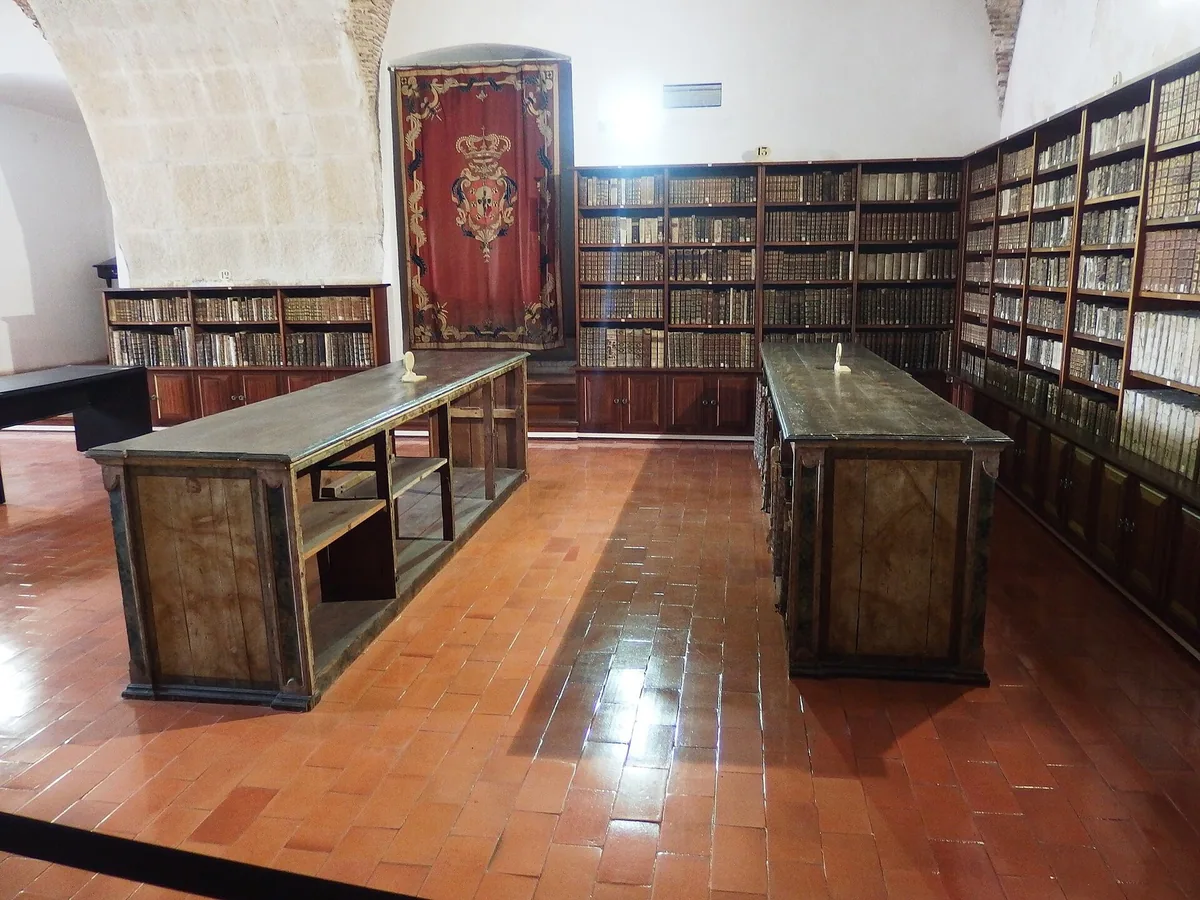
Photography and filming are prohibited on the Noble Floor of the Joanina Library. Read that twice. The gilded halls that brought you here are the part you cannot photograph, and this is the rule visitors most reliably fall foul of.
You may photograph the rest of the circuit. Flash is banned everywhere in the visiting spaces, as are tripods and selfie sticks. Drones require prior authorisation, and any commercial or academic use of images does too.
The ban is not squeamishness. The Noble Floor is a controlled environment held stable by mass and habit rather than machinery — walls 2.11 metres thick, oak shelving chosen for an odour that repels insects, two colonies of bats eating what gets in — and the university moves fifty people through it every twenty minutes. A room where everyone stops to frame a shot is a room where the slot collapses.
Plan for it rather than resent it. Twenty minutes without a camera in your hand is a different and better visit, and the postcards in the Palace of Schools shop are shot by people with permission and lighting.
Other house rules: no animals except service dogs; no smoking; no eating or drinking; no dangerous objects. The university asks visitors with walking difficulties, dizziness or heart conditions to take the stairs carefully, which is fair warning in a building whose circulation is largely original.
What you can photograph freely: the courtyard, the Via Latina colonnade, the tower from below and the view out over the river — all of it outdoors, all of it free, none of it ticketed. If you only want the picture, you do not need a ticket at all, and we would rather say that than sell you one.
Building a day around the ticket
Work backwards from the slot. It is the only fixed point.
Pick the Joanina time first, ideally the 09:00 opening or the last hour before 19:00, then hang everything else off it. The two-day validity is the quiet kindness in the whole structure: do the library and the palace on an afternoon, and the Science Museum side the next morning when you are fresh.
Arrive ten minutes early. Entry is batched and late arrivals are refused. The kiosk queue in front of the Faculty of Medicine moves slowly in July.
Bring a layer, even in August. Those 2.11-metre walls hold the interior cold and dry all summer, and you will be standing still in it for twenty minutes after walking uphill in thirty-five degrees.
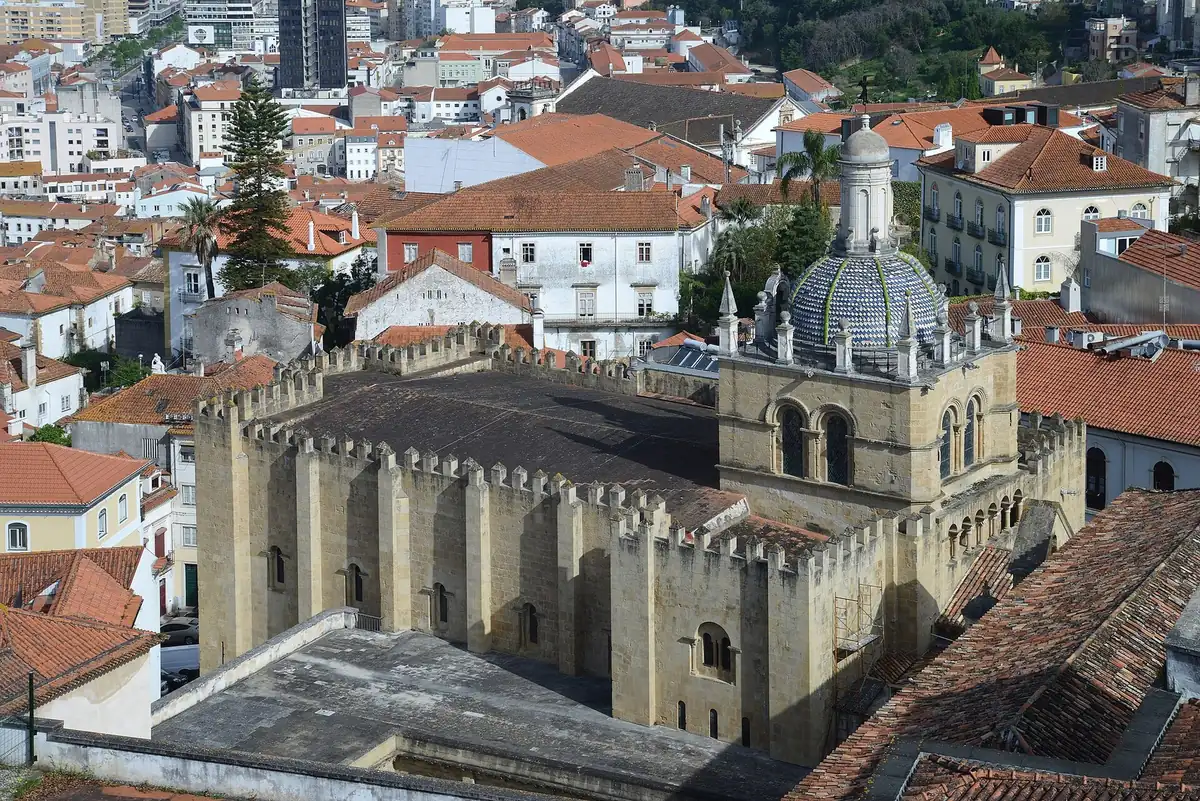
Then walk downhill. The Sé Nova is a minute from the ticket kiosk and costs 1.00 EUR, the cheapest interior in the Alta. The Sé Velha is fifteen minutes down the hill at 3.00 EUR. The Alta to Baixa descent is the route, and it ends at the royal tombs in Santa Cruz.
Know what is shut before you walk to it. The Museu Nacional Machado de Castro, five minutes from the kiosk beside the Sé Nova, has been closed since February 2026. Santa Clara-a-Velha across the river has been closed since October 2025. Neither publishes a reopening date, and the honest verdict page starts with both.
Getting up here. The Elevador do Mercado rises 51 metres in two stages, Monday to Saturday 07:30–21:00 and Sundays and holidays 10:00–21:00. Use it and arrive at your slot without a shirt full of sweat.
And spend the ticket you have already bought. Nearly everyone walks out of the Joanina, photographs the courtyard and leaves, having used one space on a ticket covering nine. The Museu Académico, the Cabinet of Curiosities, the Mineral Gallery and the Chemistry Laboratory are all on it, they run thirty to forty-five minutes each, and they are the difference between seeing a famous room and understanding the institution that built it.
For the whole day in order, the one-day itinerary is built from these published hours rather than from optimism.