
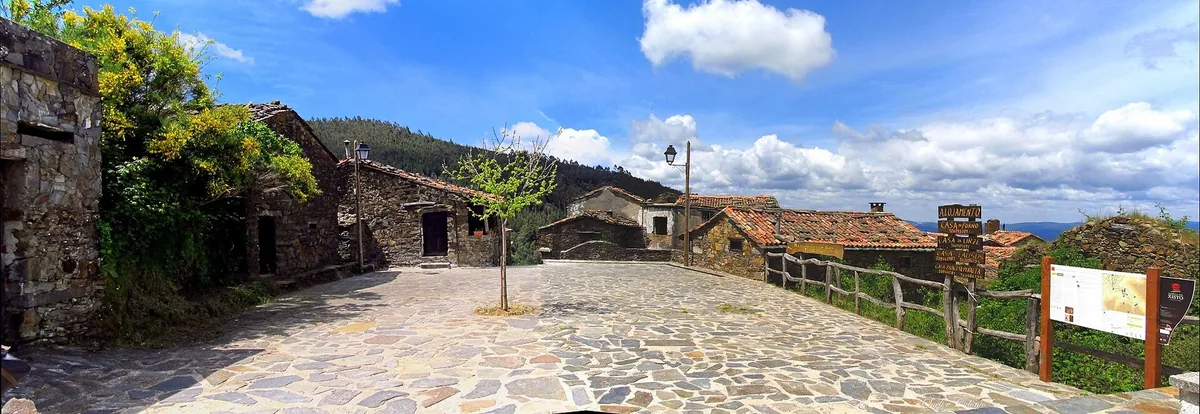
A mountain town below the Serra da Lousã, with a castle, river beaches, and a cluster of restored schist-built hamlets in the hills above it — Talasnal, Casal Novo, Candal, Chiqueiro. Villages built entirely of the dark layered stone they stand on, largely abandoned in the twentieth century and restored since.
The reason this page exists now rather than five years ago is transport. The Ramal da Lousã railway closed in 2010. For fifteen years there was no rail-standard link from Coimbra. On 16 December 2025 the Metrobus opened on the converted alignment of that old railway — Portuguese coverage put it exactly: fifteen years after the end of the line. As of this month, Lousã is a public-transport day trip from central Coimbra for the first time in sixteen years.
What changed, in order
Three dates, all sourced, and they matter because every competing guide still describes Lousã as car-only.
- 16 December 2025 — the Coimbra–Lousã Metrobus began running on the converted alignment of the old railway, fifteen years after the line closed.
- 24 January 2026 — the Lousã–Serpins section was interrupted by a landslide that destabilised the structure. Repair was estimated at 3 million EUR.
- 1 September 2026 — that section resumed.
And then the piece that joins it to your trip: since 10 September 2026 the Metrobus urban section also reaches Coimbra-B and Praça da República, so the suburban Lousã line now connects directly into the city centre and the mainline station. Weekday runs across the system went from 291 to 452.
That is a two-week-old transport situation. Anything published before this month describes something else.
What we cannot tell you
The timetable, the fare and the journey time are all unpublished as far as we could reach. Metro Mondego’s own site returned no content when we fetched it on 15 September 2026.
We are not going to estimate a journey time for a service that opened nine months ago and had a section closed for seven of them. Get the current times from Metro Mondego or from the city’s mobility hub before you commit to a day.
This is a genuine limitation and it is the difference between “Lousã is reachable” and “here is your day”. What we can tell you with confidence is that the connection exists, that it runs on a dedicated former-railway alignment rather than in general traffic, and that it now reaches the centre of Coimbra.
For what the rest of the network does, see getting around Coimbra and the station guide.
The villages are a separate problem
Do not assume the Metrobus takes you to Talasnal. It does not. It reaches Lousã and Serpins — the towns on the valley floor and the old railway alignment.
The schist villages sit up in the Serra above, reached by steep mountain road. How you get from Lousã town up to Talasnal, Casal Novo, Candal and Chiqueiro is not something we could source, and we will not invent a bus or a taxi arrangement.
What we can say is the shape of the problem: it is a mountain road, public transport up it is limited or absent, and the realistic options are a taxi arranged in Lousã, a car, or walking up — the last of which is a hike rather than a stroll and needs planning we cannot do for you from here.
The villages themselves are inhabited settlements, not ticketed sites. There is no admission and no opening time; there are people living in them. Treat them as somewhere you are visiting rather than something you are visiting, and behave accordingly with cameras and doorways.
The food connection nobody makes
This is hill country and it produces the dish most visitors to Coimbra eat without knowing where it comes from.
Chanfana — old goat braised in red wine in a clay vessel in a wood oven — comes from exactly here. The documented origin claim is the Mosteiro de Semide, near Miranda do Corvo, where nuns received goat meat as rent and preserved it by cooking it in red wine. Three municipalities dispute primacy: Miranda do Corvo, Lousã and Vila Nova de Poiares, each holding an annual gastronomic week.
Do not repeat the Napoleonic origin story. The romantic version ties chanfana to the French invasions; the sourced account says those versions lack documentary support, and that the practical explanation — using up old goats past breeding age — is more plausible historically.
The same whole-animal tradition produced negalhos, tripe-based, alongside a wedding soup made with the chanfana broth and a dish from the goat’s feet. The municipal page defining negalhos returned a 404 when we checked, so a precise recipe definition is one of the gaps on this site.
Is it worth the day
Honestly: it depends on whether the transport question excites you or merely inconveniences you.
If you want a straightforward, well-signposted day out with verified times and a ticket price, take Conímbriga instead. The bus timetable is published, the site opens daily and admission is 10.00 EUR.
If what appeals is a mountain range, schist villages that were nearly lost, river beaches and a valley that spent sixteen years off the public-transport map, Lousã is the more interesting day and you should accept some improvisation. Go to the town, ask locally about getting up to Talasnal, and treat the villages as the bonus rather than the plan.
The alternative framing: Figueira da Foz for the coast, Buçaco for the forest, Aveiro for the canals. Lousã is the one for mountains, and now the one with a genuine news story attached.