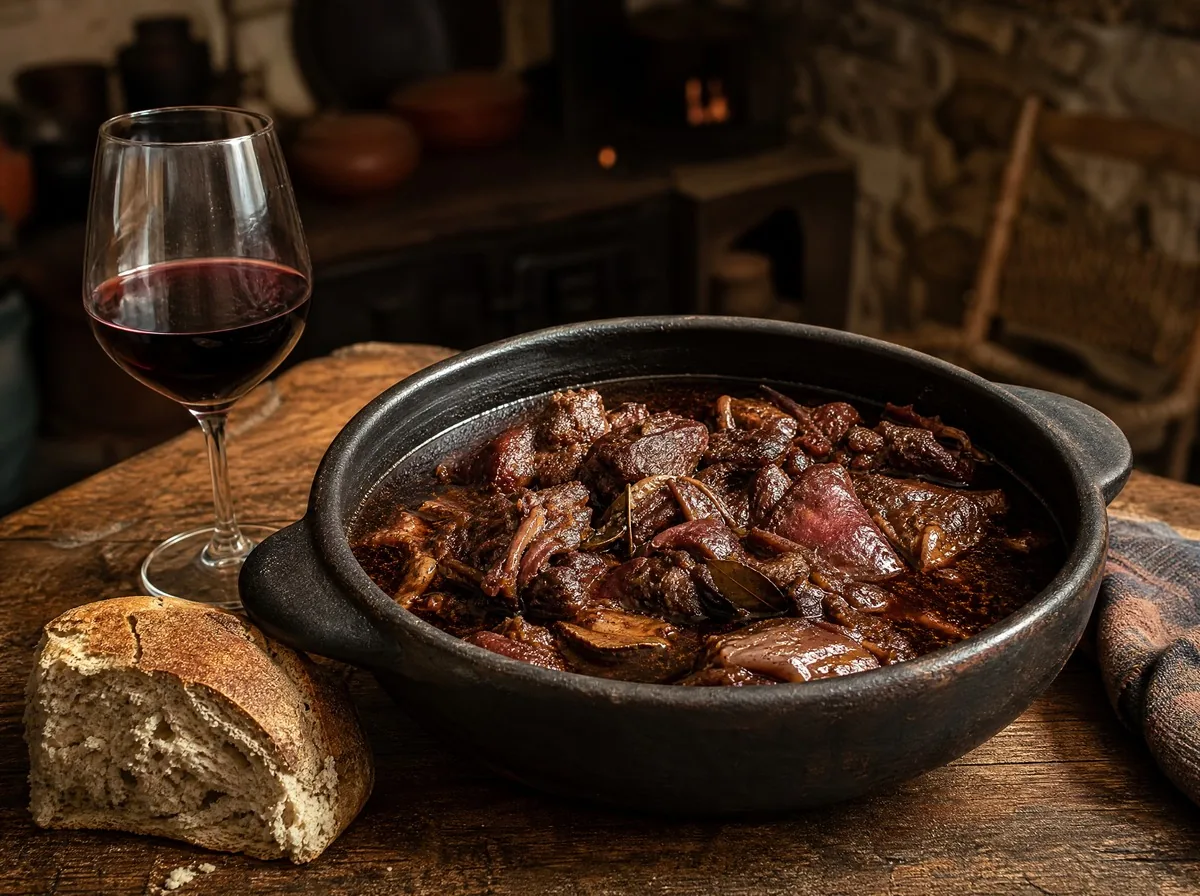

It comes to the table in the pot it cooked in: black clay, blistered from the oven, still ticking. Inside, dark meat under a surface of wine that has reduced to something between a sauce and a glaze. The smell is wine first, then garlic, then bay, then the animal. Put a fork in and the meat gives up without argument, which is the whole point, because five hours ago it would not have.
Chanfana is cabra velha — old goat, past breeding age — braised in red wine in a sealed clay vessel in a wood-fired oven. It is the great dish of the country south of Coimbra. It is not a Coimbra dish, whatever the menus in the lower town suggest, and the romantic story usually attached to it is not supported by the documentary record. Both of those are worth knowing before you order.
Where it actually comes from
The documented origin claim points to the Mosteiro de Semide, near Miranda do Corvo, in the hills south of Coimbra. The account is that the nuns there received goat meat as rent and preserved it by cooking it in red wine.
Three municipalities dispute primacy — Miranda do Corvo, Lousã and Vila Nova de Poiares — and each holds an annual gastronomic week devoted to the dish. That is a live argument, not a historical footnote, and it is a better guide to the dish’s home than any menu.
None of those three towns is Coimbra. They are in Coimbra district, in the schist hill country that rises south-east of the city, and the distance is roughly twenty to thirty kilometres. Coimbra restaurants serve chanfana and serve it well. Coimbra did not produce it.
If you want to eat it at home rather than in translation, the Lousã schist villages put you inside the disputed zone, among the stone villages and the goats that made the recipe necessary.
The Napoleon problem
You will be told, possibly by a waiter, that chanfana was invented during the Napoleonic invasions — that villagers cooked tough old goat in wine to feed the French, or to poison them, depending on who is telling it.
The sourced account says that story lacks documentary support. On-Centro, reporting on the origin question, states that the Napoleonic versions are undocumented and that the practical explanation is more historically plausible: goats past breeding age had to be used up, and long braising in wine was the technique that made them edible.
That is a less exciting story and a much more convincing one. Every peasant cuisine in Europe has a dish for the animal that has stopped earning its keep, and almost none of them needed an invasion to think of it.
We are printing the convent origin, the three-town dispute and the economic explanation. We are not printing the Napoleonic legend as fact, and a guide that does is telling you something about its research rather than about the dish.
What separates a good one from a bad one
Time, and nothing else. The technique has three variables and a bad chanfana fails on the first.
The cook. Old goat needs hours. A short braise gives you tough meat in thin gravy, which is what a lazy kitchen serves and what puts people off the dish for life. Properly done, the meat comes away with a fork.
The wine. It should taste reduced, not added — concentrated, slightly sweet at the edges, with the alcohol gone. If the sauce tastes sharply of wine, it has not been in the oven long enough.
The vessel. Traditionally a black clay pot, sealed, in a wood oven. The clay holds and evens the heat and the seal keeps the liquid in. Restaurants that serve it in the pot are usually the ones that cooked it in the pot.
One further thing to expect: chanfana is gamey. Old goat is a strong meat and the dish does not hide it. If you want something mild, this is the wrong order, and there is no version of it that tastes like lamb.
Where to eat it in Coimbra
Two addresses in the city are documented by a named writer, and we will not add more from rumour.
A Cozinha da Maria, which the travel writer Ola Daniela calls the best chanfana she has ever eaten, banded €€. Note that two sources give two different streets for it — Praça do Comércio and Rua das Azeiteiras — which are ninety seconds apart.
Taberna Casa Costa, on Rua Augusto Filipe Simões, banded € by the same writer. Cheaper, and with no street number published.
A third name comes up constantly in the city — Zé Neto, on Rua das Azeiteiras — but no named source we read confirmed chanfana on its menu, so we have not listed it as a chanfana address. Ask when you get there.
Ask before you sit down. Chanfana is braised in batches in the morning and runs out. In the towns where it is a local institution it is a Sunday and festival dish, cooked when the oven is lit for a crowd; a city restaurant midweek is making a smaller pot.
The rest of the goat
Chanfana is one dish out of an animal, and the tradition that produced it used all of it.
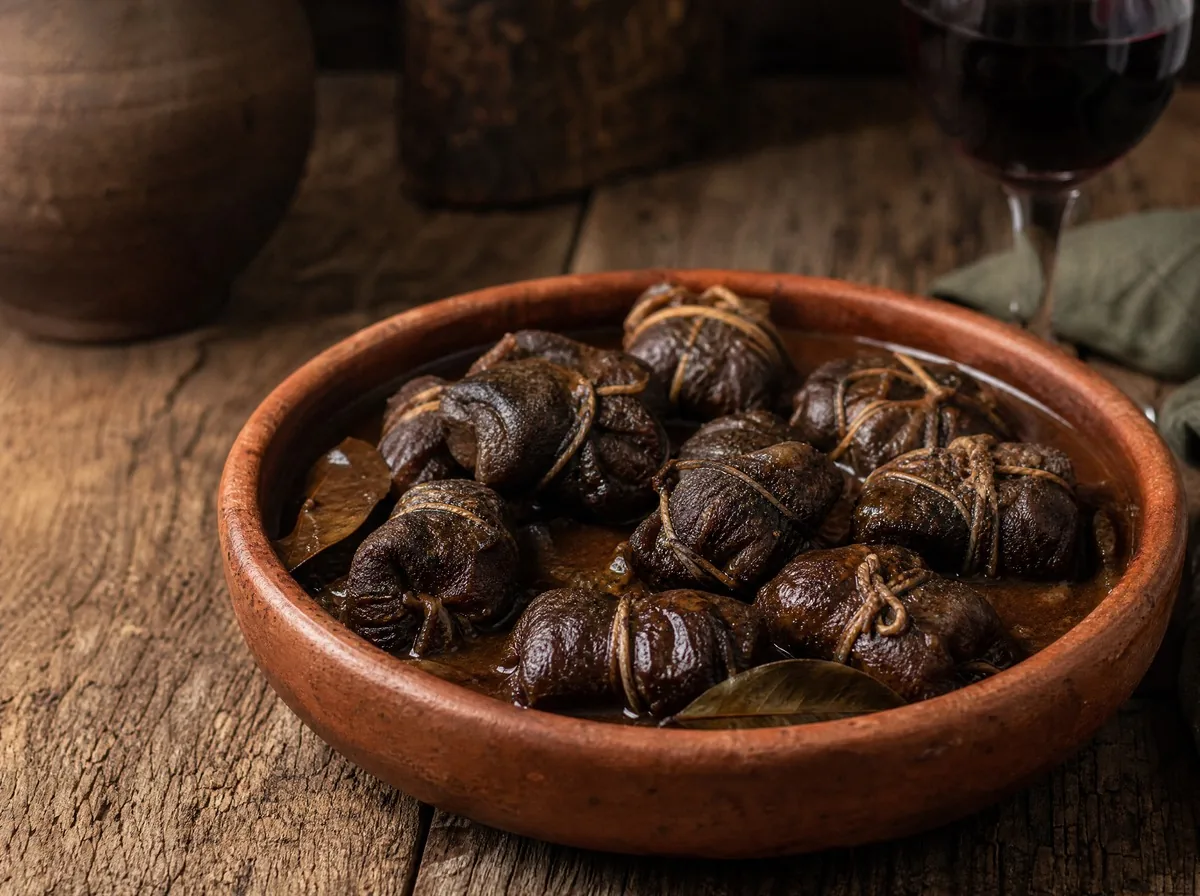
Negalhos are the tripe-based dish from the same hill country. Sopa de casamento — wedding soup — is made with the chanfana broth. Chispe comes from the goat’s feet. Together they are a complete accounting of a carcass by households that could not afford to waste any of it.
That is the honest context for chanfana, and it is more interesting than the Napoleonic story. This is not rustic charm; it is arithmetic. A goat that has stopped breeding is a liability, and this cuisine turned it into four named dishes.
What we could not find is a Coimbra restaurant documented as serving negalhos, and the Miranda do Corvo municipal page that would have defined them precisely returned a 404 when we tried it. Our page on them says so.
For the full sorting of which of this region’s dishes belong to the city and which do not, read what to eat in Coimbra.