
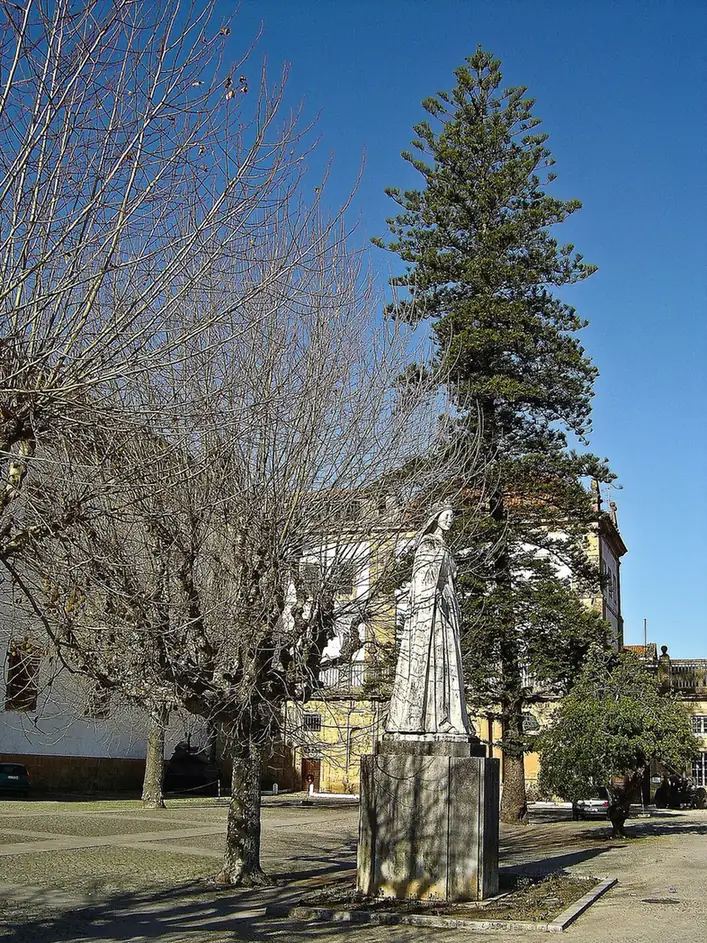
Coimbra’s patron is Isabel of Aragão, the Rainha Santa, who died on 4 July and whose body lies in a silver-and-crystal urn at Santa Clara-a-Nova on the hill across the river. July is her month, and the city takes the date seriously enough to make it a public holiday.
This is also the month where guides are most reliably wrong, in a way that will cost you a trip if you follow them. The religious processions run in even-numbered years, not odd ones. Get that the wrong way round and you arrive for a procession that is not happening.
The festival, and the even-year rule
There are two things running under one name. The Festas da Cidade — the secular city festival — run every year, even and odd. The religious festivities of the Rainha Santa Isabel, with the great processions, run every two years, in even-numbered years.
The 2026 programme ran 1–12 July: a triduum from 1 to 3 July with preaching at 21:30, the main feast on 4 July with an 11:00 Eucharist presided by the Bishop of Coimbra, the public procession at 18:00 on 9 July, and the closing Mass and return procession at 16:00 on 12 July. The pattern is a Thursday procession following 4 July, with the solemn procession three days later on the Sunday.
The next procession year is 2028. In odd years the city runs other traditions instead, including the Casamentos da Rainha Santa, the Queen Saint’s Weddings.
One wrinkle worth knowing, because it is the source of the confusion: 2025 had processions despite being an odd year, as a one-off for the 400th anniversary of the canonisation and 700 years of pilgrimage to Santiago. The Confraria’s own president described it as a special celebration “despite being an odd year” — which only makes sense if odd years are normally the off years.
What 4 July actually closes
A municipal holiday in Portugal is a closing day, not an opening one, and this is the practical warning of the month.
4 July appears on the annual closure lists of the state monuments — the Machado de Castro museum and Santa Clara-a-Velha both list it alongside 1 January, Easter Sunday, 1 May and Christmas Day. Both happen to be closed indefinitely for works anyway, but the rule tells you what a municipal holiday means here.
The Torre de Almedina museum, inside the Almedina gate, closes on public holidays as well as Sundays and Mondays. Assume the municipal museum network is shut on 4 July.
What is open: the university circuit, whose published closure list for this cycle covers Christmas, New Year and the two student parade days but not 4 July. And the Botanical Garden, free and open to 20:00.
Where to go for the Queen
If the processions are why you came, the destination is Santa Clara-a-Nova, the hilltop monastery the Poor Clares moved to when the river drove them out of the old house in 1677. Visits run 08:30–18:30 in summer, with no visits during services — liturgy on Thursdays at 18:00, Saturdays at 16:30 and Sundays at 11:00.
Admission is 6.00 EUR, or 3.00 EUR for groups of six or more and for ages 12–18, free under 12; a guided visit is a flat 10.00 EUR on top, booked ahead. The site describes the charge formally as a donation toward the monastery’s upkeep. No flash inside.
The detail worth the climb is that there are two tombs of the same queen in the same building. The silver-and-crystal urn sits in the main chapel. Down in the coro baixo is her original Gothic stone tomb, carved by Mestre Pero in 1330, which the nuns dragged up the hill with them when the floods won.
The rest of July
Everything is on full summer hours. The Sé Velha runs to 18:30 on weekdays and Saturdays, the Buçaco forest gates to 19:00, Portugal dos Pequenitos to 19:00 and the free Botanical Garden to 20:00. The Joanina Library takes its last entry at 19:00.
One date for day-trippers: Conímbriga is closed on 24 July. It is on the site’s published annual closure list along with 1 January, Easter Sunday, 1 May and 24–25 December. Do not build a day around it without checking.
July is also the month where the Portugal dos Pequenitos and university combined ticket does not exist — the park’s price list restricts it to October and March. Families turning up in summer expecting it will not find it.
If the heat and the crowds are against you, the river is the answer: the Mondego cruise, the riverside walk, or a day at Figueira da Foz on the coast.