
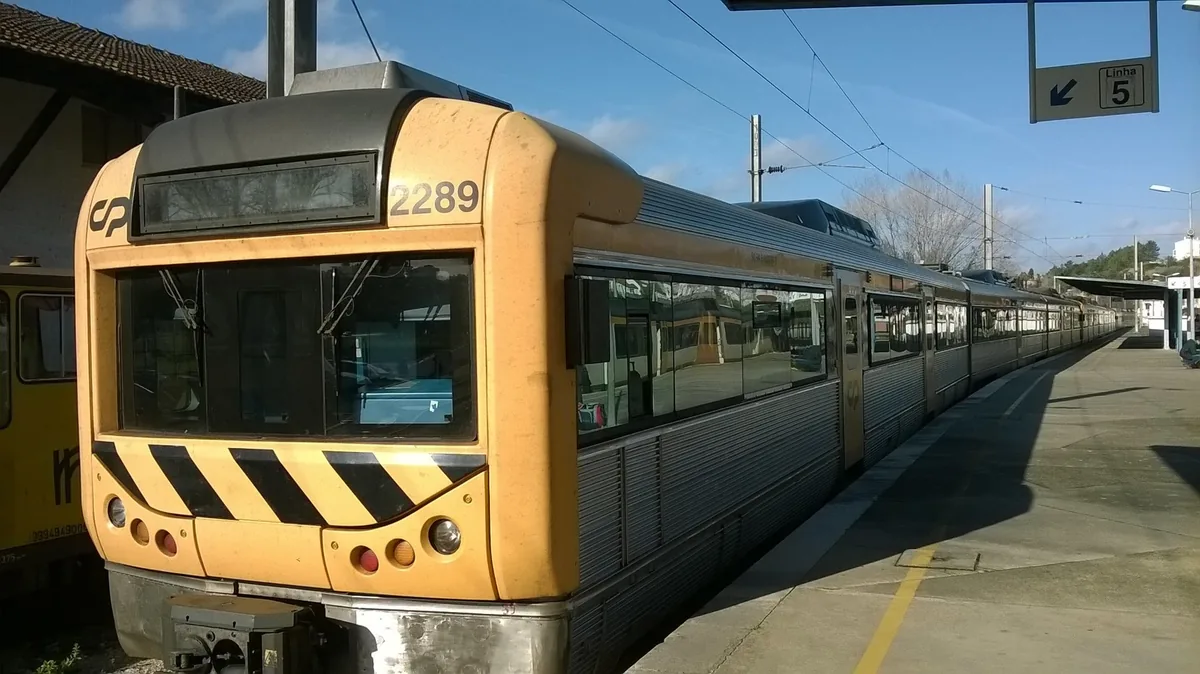
You are on the Alfa Pendular from Lisbon, the guidebook says to change at Coimbra-B for the free four-minute shuttle to the central station, and you are looking for a platform that no longer has a train on it. That shuttle stopped running on 12 January 2025. It is not suspended, not seasonal, not replaced by a later service. The rail corridor between the two stations has been torn up and rebuilt as a busway.
Then it changed again. On 10 September 2026 — five days before this page was written — the Metrobus reached Coimbra-B and Praça da República, and the number of weekday runs went from 291 to 452. Anything you read about arriving in Coimbra that was published before this month is describing a city that no longer exists. This page is the current answer.
What the two stations are
Coimbra-B is the mainline station on the Linha do Norte, roughly two kilometres north of the centre. Every long-distance train calls here: Alfa Pendular, Intercidâdios, InterRegional and Regional services on the Lisbon–Porto spine. It is not in the city. It is a junction with a car park.
Coimbra — officially just “Coimbra”, universally called Coimbra-A and locally the Estação Nova — is the small terminus down by the river in the Baixa. You can walk out of it and be at the Arco de Almedina in five minutes. That is why every guide ever written told you to go there.
The geography is the whole problem. The station with the trains is not the station in the city, and for decades a short rail shuttle papered over the gap. It does not any more.
The shuttle train is gone
Infraestruturas de Portugal, the national rail infrastructure manager, published the notice in January 2025. The wording leaves no room: with the construction of the Sistema de Mobilidade do Mondego the rail link between Coimbra-B and Coimbra “será desativada definitivamente” — permanently deactivated — with services to Coimbra station suppressed from 12 January 2025, immediately after the 00:20 departure.
There will not be another one. The corridor has been converted for the Metrobus. This is not a service that might come back when works finish; the works were the point.
Guides still tell readers to take a free shuttle train that is included in the CP ticket and takes four minutes. If you are reading that anywhere, you are reading something written before January 2025 and never checked since. We wrote up what actually happened to the shuttle at greater length.
What runs instead
Two things, and they now overlap.
The free transfer. Metro Mondego runs identified buses between the two stations, free for CP passengers, with a marked stop beside each station and a connection timed to every train that used to run through to Coimbra station. Infraestruturas de Portugal put the peak capacity at twelve buses per hour. Your train ticket is your fare. Nobody will sell you anything.
The Metrobus. Since 10 September 2026 the Metrobus itself serves Coimbra-B and Praça da República. Weekday runs across the system went from 291 to 452; the urban section now averages five minutes at peak and 7.5 minutes off-peak, on vehicles carrying 136 passengers. That is a tram-grade frequency on a corridor that was a railway eighteen months ago.
Fares are the open question. Metro Mondego does not publish a clean visitor fare table we could verify, and SMTUC monthly passes were only being honoured on Metro Mondego validators through the end of September 2026 as a transition measure. Check the city’s current ticketing position and the municipal mobility hub before you plan around a price. We are not going to invent one.
Which station should you get off at
Coimbra-B. Always, if you are on a long-distance train — because it is the only one that stops. There is no choice to make on an Alfa Pendular or an Intercidades. You get off at B, you walk to the marked stop, you ride in free.
The decision people think they are making — B or A — was abolished along with the shuttle. What is left is a smaller and more useful question: which stop do you get off at on the way in? If you are sleeping in the Baixa or by the river, stay on to the riverside end. If you are staying up in the Alta, you are climbing either way, and Praça da República puts you on the university side of the hill rather than at the bottom of it.
With a suitcase, the climb from the Baixa to the university is the part to plan for, not the transfer. The Elevador do Mercado rises 51 metres in two stages and runs Monday to Saturday 07:30–21:00, Sundays and public holidays 10:00–21:00. Uber operates in Coimbra if the hill and the hour are against you.
What still uses Coimbra-A
The CP Coimbra Urban line to Figueira da Foz is the surviving local service, and it is the reason the central station is still a station rather than a listed building. CP describes the service as running “between Coimbra and Figueira da Foz”, serving 19 stations and halts, with accessible toilets and a platform lifting mechanism for wheelchairs.
Here is a gap we will not paper over. Which Coimbra station those urban trains now start from, after the corridor conversion, is not resolved by CP’s own English page — it names Coimbra-B as the interchange point but does not state the city-end terminus. If your beach day in Figueira depends on it, check the CP timetable PDF for your date rather than trusting any guide, this one included.
For Aveiro the answer is simpler: that is a Linha do Norte journey, so it starts at Coimbra-B. Budget the transfer time into the front of your day.