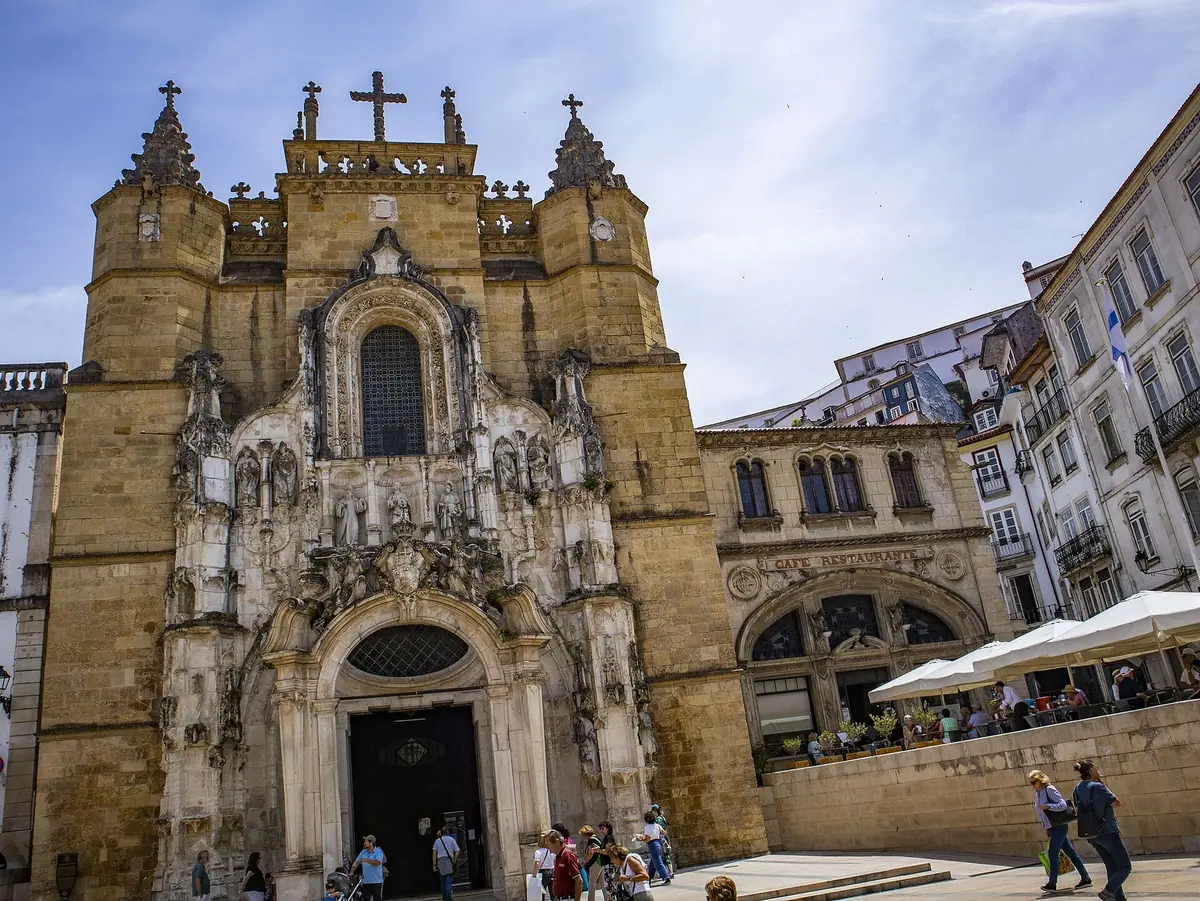
You arrive in the flat part. The Baixa runs along the river on level ground, the shops are on it, most of the restaurant addresses are on it, and for about ten minutes Coimbra feels like an easy city. Then you look up, see the university on the skyline, and start walking toward it.
Here is the honest answer to the question in the title. Yes, Coimbra is walkable, and no, it is not flat. Every monument on this site sits within roughly twenty-five minutes on foot of every other one, which is a genuinely compact historic centre. The complication is that the good half of it is on top of a hill, the bottom half is beside a river, and the connection between them is a set of medieval lanes that were laid out before anyone thought about luggage.
The city publishes one hard number for that climb. It is 51 metres, and it belongs to a lift.
The only published number
Nobody publishes the height difference between the lower town and the university. Not the municipality, not the tourist board, not the university. What does exist is an operator’s technical description of a public lift, and it is the best measurement anyone has.
SMTUC, the municipal transport service, describes the Elevador do Mercado as opened in 2001 and linking Rua Olímpio Nicolau Rui Fernandes, beside the D. Pedro V municipal market, to Rua Padre António Vieira, by a mixed route: a vertical lift for the first 20 metres, then an inclined-plane lift to the top, at 51 metres.
So: a 51-metre rise, in two stages. That is roughly a seventeen-storey building, done as a climb rather than a staircase, and it is the figure to hold in your head when someone tells you Coimbra is “a bit hilly”.
Two caveats, because this is the kind of number people misuse. It is not the full Baixa-to-university height difference — the Paço das Escolas sits higher again than where the lift lets you out. And it measures the lift’s own route, not the street route beside it, which is longer and less direct. It is a floor, not a ceiling.
The other verified vertical fact in Coimbra comes from the university, and it is about a climb you cannot currently do. The Torre da Universidade is 184 steps and “a narrow area”, with entry barred to children under six and a warning for anyone with walking difficulties, dizziness or heart problems. The tower is closed, with no reopening date published. The number still tells you something about how far above the river the university sits.
The street called Back-Breaker
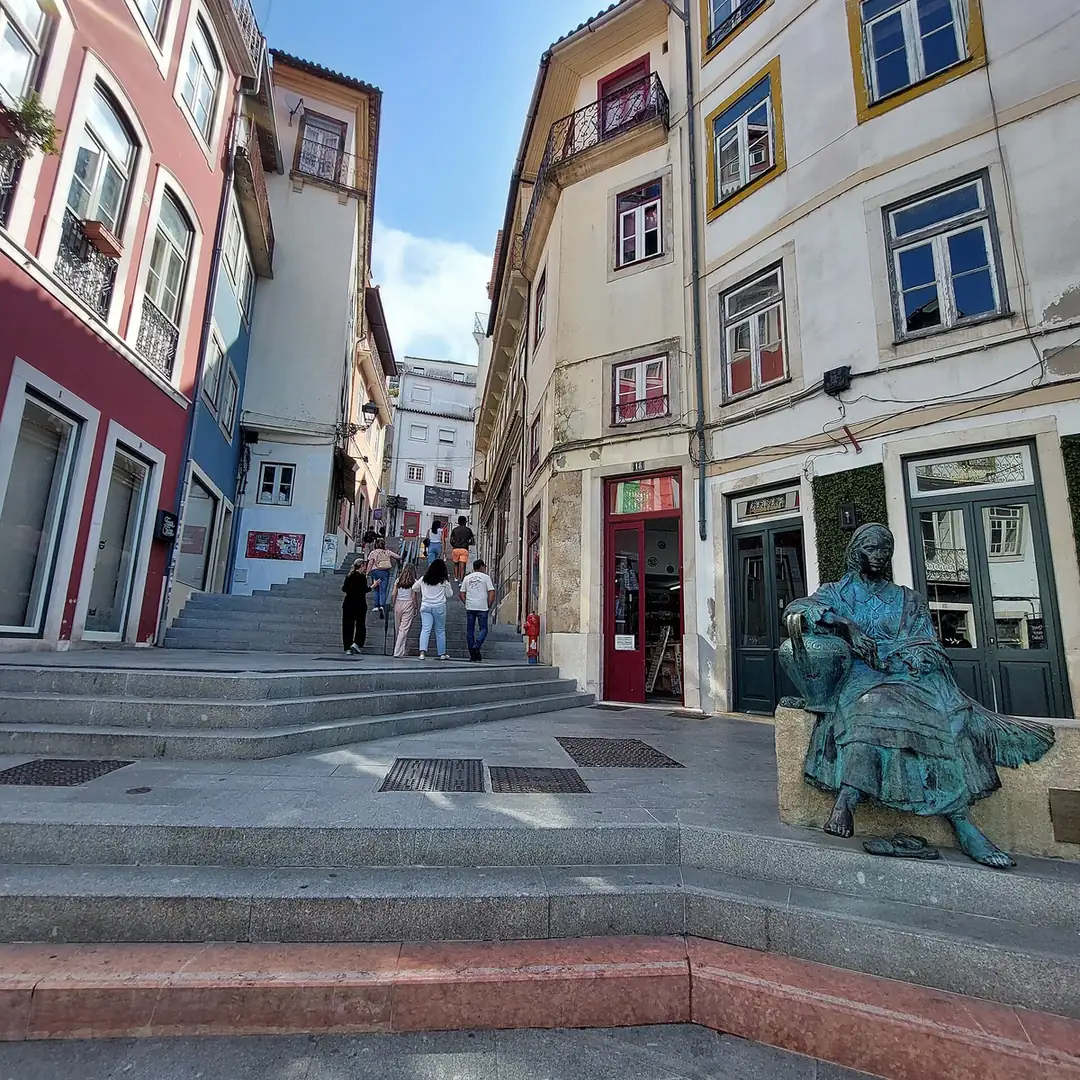
The main pedestrian climb from the lower town to the Alta runs from the Arco de Almedina, the surviving town gate on Rua Ferreira Borges, up a stepped lane to the Sé Velha.
That lane is called Rua do Quebra-Costas. It translates as Back-Breaker Street, and it is not a nickname somebody invented for a guidebook: it is the street’s name, and it appears in SMTUC’s official definition of the historic-centre pass zone alongside Couraça dos Apóstolos, Rua de São João, Rua de São Pedro, Couraça de Lisboa, Rua da Estrela, Rua Fernandes Tomás, Rua de Sobre-Ripas and Rua do Colégio Novo.
Read that list as a warning label. Those are the streets the transport operator considers to constitute the historic hill, and it maintains a subsidised pass for the residents who live on them.
Coimbra, in other words, looked at its principal tourist climb, named it Back-Breaker, and then built a 51-metre lift a few hundred metres away. Both decisions are correct. The lane is beautiful, stepped, shaded, and lined with the fado houses on Rua do Quebra Costas at numbers 7 and 12. It is also a genuine effort with a bag, in August, at 15:00.
Two of the city’s fado venues are on that same lane, at numbers 7 and 12, roughly 120 metres apart. That is a small detail with a practical consequence: an 18:00 show and a later one sit a few doors from each other on the steepest pedestrian route in Coimbra, so if you are going to both in one evening you climb once and stay up there, rather than descending between them and paying for the hill twice.
The compensation is that it is much easier downhill, which is the argument for the Alta to Baixa descent: ride or climb up once at the start of the day, then spend the rest of it going down through two cathedrals and a town gate to the royal tombs.
Does the lift actually run
Yes, and this needs saying because the answer changed recently enough to have confused people.
Elevador do Mercado hours: Monday to Saturday 07:30–21:00, Sundays and public holidays 10:00–21:00. Those are SMTUC’s published times.
It had been out of service, and came back. In January 2026 the Câmara Municipal announced that the “Elevador do Mercado volta a ligar a Baixa e a Alta de Coimbra” — that it would again connect the lower and upper town from the following day. If you read somewhere that the lift is broken, you were reading something written before that.
The fare is the gap. SMTUC states that you can use the Elevador do Mercado with any valid SMTUC transport title, and does not publish a standalone single-ride price on the lift’s own page. We are not going to invent one. Buy at an SMTUC point or ask at the lift; the useful thing to know is that it is a transport service on the city network rather than a tourist attraction with its own turnstile price.
Residents of the historic centre and the Alta can hold a Passe Social Especial Centro Histórico, an annual pass giving free use of the lift and of the Linha Azul city bus. That is the clearest possible evidence about who the lift is for: the people who live at the top and have to do this every day.
Any other lift or funicular: there is not one. The Elevador do Mercado is the only one SMTUC publishes a page for. The getting around guide covers the buses and the Metrobus.
Planning around the hill
The single best decision you can make about walking in Coimbra is made before you arrive, when you book the bed.
Stay in the Baixa and you sleep on the flat, walk to dinner without effort, and climb once a day on your own terms. Stay in the Alta and you are inside the UNESCO perimeter with the monuments at your door, but every trip to a restaurant or a supermarket is a descent followed by a return. The where to stay guide treats this as the main axis of the decision, because it is.
Then sequence the day downhill. Go up once, early, and come down slowly. Use the lift or a bus for the ascent, do the university circuit while your legs are fresh, then walk down through the Sé Velha, through the Arco de Almedina, and out into the Baixa for lunch. The one-day itinerary is built in that direction on purpose.
Distances, honestly. Nobody publishes walking times between Coimbra’s monuments, and we are not inventing them. What we can say from the geography is that the whole ticketed core — university, both cathedrals, the town gate, Santa Cruz — falls inside a single descent of a few hundred metres of street, and that the effort is entirely vertical rather than horizontal. A flat city of the same footprint would be a fifteen-minute walk end to end. This one is not, and the difference is the 51 metres.
Do not underestimate the surfaces. The Alta is cobbled and stepped, the steps are uneven, and wet cobbles in winter are slick. Trainers rather than sandals, and nothing with a smooth sole.
And build in the flat half deliberately. The Mondego riverside walk uses both banks and the Pedro e Inês footbridge and involves no climb at all; the botanical garden is free, thirteen hectares, and runs downhill from the Alta toward the river, which means you can finish a hard morning by drifting down through it rather than walking back the way you came.
If stairs are a problem
This is where we should be straight rather than encouraging.
Coimbra’s historic core is difficult terrain for anyone with limited mobility, and the difficulty is structural rather than fixable. The circulation in the Joanina Library building is largely original, and the university warns visitors with walking difficulties, dizziness or heart conditions to take the stairs carefully; entry to the library is through the Academic Prison, via a winding medieval staircase. The university does not publish a step-free route to the Noble Floor, and we are not going to imply one exists. If access is critical, contact Turismo UC before you book anything.
What does work: the lift, for the main ascent, within its published hours. City buses, including the Linha Azul that serves the historic centre. Uber, which operates in Coimbra and has an official city page, although we have no verified fare to quote you. And the flat riverside, which is genuinely level and has the best view of the hill town in any case.
Outside the city, the picture is mixed and worth knowing in advance. At Conímbriga the museum states it has no architectural barriers and is accessible, while the ruins themselves are explicitly not — “as Ruínas ainda não reúnem condições” — with adapted toilets by the shop and a wheelchair available to borrow. CP’s Coimbra urban trains have accessible toilets and a platform lifting mechanism for wheelchairs.
The practical information page keeps a running list of what this city does and does not publish, which in accessibility terms is more of the second than the first.