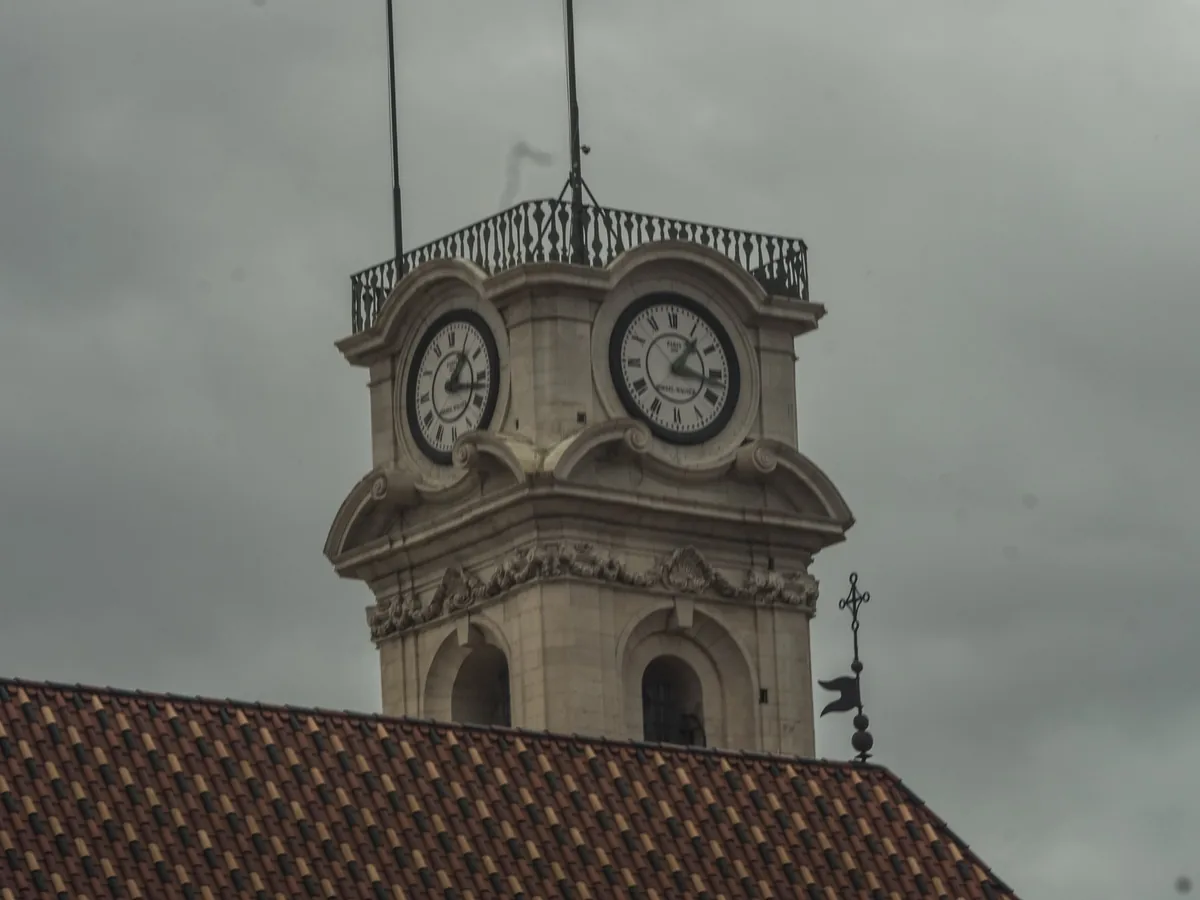

It is the thing you have already seen. Every photograph of Coimbra puts this tower on the skyline above the river, pale and vertical over the Alta, and every visitor arrives half-planning to climb it. You cannot. The University of Coimbra says so on its own visitor page, in its own words: “Tower of the University — We regret to inform you that this facility is closed.”
No reopening date is published. No reason is given. No ticket to the tower appears in any of the 2026 programmes sold by Turismo UC. If a guide, a listing or an aggregator tells you the climb costs a few euros and takes twenty minutes, it is describing something you cannot buy today. This page tells you what is shut, what is known, what you can still see for nothing, and where the view is instead.
The tower is closed
The closure is stated by the University itself, on the opening-hours section of its visitor information page, alongside the hours for every space that is open. It is not a rumour, a seasonal quirk or a maintenance day. It is a standing notice.
What that notice does not do is explain itself. There is no published reason — not restoration, not safety, not staffing. Anything you read that names a cause is filling a gap the University has left empty.
There is also no published reopening date. I would rather print that flatly than dress it up. The honest line for a traveller is: assume it is shut for your trip, and treat a reopening as a bonus if it happens.
The consequence for planning is small but real. The tower was the only ticketed high viewpoint inside the university complex, and a fair number of one-day itineraries are built around climbing it around sunset. Rebuild that hour somewhere else.
Nothing else in the Paço das Escolas is affected. The Royal Palace rooms, St Michael’s Chapel and the Biblioteca Joanina are all open on their usual tickets, and the courtyard under the tower is free to walk into.
Two other headline sites in Coimbra are also closed this year, which changes an itinerary more than this tower does: the Museu Nacional Machado de Castro, shut since February 2026, and Santa Clara-a-Velha, shut since October 2025. Neither has a published reopening date either.
If you want a single reliable source to re-check before you travel, use the University’s own information page rather than a listing site. It is where the closure is stated and it is where a reopening would appear first.
It is worth being clear about what a closure like this does to published information. Listings age badly, and a tower that was climbable for years leaves a long trail of blog posts, itineraries and printed guides describing a visit that no longer exists. None of them are lying; all of them are out of date.
The pattern repeats across Coimbra right now, which is why three of this city’s best-known sights need a closure warning at the top of the page rather than a line at the bottom. Check status before you build a day, not after.
The 184 steps
Here is the number almost nobody publishes, and it is worth knowing even while the door is locked. The University’s visiting guidelines state that access to the tower “consists of 184 steps and a narrow area”.
The same guidelines ask visitors with walking difficulties, dizziness or heart problems to take particular care, and state that entry is not allowed for children under 6. Those are the rules for the climb as the University defines it, and they survive the closure as a description of what the climb actually is.
184 steps in a narrow shaft is not a gentle spiral with landings. It is the kind of ascent where two-way traffic is managed by waiting, where the last flight is the steepest, and where the reward is entirely at the top.
Put that number next to the other vertical fact in this city and you get a useful picture of Coimbra’s shape. The Elevador do Mercado climbs 51 metres from the Baixa to the lower Alta in two stages, and the Paço das Escolas sits higher again. The tower then starts from there.
That is why the silhouette reads from so far away, and why the Alta feels like a different town from the riverside streets four hundred metres below it. The stepped lane that links them is called Rua do Quebra-Costas — Back-Breaker Street — and it is not being coy.
So if you were looking forward to the climb, the loss is real. 184 steps to the bells above a World Heritage courtyard is a genuinely good twenty minutes, and it is not currently on offer.
For the full account of how steep this city is, with the sourced numbers rather than the usual vague warnings, read is Coimbra walkable.
The under-6 rule is the detail that tells you most about the space. Museums do not bar small children from ordinary staircases. They bar them from shafts with open drops, uneven treads and no room to turn around, and the University is being straightforward rather than cautious.
Compare it with the library circuit below, where the University warns about stairs and narrow areas but sets no age limit. The tower was in a different category of climb, and that is worth remembering when it reopens and somebody in your group has knees.
The bell that ran the university
The eighteenth-century baroque tower over the Paço das Escolas is not decoration. It is a clock tower, and its bell — known to generations of students as the cabra, the goat — called students to class.
That is the thing to hold on to while you look up at it from the courtyard. Before timetables printed on paper, before anyone carried a watch, the working day of the whole University was set by one bell in one tower, audible across the Alta and down into the Baixa.
A bell that summons you is also a bell you resent, and student slang usually tells you which. Coimbra’s students named it after a goat rather than a saint, and the nickname outlived the function.
The tower still marks the hours over a quarter where academic ritual is not a museum exhibit. The black capes crossing the courtyard belong to a living tradition, the faculty colours in the palace rooms match the ribbons burned at the Queima das Fitas, and the Latada closes the whole university circuit for a day each autumn.
If that world is what brought you here, the Academic Museum is included in the standard university ticket and covers exactly this: the capes, the rituals, the repúblicas, the Queima. It is the most skipped room on the ticket.
For the short version, read why the students wear black capes. Then look at the tower again and it stops being a postcard.
Clock towers over universities are common. Clock towers that are the tallest thing in a walled hill town, visible from every approach road and from the river, are not, and that is the difference here. This bell did not just organise lectures; it organised the city’s idea of where the university was.
Look at the tower from the Baixa and the point makes itself. The Alta is a separate world above the shopping streets, reached by a stepped lane called Back-Breaker Street or by a 51-metre lift, and the tower is the sign that tells the lower town it is up there.
What you can still see
The good news is that the tower’s best angle was never from inside it. The Paço das Escolas courtyard is free and open, daily, and the tower rises directly out of it. You can photograph it from the base, from the Via Latina colonnade opposite, and from the terrace balustrade.
That terrace is the consolation prize and it is a good one. It looks straight down over the Mondego valley, the Baixa roofs and the left bank, and it costs nothing at any hour the courtyard is open — 09:00 to 19:30 daily.
The other free viewpoint worth the walk is Penedo da Saudade, a clifftop garden east of the Alta whose rock faces carry verses left by generations of students. No official page publishes hours for it, so treat the “open 24 hours” line on mapping apps as user-generated rather than fact, and go in daylight.
Across the river, the hill of Santa Clara-a-Nova puts you above the left bank looking back at the Alta — which is the angle that actually shows you the tower in its city. Entry to the monastery is 6.00 EUR and the approach is free.
And the flat option: the Mondego riverside walk crosses the Pedro e Inês footbridge and gives you the whole Alta stacked above the water, tower on top, with no climbing at all.
Do not pay anybody for a “tower view” in Coimbra this year. Nobody is selling access to this one.
One more angle, and it is the cheapest in the city: the courtyard terrace at the end of the day. The Paço das Escolas stays open to 19:30, which in summer means you can be standing above the Mondego with the light going and no ticket in your pocket.
Photographers should know the constraint, though. The tower faces are pale stone and they blow out badly in midday sun; the courtyard is also at its most crowded then. Early morning and the last hour are the two windows that work.
If your interest is the skyline as a whole rather than this one building, the left bank gives you the composition — river, bridge, terraced town, tower on top — and it is a fifteen-minute walk from the Baixa across the footbridge.
Practical logistics
There is no ticket, no queue and no booking for the tower. The 2026 programmes sold by Turismo UC — 16.50 EUR with the Joanina, 12.50 EUR without it, 25.00 EUR guided, 16.00 EUR for the Science Museum and Exploratório — do not include it, and no historic price for the climb is published by an official source.
The courtyard under it keeps Palace of Schools hours: daily 09:00 to 19:30, with last admission to the ticketed spaces at 19:15. The ticket office kiosk in front of the Faculty of Medicine runs 09:00 to 19:00; its official GPS is 40.207938, -8.424189.
Photography of the tower from outside is unrestricted, without flash and without tripods or selfie sticks inside the visiting spaces. Drones need prior authorisation from the University, and commercial or academic image use needs written permission.
Closure dates for the wider circuit: 24 and 25 December 2026, 31 December 2026 and 1 January 2027, plus the movable academic days — the whole complex shut on 24 May 2026 for Academic Week and closes again on 4 October 2026 for the Latada.
Getting up here without a fight: the Elevador do Mercado runs Monday to Saturday 07:30–21:00 and Sundays and public holidays 10:00–21:00, and any valid SMTUC transport ticket works on it. It was out of service for a period and returned in January 2026, so ignore older guides that call it broken.
If you want a reopening confirmed rather than hoped for, ask Turismo UC directly before you build a day around it.
Do not let the closure talk you out of the Alta. The four things people actually remember from Coimbra — the Baroque library, the ceremonial hall, the prison you enter through and the cathedral down the hill — are all open, all ticketed and all within a few hundred metres of this tower.
And budget honestly. Between the 16.50 EUR university circuit, 3.00 EUR at the Sé Velha, 1.00 EUR at the Sé Nova and a free botanical garden, a full day in the Alta costs about 21 EUR in entry fees at 2026 prices.
What to combine
Spend the hour you had reserved for the climb on the room most people rush. The Sala dos Capelos carries 172 carved ceiling panels and portraits of every Portuguese king from Afonso Henriques to Manuel II, with the Philippine dynasty of 1580–1640 deliberately missing. That gap is a better twenty minutes than any view.
Or go down rather than up. The Academic Prison, the oldest preserved prison in Portugal, is the entrance to the Joanina, and the chisel marks of the masons are still on the arch stones of the Middle Floor.
For air and space without a ticket, the Botanical Garden is free, 13 hectares, part of the same 2013 UNESCO inscription, and ten minutes downhill — open to 20:00 from April to September.
Then take the Alta to Baixa descent, which starts under this tower and finishes at Santa Cruz, past the Sé Velha and the Arco de Almedina. It is the walk that explains the city’s vertical logic better than any viewpoint would.
If you are assembling a day from scratch around the closures, the guide to visiting the University sets out what each ticket actually opens.
One more substitution worth making. If the tower was going to be your architecture fix, the Sé Velha ten minutes downhill is the better building and costs 3.00 EUR: a Romanesque cathedral begun in 1164 whose carved capitals contain no human figures and no biblical scenes at all.
And if it was going to be your photograph, take the descent at the end of the afternoon instead. The light comes up the Mondego valley and hits the Alta face-on, which is exactly the angle you cannot get from inside a tower.