
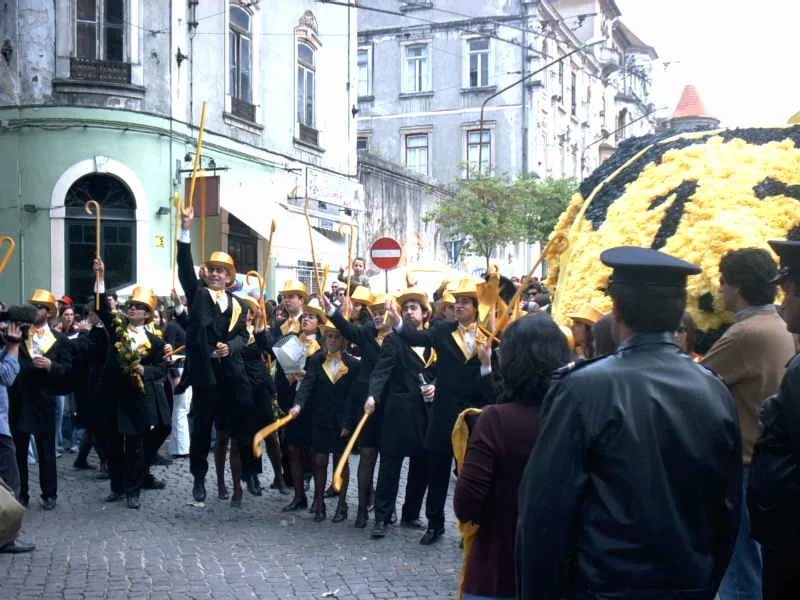
May in Coimbra is not a weather question. It is the month of the Queima das Fitas, which the Câmara Municipal describes as the largest student festival in the whole of Europe, and which the university takes seriously enough to close its own World Heritage circuit for.
Eight days, one for each of the university’s eight faculties. For finalists it is goodbye to student life; for first-years it is formal initiation into the Academia. The same week means opposite things depending on which end of a degree you are at, and the city runs on that tension.
What is on in May
The festival opens with the Serenata Monumental at the Largo da Sé Velha, and the timing is exact: it begins after the twelve strokes of midnight, when the first guitar chords sound and the students on the cathedral steps start to sing. In 2026 there was a marked enclosure by the monument and new access and security arrangements, so expect a controlled crowd rather than a free-for-all.
Then, in order: the “Queima” do Grelo at the Largo da Sé Nova at 10:00; the Cortejo dos Quartanistas, the parade of floats covered in paper flowers in the faculty colours, carrying satire and student demands; the Baile de Gala at the university stadium; and the Noites do Parque, nightly concerts at the Praça da Canção.
The 2026 edition ran 22–30 May. The Benção das Pastas, the blessing of the folders, sits separately in June.
What closes, and this is the important part
The University of Coimbra shut its entire tourist circuit on 24 May 2026 for Academic Week. That means no Joanina Library, no Royal Palace, no Sala dos Capelos, no Science Museum.
The Santa Cruz monastery closes on the day of the Queima das Fitas parade, listed among its annual closures alongside Christmas Day and New Year’s Day.
Read that twice. A UNESCO World Heritage site and a national pantheon both shut their doors for a student party. If you book Coimbra for parade day expecting the library, you will see neither the library nor the monastery.
2027 dates are not published as of 15 September 2026, and we will not extrapolate a rule from past editions. Before booking anything in late May, open the university’s own visitor information page and read its closure list for your dates.
Hours and the season change
May sits on a seasonal boundary and the venues do not agree on where it falls.
Already on summer hours: the free Botanical Garden runs 09:00–20:00 from 1 April; Portugal dos Pequenitos runs 10:00–19:00 from 1 March; the Quinta das Lágrimas gardens run Tuesday to Sunday 10:00–19:00 from 16 March, closed Mondays.
Still on winter hours: the Sé Velha does not switch to its 18:30 summer close until June — in May it shuts at 17:30 on weekdays and Saturdays, and 17:00 on Sundays. The Buçaco forest gates likewise run winter hours until June.
Unchanged all year: the Palace of Schools 09:00–19:30 when it is open at all, Santa Cruz closing at 16:30, and the Sé Nova at 1.00 EUR, daily 09:00–18:00.
What else May is good for
If the festival is not why you came, May gives you a working city with long evenings and no seasonal closures of its own. The three big permanent closures apply in May as in every other month: the Machado de Castro museum since February 2026, Santa Clara-a-Velha since October 2025, and the University Tower. None has a published reopening date.
This is a good month for the day trips, because the Conímbriga bus timetable gives you a full day on site without a tight return: three buses each way, with the last weekday departure from the ruins at 17:55. The site is open daily 10:00–18:00 with the ticket office closing at 17:15.
Closer in, the Botanical Garden is at its best and its longest hours, and it costs nothing. The riverside walk is the flat counterweight to a week of climbing the Alta.
For the music behind the festival rather than the crowd around it, the fado show on Rua do Quebra Costas runs daily at 18:00, every day of the year without exception, and lasts about 50 minutes.
Crowds, beds and transport
Festival week is the annual peak for accommodation, and it is the one week where where you sleep genuinely changes your night. The Alta is noisy in ordinary term time; during Queima it is the venue.
The concerts are at the Praça da Canção rather than in the historic centre, so the late-night movement in the city is between the two. If you want to see the festival without living inside it, the Baixa or across the river in Santa Clara gives you a door you can shut.
On transport, note that anything you read about arriving in Coimbra before September 2026 is out of date: the Metrobus network expanded to Coimbra-B and Praça da República on 10 September 2026. See which station to get off at before you travel.