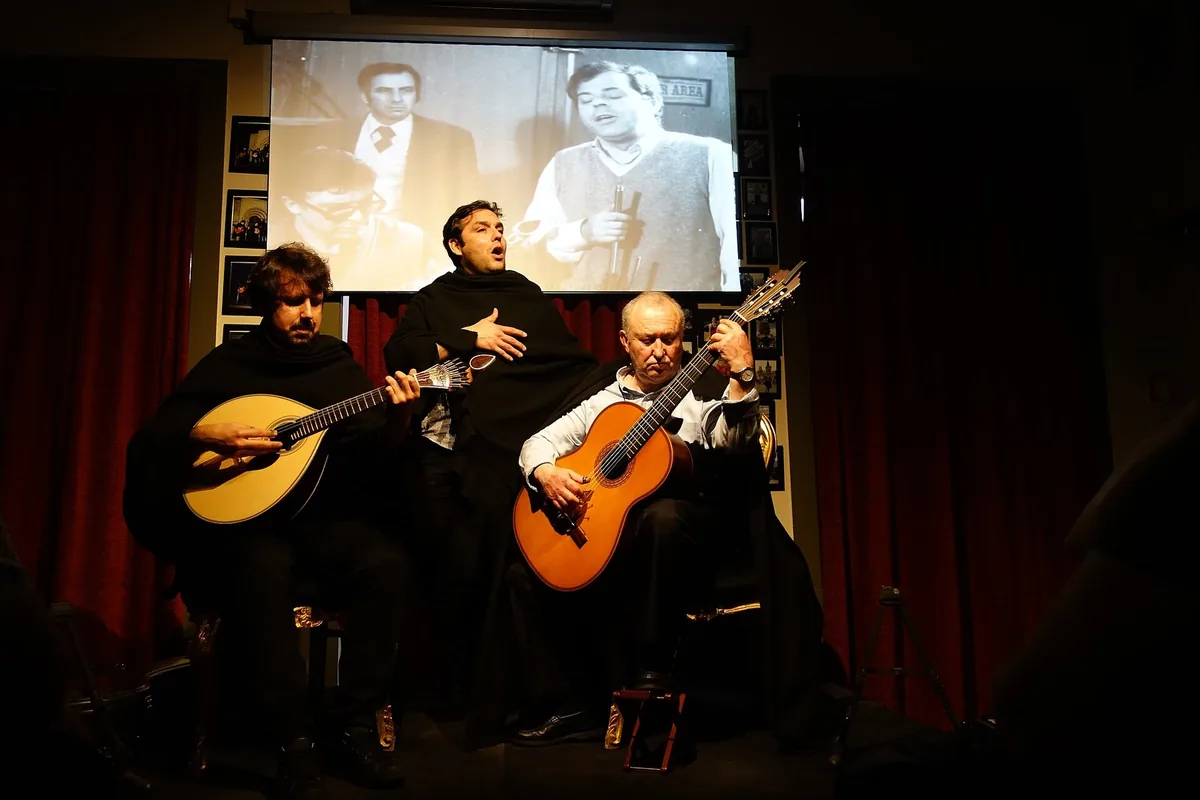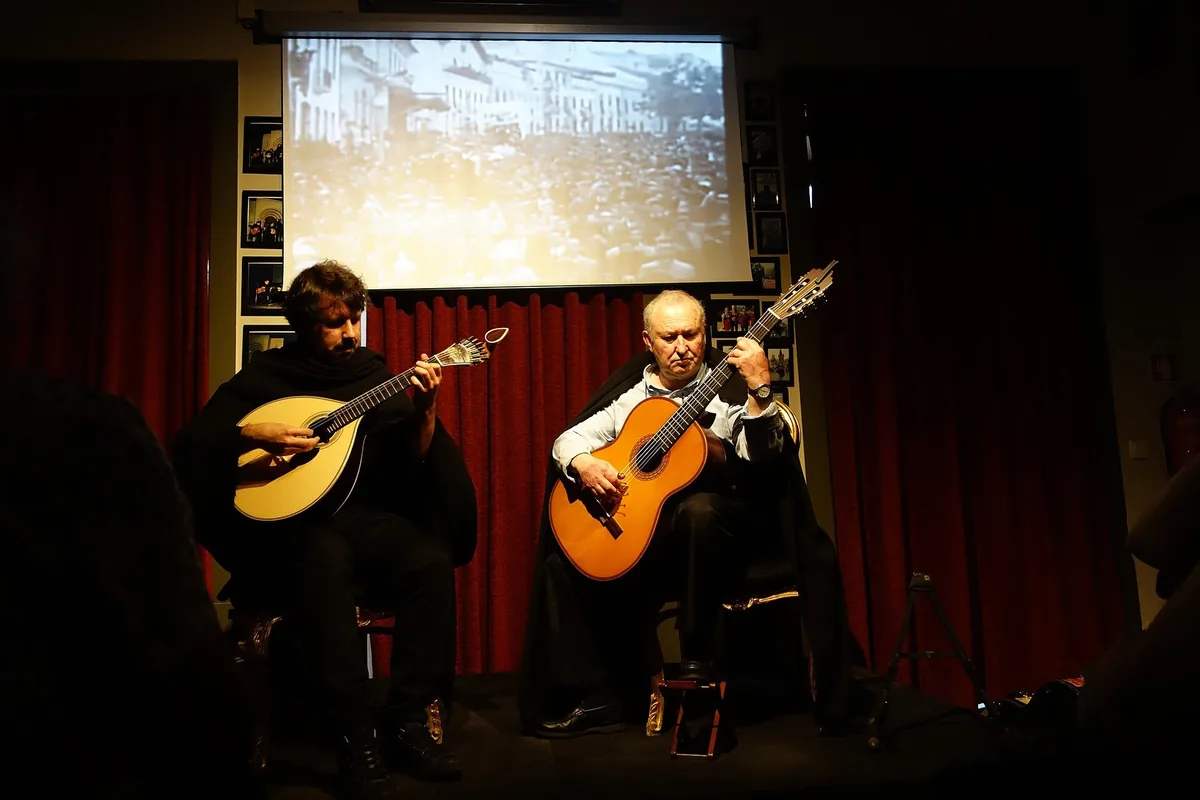

Start with the thing that makes this worth your evening rather than a box ticked. The Coimbra guitar is tuned a whole tone below the Lisbon one. It is a different instrument — teardrop-shaped, and in the musicians’ own phrase, afinada num tom abaixo. That is why Coimbra fado sounds darker than the fado you may have heard in Alfama, and it is not a matter of interpretation.
The second difference is social. Lisbon fado came from the urban poor. Coimbra fado is academic: the learned and the popular shared songs and stories from the start, and its poems come from the illustrious poets who passed through the Academia. It is a serenade and a street music — sung standing, outdoors, to someone — not a seated tavern lament.
The daily 18:00 show
The reliable one is Fado ao Centro, at Rua do Quebra Costas 7, which runs daily at 18:00, every day of the year without exception. It is the only Coimbra fado venue that publishes a full ticket structure, which is why it is the one we can write about properly.
Tickets: adults 16.00 EUR, youths 7–17 9.00 EUR, children under 6 free, family ticket 45.00 EUR for two adults and up to three youths. The ticket includes a glass of Port wine. The concert runs about 50 minutes.
And there is a free ticket, for exactly the right people. University of Coimbra bachelor’s and master’s students — not postgraduates — get in free on presentation of a current student card, capped at two a day. The music is about being a student in this city, and the venue lets students in for nothing. That is the best thing on this page.
The venue is a cultural project founded in Coimbra in 2010 by three musicians, all former students of the university.
Booking and seating
Book ahead. Turismo Centro de Portugal states it plainly: advance booking is advised because it is normally difficult to get a place on the day. For a 50-minute show in a small room at a fixed daily time, that is entirely believable.
Then note the second half of the rule, which surprises people. The ticket guarantees a place in the hall, not a seat in particular — entrance and seat selection are first-come, first-served. Arriving on time with a ticket is not the same as arriving early with a ticket.
Small children are allowed, with a condition the venue states directly: absolute silence must be maintained. Under-6s are free. Treat that as a real constraint rather than a formality — this is a concert where the room is quiet enough to hear the guitar decay.
Contact is by phone on +351 239 837 060.
The alternatives, and what we could not verify
Coimbra has several fado venues. Most do not publish prices, and we will not print figures we could not source.
- àCapella, Rua Corpo de Deus — a café converted from a chapel built in 1364, with fado nightly at 21:30. A published cover charge exists in third-party listings but we could not confirm it from the venue; treat it as needing checking at the door.
- Café Santa Cruz, on Praça 8 de Maio — and this is the one worth knowing: it lists Coimbra fado sessions at 18:00 and 22:00 daily, admission free, with no 22:00 session on Sundays. In a deconsecrated church that has been a café since 1923.
- Quebra o Galho, Rua do Quebra Costas 12 — fado nights 1 April to 15 November, daily except Saturdays, booking compulsory. Price not published.
Two of these are on the same 120-metre street. Fado ao Centro at number 7 and Quebra o Galho at number 12, both on the stepped lane called Back-Breaker Street.
For the instrument rather than the evening, the municipal museum runs the Torre de Anto — Núcleo da Guitarra e do Fado de Coimbra on Rua de Sobre Ribas, Tuesday to Saturday 10:00–13:00 and 14:00–18:00. Almost no English-language guide lists it. Admission is not published.
What the evening is actually like
Solemn, and short. The tradition is described by the regional tourism body as um acontecimento solene — a solemn event — and students have sung in these streets since the sixteenth century. The themes are saudade for a woman, for the city, and for the Academia itself: longing for the institution you are about to leave.
Fifty minutes is the right length. This is not a floorshow and there is no dinner attached; the glass of Port is the extent of the hospitality, and that is a feature.
One thing we will not repeat. You will read everywhere that Coimbra fado audiences cough instead of clapping. We could not find that in any official source, and we are not going to print a piece of folklore as fact. Ask at the venue; if a musician tells you, you will have a better story than we can give you.
The music is the through-line of the student year: it opens the Queima das Fitas with the Serenata Monumental on the cathedral steps after midnight, and the Latada with a serenade at the Sé Nova.