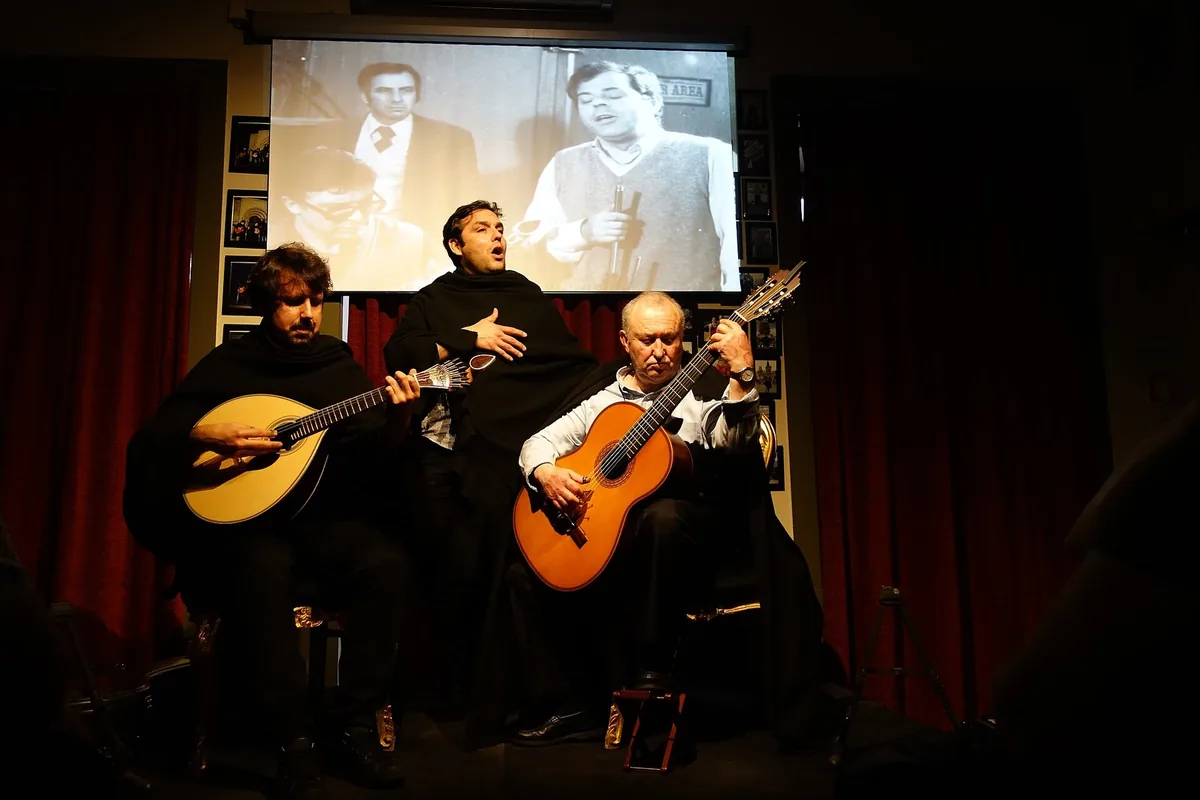

The Rua do Quebra-Costas is a staircase pretending to be a street. It climbs from the Arco de Almedina toward the Sé Velha, worn smooth, walled on both sides, and the name means Back-Breaker. Fado ao Centro is at number 7, which is to say partway up it, which is to say you will arrive slightly out of breath and that is somehow correct for a music born on these steps.
This is the fado house built for people who do not yet know what fado is. The format is a short show with the tradition and the instrument introduced as you go, rather than an evening of music that assumes you already understand why nobody is clapping. For a first encounter with Coimbra fado it is the right room. The catch is that the venue publishes remarkably little about itself.
What is not published
We read the official site on 15 September 2026. It gave no show time, no ticket price and no duration, and the ticket product page returned empty content when we tried to open it.
That is an unusual gap for a venue whose whole proposition is a scheduled, ticketed show, and it means we cannot give you the two numbers you most want. We are not filling them in from aggregators or from memory.
What you can do instead: contact the venue through fadoaocentro.com for the dates you are in Coimbra, or book the equivalent product through a reseller, which does publish times — see the next section.
The address, at least, is certain and comes from the venue’s own site: Rua do Quebra Costas 7, 3000-340 Coimbra.
The version you can actually book
There is a way to get concrete numbers, with one caveat.
GetYourGuide sells a product called Coimbra: Live Fado Show with Glass of Port Wine, and its listing gives the venue as Casa Fado ao Centro. The listing describes a 50-minute show including a glass of Port and interaction with the musicians. At the time of our research it carried a rating of 4.7 across roughly 1,210 reviews, which makes it the best-reviewed Coimbra product on that platform by review volume.
The caveat is price. GetYourGuide “from” prices are quoted in dollars and demonstrably moved between page loads on the same day during our research; review counts drifted too. We will not hard-code a figure that unstable. Check the current price yourself at the moment you book.
A thousand-plus reviews at 4.7 is a genuinely strong signal in a city where most products have double-digit review counts. Whatever else is unclear here, people who go are pleased they went.
What you will hear
Coimbra fado is not Lisbon fado and the difference is the entire point of a house that explains itself.
It is sung by men, traditionally students and graduates of the university, in the black academic dress the city is known for. It grew out of the serenade — music sung under a window or on the steps of the old cathedral — rather than out of the tavern. The repertoire is student songs, farewells, and the city itself as a subject.
The guitarra de Coimbra has its own tuning and a heavier, more formal sound than the Lisbon instrument. A good show will put it in your hands, figuratively at least, before it is played.
You will be told not to clap. The claim that Coimbra audiences cough instead of applauding is everywhere and sourced nowhere; a venue that explains the tradition to you is the best guide to what the room actually does. You will see the room do it and wonder whether everyone has a cold. They do not.
The tradition’s annual peak is the Serenata Monumental on the cathedral steps during the Queima das Fitas in May — the same music, performed to a crowd of thousands, at midnight, for free.
Choosing between the three fado venues
Coimbra has three documented fado addresses and they do different jobs.
Fado ao Centro is the introduction: short, explained, early enough to be followed by dinner, and the one to choose if this is your first exposure.
Café Santa Cruz is the free one. Sessions at 18:00 and 22:00 daily, none at 22:00 on Sundays, inside a church deconsecrated in 1834 and converted in 1923. Admission is free and the room is extraordinary.
À Capella is the late one, in a chapel built in 1364, with sessions reported at 21:30, 22:30 and 23:30 and a 5 EUR cover — figures from an undated source that need confirming.
A good sequence for two nights: the explained show here first, then the free 22:00 session at Café Santa Cruz on the second evening, by which point you will know what the cough means.
Getting there
Number 7 on the Quebra-Costas puts you on the main stepped route between the Baixa and the Alta, just above the Arco de Almedina.
From the lower town it is a short but genuinely steep walk on worn limestone, slick in rain. The alternative is the Elevador do Mercado, which rises 51 metres in two stages and runs Monday to Saturday 07:30–21:00 and Sundays and holidays 10:00–21:00, then walking back along the ridge.
Because the venue is on the stairs rather than at the top of them, this is the easiest of the three fado houses to reach on foot from a hotel in the lower town. If knees are a consideration in your party, choose this one.
Combine it with the descent at the end of a monument day — the Alta to Baixa descent passes the door.