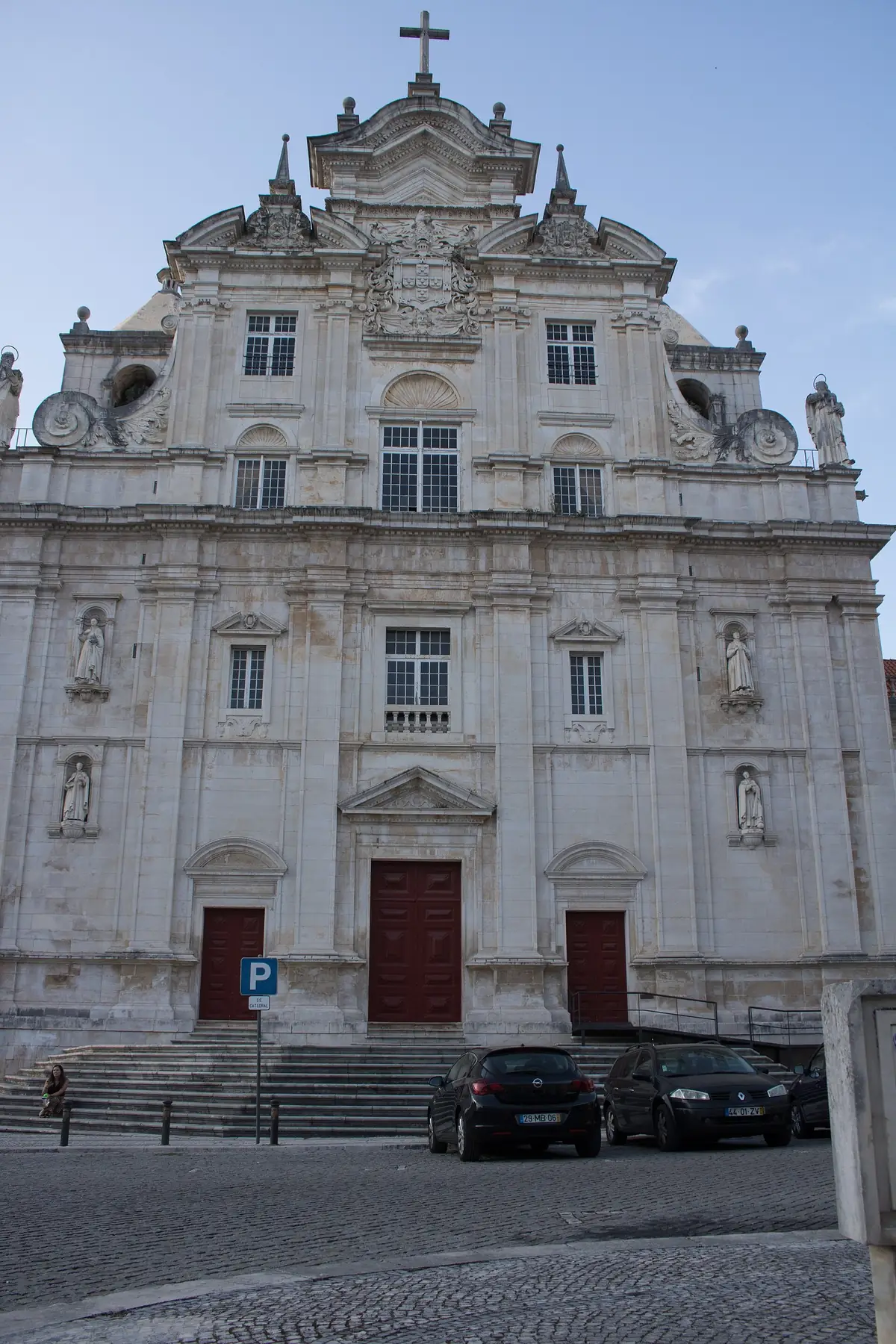

Two minutes from the university ticket kiosk there is a wide stone facade on a square full of students, and a doorway that costs one euro. Inside it is tall, bright, plain-walled and enormous — nothing like the fortress-dark cathedral ten minutes downhill. The scale is the whole explanation of why the building is here, and of why the bishop moved into it.
It was begun in 1598 as the church of the Jesuit College of the Eleven Thousand Virgins. It was inaugurated in 1698 — a hundred years later. The Jesuits who built it were expelled by the Marquis of Pombal in 1759, barely sixty years after they finished. And in 1772 the bishop’s seat was moved here from the Sé Velha for a reason nobody has ever dressed up: this church was bigger.
What to look for inside
Start with the volume, because it is the argument. A Jesuit church is a preaching box: one wide nave, side chapels rather than aisles, clear sightlines from every seat to the pulpit and the high altar, and as few piers as the structure will allow.
Stand at the west end and check it for yourself. You can see the altar from anywhere. That is a design intention, not an accident of ruin or restoration, and it is exactly what the Counter-Reformation wanted from a room.
Compare that with the Sé Velha downhill, where thick piers, small windows and a stone vault turn the nave into a series of dark compartments. Same city, same diocese, five hundred years apart, two completely opposed ideas of what a congregation is for.
The interior finishes are the second thing. Where the Old Cathedral gives you carved capitals, this one gives you altarpieces, gilt, and surfaces meant to be read from a distance by a crowd.
Look for the choir stalls. They are not Jesuit work and they were not made for this building — they came up the hill from the Old Cathedral when the seat moved. More on that below.
The same goes for the Gothic-Manueline font, which is older than the walls around it by a wide margin and sits in a church whose architecture has no use for it.
Those two objects are the most interesting things in the building, precisely because they do not belong. A cathedral that was promoted rather than built carries its predecessor’s furniture.
There is an optional visit guide booklet for 1.00 EUR at the door, which doubles the cost of your visit to two euros and is worth it if you want the altarpieces named.
Twenty to thirty minutes is enough. This is not a building that rewards an hour, and I would rather tell you that than pad it out.
Notice also what the building does with daylight. Jesuit churches are lit from high windows above the side chapels so the nave is bright and the chapels are not, which pulls every eye forward. Coimbra’s version does it well.
The facade outside is worth two minutes before you go in. It is restrained, horizontal and stone-coloured, the opposite of the gilt you find inside, and it faces a square that is now mostly students eating lunch.
That square is called Largo da Feira do Estudante — the Student Fair square — which tells you who has owned this corner of the Alta for the last four hundred years, Jesuits or no Jesuits.
A hundred years to build
Begun 1598. Inaugurated 1698. Read those two numbers together and the building becomes interesting.
A century of construction means a century of changing architects, changing money and changing taste. The Jesuits started this church in the reign of Philip II of Spain, during the sixty years when Portugal was ruled from Madrid, and finished it under a restored Portuguese dynasty.
The order was not short of ambition or of resources. It was short of the one thing that builds cathedrals quickly, which is uninterrupted political weather.
Then the punchline. In 1759, sixty-one years after the inauguration, the Marquis of Pombal expelled the Jesuits from Portugal and its empire. The men who spent a hundred years building this church had six decades in it.
Pombal’s reforms are everywhere in Coimbra once you start noticing. He rebuilt the university’s teaching, founded the Botanical Garden in 1772, created the Chemistry Laboratory that now houses the Science Museum, remodelled the Academic Prison in 1782 and abolished the old dusk examination in the Royal Palace.
A single reforming minister set the shape of half the sights on a modern Coimbra itinerary, and this church is where you can see the destructive half of that programme rather than the constructive one.
The empty college buildings around it were repurposed. The church itself was handed a promotion.
Which is the last irony worth carrying in: the Jesuits built the biggest church in the Alta, were thrown out of the country, and thirteen years later their church became the cathedral.
It is also useful to remember what a Jesuit college was. Not a monastery: a teaching institution, with classrooms, dormitories and a church built to hold a student body. The order came to Coimbra to teach, in a city that already had a university.
Those college buildings are still around you. The Colégio de Jesus and the former refectory that became the Pombaline Chemistry Laboratory are part of the same Jesuit footprint, now full of scientific instruments and mineral cases.
So the Science Museum on your university ticket occupies the buildings of the order expelled in 1759, and the church next door is their church. The whole quarter is a hostile takeover with the architecture left standing.
The things carried up the hill
When the seat moved in 1772, it did not move alone. The choir stalls and the Gothic-Manueline font were carried up from the Sé Velha and installed here.
Picture the logistics. The Old Cathedral sits below on the Quebra-Costas climb; this church sits at the top beside the university. That is a serious haul of heavy carved timber and stone up a stepped hillside, done deliberately.
Furniture like that is not moved for convenience. It is moved because it carries the identity of the institution, and a cathedral without its choir stalls is a large church with a bishop in it.
The font is the stranger object of the two. Gothic-Manueline work in a Counter-Reformation preaching hall is a centuries-wide mismatch, and nobody tried to hide it.
So when you look at these pieces you are looking at continuity being asserted physically, in wood and stone, against an architectural setting that contradicts it.
It also tells you what happened to the old building. The Sé Velha was not abandoned, but it was stripped of its function and some of its fittings — and that, paradoxically, is why it survives so intact today. Nobody bothered to modernise a demoted cathedral.
If you visit both in one day, do the Old Cathedral second and look for the gaps. That is the version of the story you can actually see.
Or do this one second, and arrive already knowing what the stalls are and where they have been.
There is a wider pattern here worth knowing, because it explains a lot of Portuguese museums. In 1834 the state extinguished the religious orders and took their property, and the contents of convents, monasteries and churches went into public collections.
That is how the Machado de Castro museum, a hundred metres below this square, got most of its sculpture and goldsmithing. Objects in Portugal move with politics, and this church’s own furniture is a small, early example of the same habit.
How to visit
One euro. That is the entry price, and it makes the Sé Nova the cheapest ticketed interior in the Alta by a wide margin — the Sé Velha is 3.00 EUR, Santa Cruz is 5.00 EUR, and the university circuit starts at 12.50 EUR.
The optional visit guide booklet is a further 1.00 EUR. Two euros total is still the best-value ticket in central Coimbra.
Hours are simple and, unusually for this city, do not change with the season or the day: every day, 09:00 to 18:00. No Sunday morning gap, no winter timetable, no lunchtime closure.
That matters more than it sounds. Coimbra’s opening hours are a minefield — Santa Cruz shuts at 16:30 and does not open until 13:00 on Sundays, the Almedina tower museum closes 13:00 to 14:00 and all day Sunday and Monday, and the university chapel shuts Sunday midday. This church is open when you are free.
No booking, no timed entry, no queue. You walk up to the door and pay.
It is an active cathedral, so dress accordingly and expect services to take priority. The parish publishes the hours above for visits rather than a separate mass timetable for this church.
Getting here is trivial if you are already at the university: it stands on Largo da Feira do Estudante, a minute or two from the ticket office kiosk in front of the Faculty of Medicine.
From the Baixa it is a climb. The Elevador do Mercado handles a 51-metre rise on any valid SMTUC ticket — Monday to Saturday 07:30–21:00, Sundays and public holidays 10:00–21:00 — and the rest is described in is Coimbra walkable.
Re-check prices before a tight budget: Portuguese monuments revise them in January and again mid-season.
One more argument for the booklet. This is a cathedral without a visitor centre, without audio guides and without wall panels, staffed as a parish church rather than as a monument. Two euros buys you the only interpretation on offer.
Where it fits in a day
Treat the Sé Nova as the gap-filler rather than the destination, and it becomes one of the most useful buildings in Coimbra.
The classic use: you have a Joanina slot at 15:00, you are done with the palace at 14:20, and you have forty minutes to spend two hundred metres from the ticket kiosk. This is where you spend them.
The second use: it is open at 09:00, like the university, and at 17:30, when the Old Cathedral is closing in winter and Santa Cruz shut an hour ago. Both ends of the day are covered.
The third: it costs a euro. On a day when you have spent 16.50 EUR on a circuit and are weighing up whether to pay for anything else, one euro is not a decision.
The fourth use is the quietest one. The university circuit is busy from mid-morning to late afternoon and the Old Cathedral fills with the same people an hour later. This church, two minutes away, is usually close to empty at exactly those times.
What it is not is a highlight. If you have half a day in Coimbra and have to choose, the Old Cathedral is the better building and the university is the reason people come.
But it is the biggest church interior in the upper town, and the story attached to it — a hundred years to build, sixty years of use, expelled, promoted — is more interesting than the fabric.
Do not plan it around the museum next door. The Museu Nacional Machado de Castro, directly below the square, has been closed since February 2026 with no reopening date published.
That closure leaves an obvious hole in this corner of the Alta, and a one-euro cathedral does not fill it. It does, however, keep you occupied for the twenty minutes you had allocated to walking past it.
A note for Sundays, which are otherwise Coimbra’s worst day. This church keeps the same 09:00 to 18:00 hours on a Sunday as on a Tuesday, while the Almedina tower museum is shut all day, Santa Cruz does not open until 13:00 and the university chapel closes midday for mass.
If you are stuck with one Sunday in Coimbra, build the morning around the university circuit and this church, and save Santa Cruz for the afternoon.
What to combine
The Paço das Escolas is two minutes uphill, and its courtyard is free even if you buy nothing. The Joanina Library, Sala dos Capelos and St Michael’s Chapel are all within the same few hundred metres.
Ten minutes downhill, the Sé Velha at 3.00 EUR is the building this one replaced, and the comparison is the best hour of architectural history in the city.
Also downhill: the Arco de Almedina and the tower museum above it — Tuesday to Saturday only, 10:00–13:00 and 14:00–18:00 — then Santa Cruz on Praça 8 de Maio, 5.00 EUR, closing at 16:30.
For free air and space, the Botanical Garden is ten minutes away, 13 hectares, founded by Pombal in the same reforming decade that stripped this church of its builders.
The Alta to Baixa descent passes the door, and what to see in Coimbra sets the priorities if your time is short.
And one for later in the day: Fado ao Centro, on Rua do Quebra Costas below the Old Cathedral, runs a 50-minute Coimbra fado show every day of the year at 18:00 — which is exactly when this church closes.
Walk down the hill as the cathedral shuts and you can be in your seat with ten minutes to spare. The ticket includes a glass of port, and seats are first come, first served.