
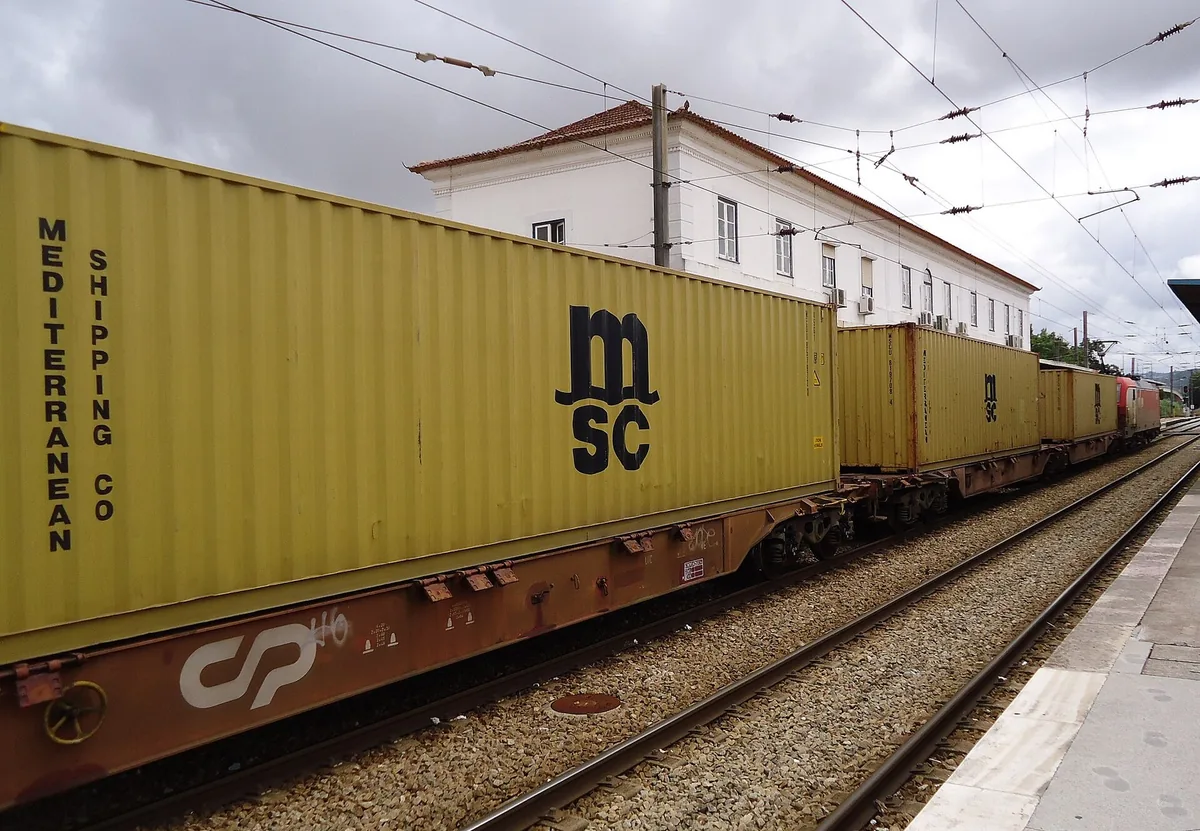
For as long as anyone writing about Portugal has been writing about Portugal, the arrival instruction for Coimbra was the same sentence. Get off the fast train at Coimbra-B, walk across the platform, take the free connecting train, and four minutes later you are in the middle of the city with your ticket still in your hand. It was one of the neatest arrivals in European rail travel, and it was true for decades.
It stopped being true at twenty past midnight on 12 January 2025. Infraestruturas de Portugal, the national rail infrastructure manager, had published the notice two days earlier. The wording was not hedged. The link between Coimbra-B and Coimbra station “será desativada definitivamente” — would be permanently deactivated — with services to the central station suppressed from that date, immediately after the train that left at 00:20.
Twenty months later, that sentence about the free shuttle is still being printed. This page is about why, and about what actually stands on the ground now.
What the shuttle actually was
Coimbra has a geography problem that predates all of this. The mainline — the Linha do Norte, the spine that carries every fast train between Lisbon and Porto — runs about two kilometres north of the city centre, and the station on it is Coimbra-B. The station in the city, down by the river in the Baixa, is officially just Coimbra, universally called Coimbra-A and locally the Estação Nova.
Two kilometres is too far to walk with a suitcase and too short to be worth a bus route of its own. So the railway solved it with railway: a short branch, a shuttle running on it, and a ticketing convention under which the shuttle was part of your long-distance journey rather than a separate fare. You did not buy a ticket. You did not check a timetable. You followed everybody else.
That arrangement did two things that are easy to underrate. It made Coimbra feel closer to Lisbon and Porto than it is, because the last two kilometres were frictionless. And it kept a working railway station in the middle of a historic city, which is a rarer thing in Europe than it sounds.
It also produced the single most copied paragraph in English-language writing about this city. Once a fact is that useful, and that stable, nobody re-checks it.
The notice, and what it said
The decision was not a service cut. It was a construction consequence.
Coimbra is building the Sistema de Mobilidade do Mondego, a bus rapid transit network running on the alignments of closed and converted railways. The corridor between the two stations is one of those alignments. You cannot run trains on a busway, and you cannot build a busway around a live railway, so one of the two had to go.
Infraestruturas de Portugal put it in the flattest possible Portuguese: with the construction of the SMM, the rail link between Coimbra-B and Coimbra “será desativada definitivamente”, with the suppression of services to Coimbra station from 12 January 2025, immediately after the 00:20 departure.
Read the adverb. Definitivamente is not temporariamente. This is not a closure for works with a reopening at the end of it. The infrastructure manager was announcing that a piece of railway had stopped being railway.
The same notice set out the replacement, which matters as much as the deletion. Metro Mondego would run identified buses between the two stations, free for CP passengers, from a marked stop beside each station, connecting with every train that had previously run through to the central station, at a peak provision of twelve buses per hour.
So the promise held: your train ticket still carries you into the middle of Coimbra at no extra cost. Only the vehicle changed. That is a smaller story than “the shuttle is gone”, which is exactly why it deserved to be reported rather than ignored.
Why guides still say otherwise
There is no conspiracy here and no laziness worth being rude about. There is a structural problem with how travel information ages.
A fact that has been true for thirty years reads as a permanent feature of the world. Nobody writing a Portugal itinerary sets a reminder to re-check whether a station still has trains in it. The instruction gets copied from an older guide into a newer one, then into a blog post, then into an answer in a forum, then into a summary of that forum, and every copy inherits the authority of the last one without inheriting the date.
The specific trap in Coimbra is worse than average for two reasons. First, the replacement is also free and also connects to your train, so somebody who arrives, follows the signs and rides a bus into town may never realise the advice they read was wrong — the outcome matched even though the mechanism did not. Second, the central station is still open. It still has trains, on the urban line toward Figueira da Foz. A page that says “take the train to Coimbra-A” is not describing a station that closed; it is describing a station that survived while its connection to the rest of the network did not. That is a harder error to spot.
We are not immune to this either. The honest version of the rule is that transport facts have a shelf life, and the only defence is to read the operator rather than the guide. That is why the station comparison page on this site links Infraestruturas de Portugal and the city’s own mobility hub rather than asking you to trust us in perpetuity.
What stands there now
Two things, and as of five days before this page was written they overlap.
The transfer bus. Metro Mondego’s identified buses still run between the stations, free on the strength of a CP ticket, from a signed stop beside the station building. If you arrive on an Alfa Pendular at any hour the service runs, this is the thing you are looking for. It is not hidden and it is not a favour; it is the contractual replacement for the train.
The Metrobus itself. On 10 September 2026 the urban section of the Metrobus reached Coimbra-B and Praça da República. The Câmara Municipal published the numbers: weekday runs across the system rose from 291 to 452, average frequency on the urban section is five minutes at peak and 7.5 minutes off-peak, and the vehicles carry 136 passengers. That is tram-grade service on a corridor that was a railway eighteen months earlier.
The same conversion programme is why Lousã is reachable from central Coimbra again after sixteen years without a railway. The Metrobus opened on the old Ramal da Lousã alignment on 16 December 2025, lost its Lousã–Serpins section to a landslide in January 2026, and resumed that section on 1 September 2026.
What we cannot tell you is the fare. Metro Mondego does not publish a visitor fare table we could verify, and SMTUC monthly passes were only being honoured on Metro Mondego validators through the end of September 2026 as a transition measure. If you are not holding a CP ticket, check the city’s live mobility hub rather than a figure from us.
What it means if you are arriving
Practically, very little, and that is the point worth making calmly rather than dramatically.
You will still get off at Coimbra-B, because every Alfa Pendular, Intercidades, InterRegional and Regional service on the Linha do Norte stops there and none of them go anywhere else in the city. You will still ride into town free. The difference is that you are boarding a road vehicle in city traffic rather than a train on a dedicated track, so build in twenty minutes of slack at the arrival end rather than four.
The other difference is a planning one. Because the transfer now feeds the wider Metrobus network, the useful question is no longer which station but which stop. Get off at the river end for the Baixa and anything flat; get off at Praça da República for the university side of the hill and the Alta. With luggage, that choice will matter more to your evening than anything else about your arrival.
One thing about the new network is still unresolved, and we would rather flag it than pretend. CP describes its Coimbra urban service as running “between Coimbra and Figueira da Foz” and names Coimbra-B as the interchange point, without stating which station the city-end trains now start from after the corridor conversion. If a beach day depends on it, check the current CP timetable for your travel date rather than trusting any guide, this one included.
And the hill is the part nobody automated away. The Elevador do Mercado rises 51 metres in two stages, runs Monday to Saturday 07:30–21:00 and Sundays and public holidays 10:00–21:00, and is the only published lift of its kind in the city. The transfer problem is solved. The climb is not.
If you want the full arrival sequence in order, the getting to Coimbra guide runs it from booking to bag-drop.