
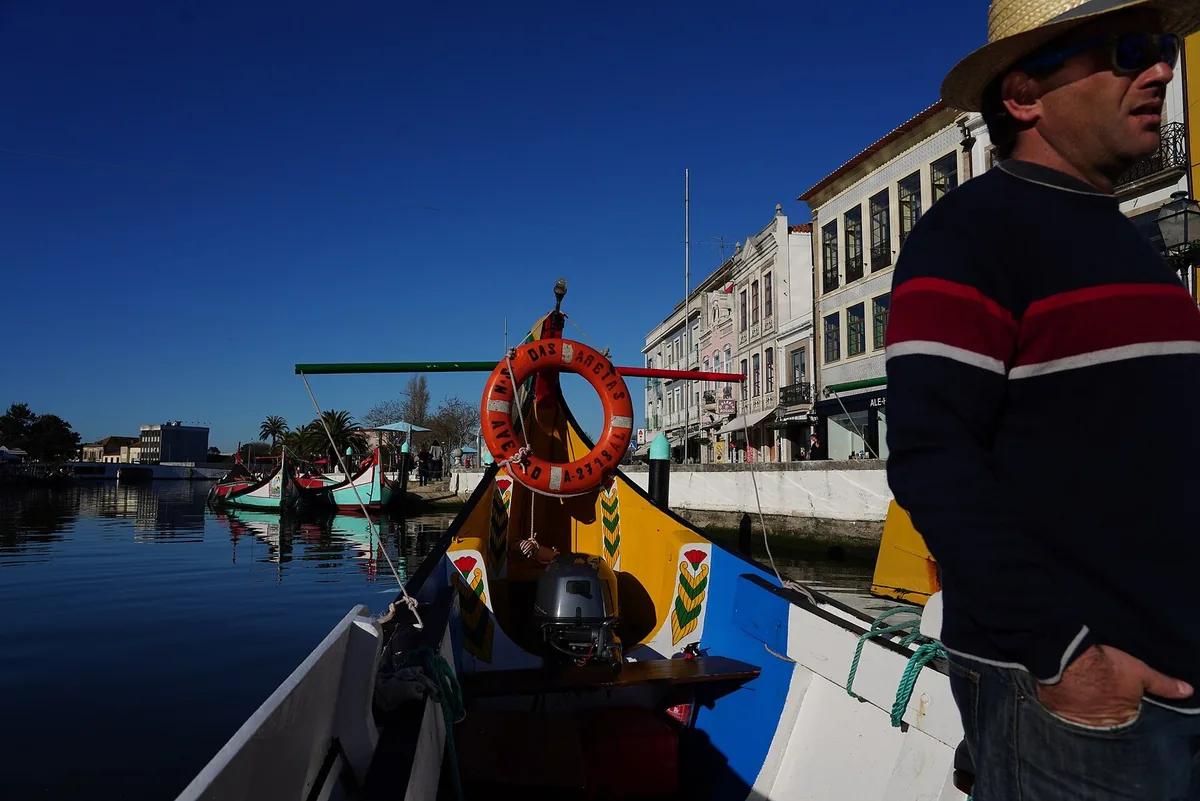
A lagoon city of canals, flat-bottomed moliceiro boats painted with jokes, Art Nouveau facades along the water, and ovos moles — the egg-and-sugar sweet sold in little wafer shells. At Costa Nova, a short way out, the fishermen’s houses are painted in vertical stripes.
Aveiro sits on the Linha do Norte, the same mainline that serves Coimbra-B, with Alfa Pendular, Intercidades, InterRegional and Regional services. That makes it the most conventional day trip on this site: a mainline train between two station buildings. The only complication is at the Coimbra end, and it is the same complication as everything else here.
Getting there, and the station trap
Your day starts at Coimbra-B. Not the central station. Every mainline service to Aveiro calls at Coimbra-B, two kilometres north of the Baixa, and the rail link between the two Coimbra stations was permanently deactivated on 12 January 2025.
So budget the transfer into the front of your day. The replacement is a free Metro Mondego road transfer for CP passengers from a marked stop by each station, timed to trains, at up to twelve buses an hour at peak. Since 10 September 2026 the Metrobus also serves Coimbra-B directly, with a five-minute peak frequency on the urban section.
This is not a hardship — it is a short, free, frequent ride. It is simply a step that older guides do not mention, because when they were written you took a shuttle train. Read the station guide once and the whole region gets easier.
Journey time, frequency and fare are not published here. We did not verify them in a form worth printing, and CP’s own booking flow will give you all three for your date. Nor do we publish a road or rail distance, because no official source we reached states one.
Why Aveiro rather than somewhere closer
Because it is genuinely unlike Coimbra, which is the point of a day trip.
Coimbra is vertical, medieval and academic: a hill with a university on top, 51 metres of climb between its two halves, and a World Heritage inscription covering 32 buildings. Aveiro is flat, aquatic and nineteenth-century. You spend a day at sea level looking at water and tiles after two days climbing stone stairs.
It also solves a problem for people who have already used their archaeology appetite. If you have done Conímbriga, a second day of Roman mosaics is not what you want, and Buçaco effectively needs a car.
What we will not do is describe Aveiro’s sights in detail. Our research covered the route and the region, not the town’s opening hours and prices. Rather than pad this page with unverified specifics about museums and boat operators, we will tell you plainly that this is a well-served mainline town and that the detail should come from Aveiro’s own tourist information.
The food, and a correction worth carrying
Aveiro’s sweet is ovos moles. Coimbra’s region has its own, and this is the place to get the attributions right, because the whole corridor between the two cities is conventual-pastry country and guides blur it into one.
Pastel de Tentúgal is IGP-protected, registered in the EU database, and comes from Tentúgal in the municipality of Montemor-o-Velho, Coimbra district — roughly 20 km west of Coimbra, not from the city and not from Aveiro. The dough is stretched to between 0.06 and 0.15 mm thick. The origin is the Convento de Nossa Senhora da Natividade, where Carmelite nuns lived from 1565 to 1898.
Leitão da Bairrada and Bairrada sparkling wine come from the Bairrada, centred on Mealhada, which lies between Coimbra and Aveiro and is largely in Aveiro district. If you are taking a slow train north, you are passing through the roast suckling pig country.
Coimbra’s own are arrufadas, the cinnamon and aniseed sweet bread, and pastéis de Santa Clara, attributed by the national register to the Convento de Santa Clara in the city.
How to plan the day
Treat it as a full day, and start early. Between the transfer to Coimbra-B, the mainline journey and the same in reverse, this is not a half-day trip even though the train itself is straightforward.
Check the Coimbra end before you go. If your visit falls on the Queima das Fitas parade day in May or the Latada in early October, the university circuit and Santa Cruz are closed anyway — those are ideal days to spend out of the city. The same applies to 4 July, the municipal holiday, when state museums close.
Costa Nova is a second decision. The striped fishermen’s houses are outside Aveiro proper and need onward transport we have not verified. Decide in Aveiro, with local information, rather than promising yourself both in advance.
If you have only one spare day and want certainty, Conímbriga and Figueira da Foz are the two trips whose services we could verify in detail. Aveiro is the better town; those two have the better-documented journeys.
If you are coming the other way
A large share of visitors meet Coimbra and Aveiro in the same sentence because tour operators sell them together from Porto, and it is worth understanding what that product is.
Several combined Porto–Coimbra–Aveiro day tours exist and rate reasonably — typically around 4.7, with the better-established ones carrying a hundred-odd reviews. One widely sold Fátima-and-Coimbra tour from Porto carries roughly 845 reviews at 4.7, but note what it is: a Fátima-led itinerary with Coimbra as a stop, not a Coimbra tour.
The weakest of them with a real sample is a private Porto–Aveiro–Coimbra tour at 4.3 across 28 reviews, at a private-tour price. A low score at a high price is worth flagging.
We do not print tour prices. The same products showed different figures on pages loaded minutes apart during our research. If you are approaching from the north rather than staying in Coimbra, the day trip from Porto guide sets out whether a combined coach day is the right call at all.