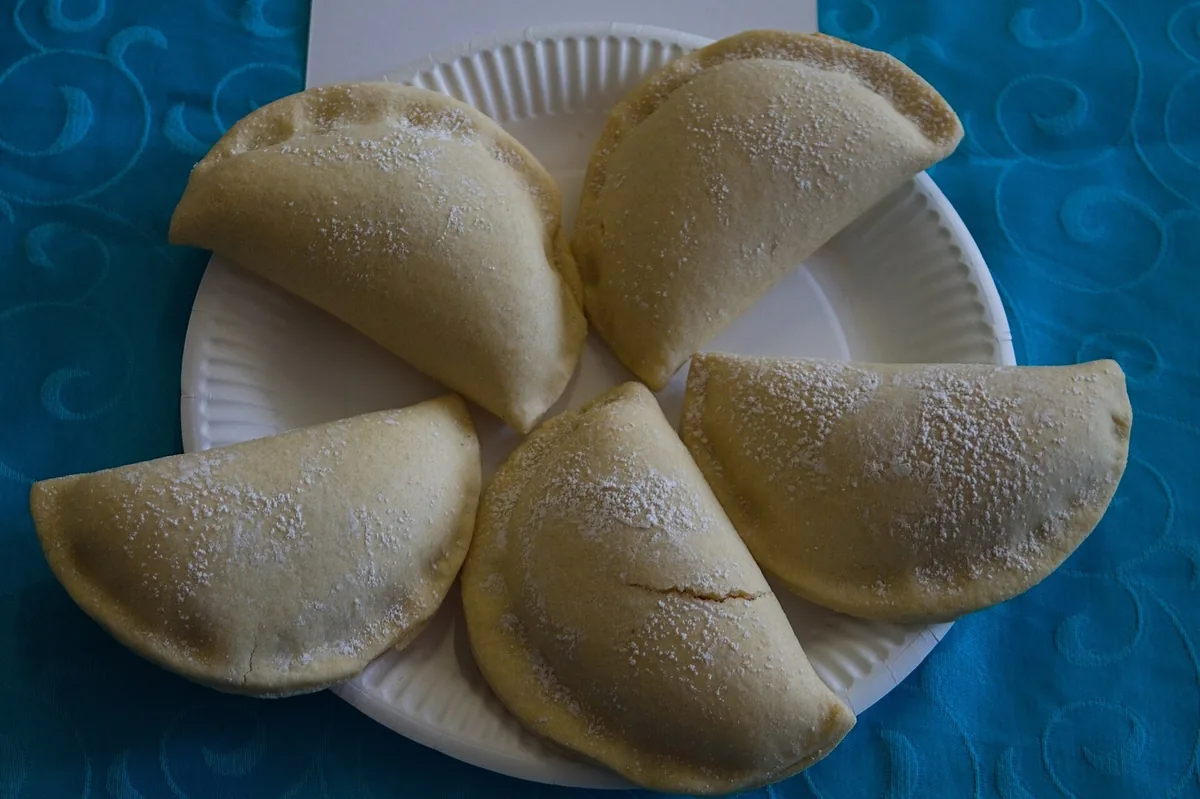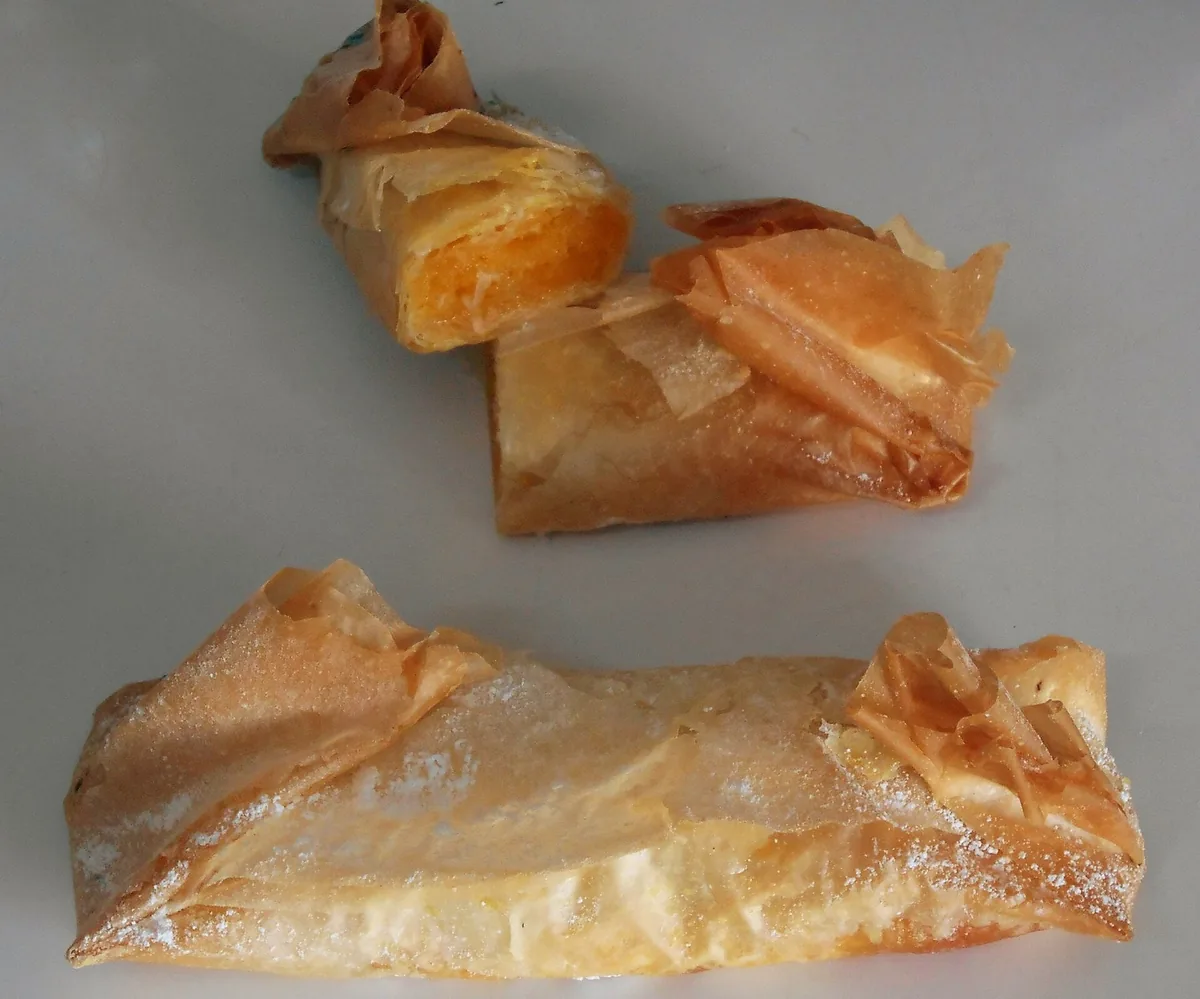

Hold one up to a window before you eat it. The pastry is stretched to between 0.06 and 0.15 millimetres — that is the official figure, not a flourish — which is thinner than a sheet of paper, and it is made from nothing but flour and water. Inside is egg yolk and whole egg cooked into sugar syrup. Bite it and the shell goes in layers, dozens of them, like something collapsing quietly.
This is one of the genuinely great pastries of Europe and it comes with a protected designation to prove it. It also comes from Tentúgal, in the municipality of Montemor-o-Velho, about twenty kilometres west of Coimbra. Not from Coimbra city, and emphatically not — as an automated summary once claimed — from the Covilhã region, which is in a different district a hundred and fifty kilometres away.
The pastry, and the 0.06 millimetres
The Portuguese agriculture ministry’s DGADR register gives the specification: a dough of water and flour, stretched to 0.06–0.15 mm, filled with egg yolk and whole egg in sugar syrup.
Four ingredients, and the entire difficulty is in one of the numbers. A dough that thin is stretched by hand across a cloth-covered table until it is translucent, then cut, filled and rolled. It tears if the room is too dry, if the flour is wrong, if the person doing it is in a hurry. This is why the skill has a producers’ association attached to it and why the pastry costs more than it looks like it should.
The filling is the Portuguese convent standard: yolks and sugar, cooked to a thick, glowing paste. It is intensely sweet and the pastry is there to give it structure and to cut it with something that is almost nothing at all.
Eat it the day you buy it. A shell that thin goes soft with humidity within hours, and a soft pastel de Tentúgal has lost the only thing that makes it remarkable.
The IGP, in full
This is one of the few dishes in this guide where we can print a protected designation with the evidence attached.
Pastel de Tentúgal holds an IGP — a Protected Geographical Indication — registered in the EU’s e-Ambrosia database under the number EUGI00000013984. The certifying body is Kiwa Sativa – Unipessoal Lda and the producer organisation is the Associação dos Pasteleiros de Tentúgal. All of that is on the DGADR register.
Compare that with leitão da Bairrada, which is routinely written “IGP” online while its certification process appears to be still in train, and which therefore carries no designation anywhere on this site. A protected name is a legal fact with a registry number behind it, and it should be treated as one.
What the IGP means in practice: a pastry made outside the defined zone, or outside the specification, cannot legally use the name. What you buy in Coimbra will have been made in Tentúgal or by a certified producer, which is the point of the scheme.
The convent, and the date
The pastry comes from the Convento de Nossa Senhora da Natividade in Tentúgal, where Carmelite nuns lived from 1565 to 1898. The DGADR dates the technique to the late sixteenth century.
Turismo Região de Coimbra adds two details: the first written reference dates to 1611, and the convent is also known as Nossa Senhora do Carmo.
Three hundred and thirty-three years of a single community making one pastry, followed by a further century of the town continuing after the nuns had gone, is an unusual continuity even by Portuguese standards. The producers’ association exists because the technique survived the institution that invented it.
The economics behind it are the same as everywhere else in the docaria conventual: convents used egg whites for starching habits and clarifying wine, and were left with yolks in industrial quantities. What Tentúgal did with its surplus was to invent a wrapper thin enough to make the yolks bearable.
A correction worth printing
During the research for this site, an automated summary of the DGADR page placed Tentúgal “in the Covilhã region”. That is wrong, and the error is instructive enough to publish.
Tentúgal is in Montemor-o-Velho, Coimbra district, about twenty kilometres west of the city toward the coast, confirmed against Turismo Região de Coimbra — which files the pastry under Montemor-o-Velho — and against the Câmara Municipal de Montemor-o-Velho, which lists Tentúgal among its parishes.
Covilhã is in Castelo Branco district, roughly 150 kilometres away, in the mountains on the other side of the country. The two have nothing to do with each other.
We print this because a guide that tells you where food comes from has to be right about geography, and because plausible-sounding location errors are the single most common failure in travel writing about regional food. This one was caught. Others in circulation have not been.
Where to eat it
Two Coimbra addresses are documented by a named travel writer. Pastelaria Briosa at Largo da Portagem, at the river end of the Baixa, which also carries pastéis de Santa Clara, queijadas de Coimbra and its own Suspiro Briosa. And Pastelaria O Alfonso, at Rua Gen. Humberto Delgado 412.
No opening hours or prices are published for either in anything we read, and we are not reprinting them from aggregators. Portuguese pastelarias bake early; go in the morning.
The better option, if you have transport and half a day, is Tentúgal itself. Twenty kilometres west, in a town whose pastry cooks have their own association, is where the thing is made rather than delivered, and freshness is the entire variable in a pastry this fragile.
And remember what you are eating. This is a Montemor-o-Velho sweet sold in Coimbra, in the same way that leitão is a Mealhada dish sold in Coimbra. The city’s own sweets are arrufadas and pastéis de Santa Clara — see what to eat in Coimbra for the full sorting.