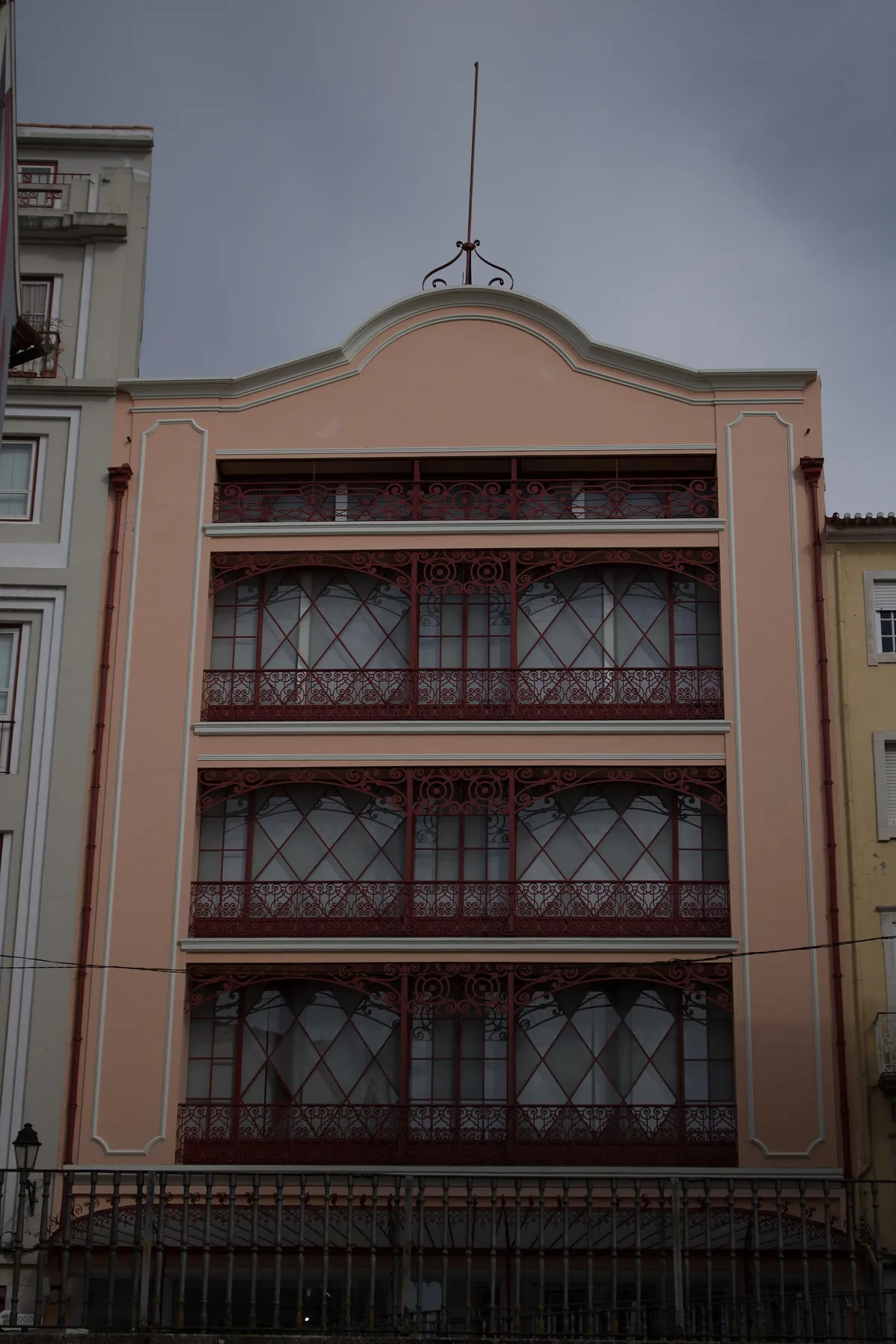

There is no building called the Museu Municipal de Coimbra. There are six, scattered through the historic centre, and the city runs them as one institution with one contact address and six different sets of opening hours. That is why almost no English-language guide handles it properly, and why visitors walk past several of them without knowing what they are.
Among the six: the tower above the Arco de Almedina, holding the display on the walled city; the Torre de Anto, holding a collection devoted to the Coimbra guitar and Coimbra fado; an exhibition on the Jews of Coimbra in the former Inquisition building; and a mikveh, a Jewish ritual purification bath. The last of those is barely mentioned in English anywhere.
Six museums, not one
Here is the whole institution in one table, with the addresses and hours the city publishes.
| Site | Address | Hours |
|---|---|---|
| Edifício Chiado — Coleção Telo de Morais | Rua Ferreira Borges, 85, 3000-180 | Tue–Fri 10:00–18:00; Sat–Sun 10:00–13:00 and 14:00–18:00; closed Mon and holidays |
| Torre de Almedina — Núcleo da Cidade Muralhada | Pátio do Castilho, 3000-103 | Tue–Sat 10:00–13:00 and 14:00–18:00; closed Sun, Mon and holidays |
| Torre de Anto — Núcleo da Guitarra e do Fado | Rua de Sobre Ribas, 3004-035 | Tue–Sat 10:00–13:00 and 14:00–18:00; closed Sun, Mon and holidays |
| Sala da Cidade — temporary exhibitions | Rua Olímpio Nicolau Rui Fernandes, 3000-303 | Tue–Sat 13:00–18:00; closed Sun, Mon and holidays |
| Edifício da Inquisição — Judeus de Coimbra | See official site | See official site |
| Mikveh — Jewish purification baths | See official site | See official site |
All six are inside the historic centre, and the first four are within about ten minutes’ walk of each other on the climb between the Baixa and the Alta.
The Sala da Cidade occupies the old refectory of Santa Cruz, which is a good reason to look in even when the temporary exhibition is not to your taste.
Allow 30 to 40 minutes per site. Three in a morning is comfortable; all six in a day is not, because of the hours.
The hours are the obstacle
Read the table again and the pattern jumps out. Most of these sites open Tuesday to Saturday, close from 13:00 to 14:00, and shut entirely on Sundays, Mondays and public holidays.
Sunday is when day-trippers from Lisbon and Porto are most likely to be in Coimbra with time on their hands. On Sunday, four of the six are shut.
The Edifício Chiado is the exception and the one to remember: it is the only site open at the weekend, Saturday and Sunday 10:00–13:00 and 14:00–18:00.
The Sala da Cidade goes the other way entirely, opening only at 13:00 — so a morning plan that ends there will find a locked door.
The reason is structural rather than perverse. These are municipal sites staffed on council hours, not commercial attractions chasing footfall, and their timetable reflects that.
The workable strategy: treat the municipal museum as a weekday morning block. Start at 10:00, do two towers before 13:00, eat, and pick up the Sala da Cidade at 13:00 or the Chiado afterwards.
Do not sprinkle them through a trip. You will miss all of them.
And if your Coimbra days are a Saturday and a Sunday, accept that this institution will mostly be closed to you and plan the university circuit instead — it runs to 19:30, seven days a week.
The two towers
If you can only do two, do the towers.
The Torre de Almedina sits above the Arco de Almedina, the surviving main gate of the walled town, and holds the Núcleo da Cidade Muralhada — the display on how Coimbra was enclosed and where the walls ran. It is the interpretive counterpart to the arch you walk through to reach the cathedral.
Its entrance is on Pátio do Castilho rather than on the lane below, which is why people photograph the gate and never find the museum. Phone +351 239 833 771, email [email protected].
The Torre de Anto, on Rua de Sobre Ribas, holds the Núcleo da Guitarra e do Fado de Coimbra — a municipal museum dedicated specifically to the Coimbra guitar and the city’s fado.
That is remarkable and almost nobody lists it. The Guitarra Portuguesa de Coimbra is a different instrument from the Lisbon guitar: teardrop-shaped, and tuned a whole tone lower, which is why Coimbra fado sounds darker than the Lisbon kind.
Coimbra fado is a serenade and a street music, sung standing, out of the university, with lyrics by poets who passed through the Academia. Students have been singing it in these streets since the 16th century.
So the city runs a museum about its own musical instrument, on the climb between the two fado venues on Rua do Quebra Costas, and hardly any visitor finds it.
Both towers keep the same hours: Tuesday to Saturday, 10:00–13:00 and 14:00–18:00.
The Jewish quarter
Two of the six sites deal with Coimbra’s Jewish history: the Edifício da Inquisição, with an exhibition on the Jews of Coimbra, and a mikveh — a ritual purification bath.
A mikveh is a specific, functional thing: a bath fed by running or naturally collected water, used for ritual immersion. Surviving medieval examples in Iberia are rare, and a city running one as a museum site is rarer still.
The city publishes addresses and hours for these two on its own platform rather than in the summary table, so check the official site directly before making the walk.
Coimbra’s Jewish quarter is a genuinely under-told story. Most English-language guides to this city do not mention it at all, and the standard one-day itinerary does not go anywhere near it.
The Inquisition building is the other half of that history, and the juxtaposition — the tribunal and the bath, run by the same municipal museum — is about as direct as heritage interpretation gets.
If this is your interest, contact the museum before you travel on +351 239 840 754 or [email protected]. These are small sites and the hours are the most likely obstacle.
It is also the strongest argument for treating the Museu Municipal as a serious half day rather than as a footnote to the university.
How to visit
The admission price is not published. The municipal museum platform lists addresses and opening hours for every site and carries no price list for any of them.
There is indirect evidence that a standard charge exists: the city has issued press releases announcing free-entry Saturdays across all the museum’s sites, which implies something to be free from. But the rate itself is not on the public record, and this page will not print a figure somebody else invented.
To find out, call +351 239 840 754 or email [email protected]. For the Almedina tower specifically, +351 239 833 771 and [email protected].
Ask about free-entry days while you are at it. If one falls in your window, it is worth rearranging a morning for.
There is an official virtual tour of the Torre de Almedina published by the city, which is the fallback if your dates land on a Sunday or Monday.
No advance booking is published or appears necessary for individuals.
Accessibility: two of the core sites are medieval towers on a steep hillside, and no step-free routes are published. The Edifício Chiado, on Rua Ferreira Borges in the flat Baixa, is the most likely to be manageable.
Municipal hours and prices change with council decisions rather than with the tourist season, so confirm on the museum platform before a fixed plan.
What to combine
The Arco de Almedina itself is free, always open and directly beneath one of the towers. Walk through it whatever the museum is doing.
Santa Cruz is three minutes from the Chiado on Praça 8 de Maio: royal tombs free in the nave, 5.00 EUR for the cloister, sacristy and high choir, closing at 16:30.
Uphill, the Sé Velha at 3.00 EUR is five minutes above the Almedina gate, and the Paço das Escolas above that runs to 19:30 when the municipal sites have long closed.
Note the big closure in this quarter: the Museu Nacional Machado de Castro has been shut since February 2026 with no reopening date, which makes the municipal sites more useful this year than they usually are.
For the music the Torre de Anto is about, Fado ao Centro is on Rua do Quebra Costas with a 50-minute show every day at 18:00, and the Coimbra fado guide explains what makes it different.