
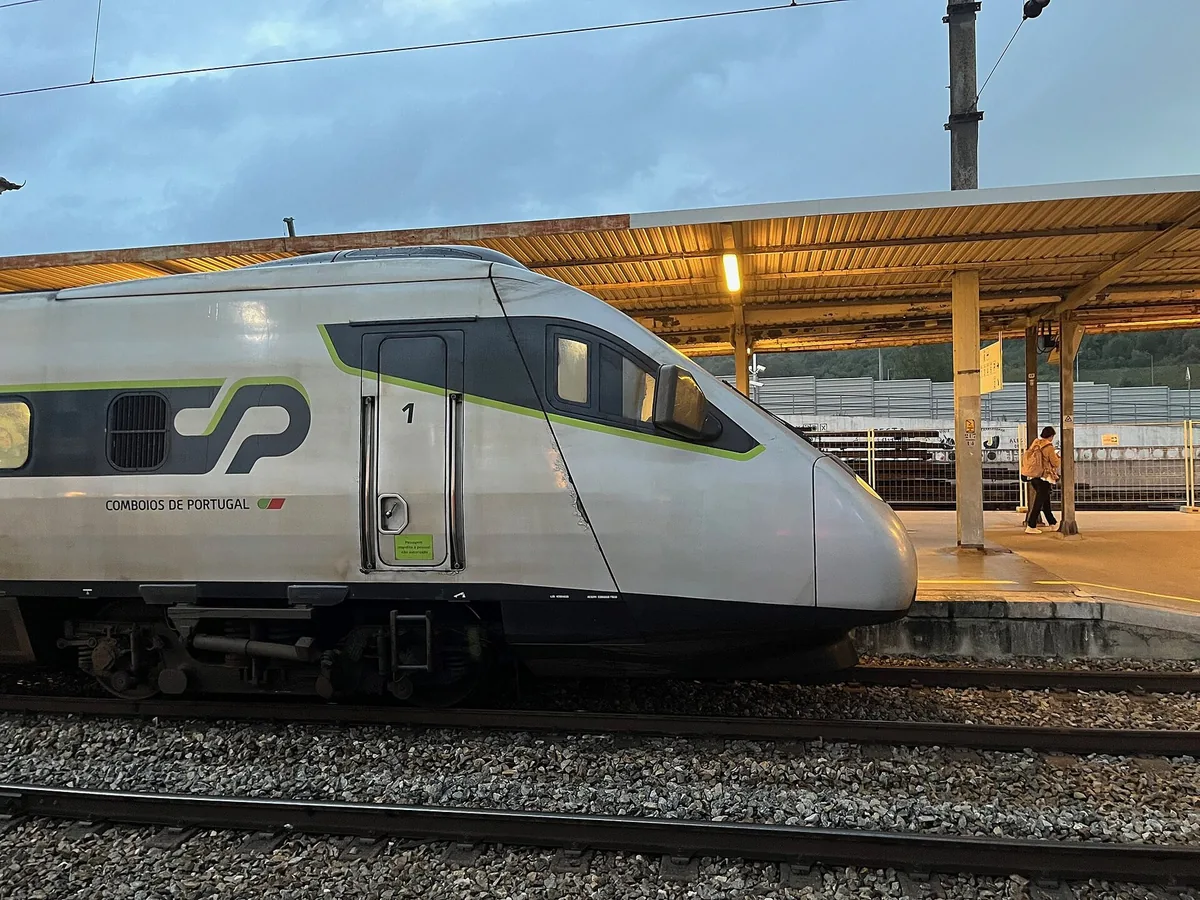
Coimbra sits on the Lisbon–Porto mainline, which makes it one of the easiest day trips in Portugal to reach and one of the easiest to get wrong. Every fast train stops here. None of them stops in the city.
The day works, and we would recommend it over a third day in Lisbon for anyone who wants contrast rather than more of the same. But it only works if you build it in the right order, and the right order is not the obvious one. You do not book the train first. You book the Joanina Library slot first, because it is a fixed time on a ticket with no exchanges and no refunds, and then you find a train that lands you here with ninety minutes in hand.
We do not publish a journey time or a fare. CP publishes both, they move with the timetable and the operator’s pricing, and a figure copied from a guide is a figure that will be wrong by the time you read it. Pull your date from cp.pt. What this page gives you instead is the arithmetic that works once you have those numbers.
Is it worth the day
Yes, with one qualification and one warning.
The qualification: what you are coming for is a university, not a skyline. The University of Coimbra was inscribed on the UNESCO list in 2013 — 32 buildings across the upper town and Rua da Sofia — and the single thing that justifies the journey is a library finished in 1728 with walls 2.11 metres thick and two colonies of bats living in it. If you want beaches, canals or tiles, Aveiro and the coast do that better and are a different trip.
The warning: three of Coimbra’s best-known sights are closed right now, with no reopening dates published. The Museu Nacional Machado de Castro has been shut since February 2026, Santa Clara-a-Velha since October 2025, and the University Tower is listed simply as closed. Perversely, that makes a day trip more feasible than it normally would be — there is less to leave out. But you should know it before you commit a day to it. The honest verdict page takes the whole question head-on.
What you get for the day: the university circuit with a stated average of three hours, a Romanesque cathedral begun in 1164 whose carvings contain no human figures at all, a national pantheon with Portugal’s first two kings in a free nave, a thirteen-hectare botanical garden that costs nothing, and — if your return train is late enough — an 18:00 fado show sung in a tradition that exists nowhere else.
That is a good day. It is not a rushed one, provided you do not also try to reach a Roman ruin.
Getting there, and the two kilometres at the end
Coimbra-B is the station. Alfa Pendular, Intercidades, InterRegional and Regional services on the Linha do Norte all call there, and none of them goes anywhere else in the city. It is about two kilometres north of the centre: a junction with a car park, not a place.
Do not look for a connecting train. This is the single instruction most guides still get wrong. A free four-minute shuttle train ran from Coimbra-B to the central station for decades, and it stopped on 12 January 2025. Infraestruturas de Portugal permanently deactivated the link so the corridor could be converted to the Metrobus. It is not suspended and it is not coming back. We have written up what happened at length, because a lot of published advice is still describing it.
What you do instead: follow the signs out of the station to the marked Metro Mondego stop beside the building, and ride in free on the strength of your CP ticket. Infraestruturas de Portugal put the peak provision at twelve buses an hour, timed to arriving trains. Keep the ticket in a pocket rather than the bottom of a bag.
Since 10 September 2026 the Metrobus itself reaches Coimbra-B and Praça da República. Weekday runs across the system went from 291 to 452, and the urban section now averages five minutes at peak. In practice the transfer is no longer something you wait for.
Get off by the river for the Baixa and a downhill day, or at Praça da República for the university side of the hill. On a day trip built around a library slot, Praça da República is usually the better choice: you arrive on the same level as the thing you booked.
Build twenty minutes of slack into the arrival, not four. This is a road vehicle in city traffic now, not a train on a dedicated track. The station guide has the full picture.
What actually fits in a day
Work it out with published durations rather than optimism. All of these are the operators’ own stated figures.
| What | Stated time | Cost |
|---|---|---|
| University circuit with the Joanina | 3h | 16.50 EUR |
| University circuit without it | 2h30 | 12.50 EUR |
| Guided Palace of Schools tour | 1h30 | 25.00 EUR |
| Sé Velha | 30–45 min | 3.00 EUR |
| Mosteiro de Santa Cruz | 45–60 min | 5.00 EUR (nave free) |
| Fado ao Centro show, 18:00 | about 50 min | 16.00 EUR |
The realistic day is the university circuit, one cathedral and Santa Cruz, on foot, with lunch. That is about five hours of sights plus walking, and it is comfortable rather than tight.
The ambitious version adds the 18:00 fado show, which pushes your return train into the evening. Fado ao Centro runs every single day of the year at 18:00 for roughly 50 minutes, 16.00 EUR with a glass of Port included, and the show ends in time for a late train. Check your last departure before you book the seat, not after.
What does not fit is Conímbriga. The Roman town is genuinely excellent and it is not compatible with a day trip from Lisbon. SIT line 209 runs three services each way on weekdays and the last one back leaves the site at 17:55. Committing to that timetable means committing your whole day to it. Conímbriga is the reason to stay a night, not the reason to rush one.
And do not plan a Sunday. Santa Cruz does not open until 13:00, the Almedina tower museum does not open at all, the Sé Velha opens at 11:00 rather than 09:30, and St Michael’s Chapel closes 11:45–14:00 for mass. Sunday removes about a third of what you came for.
The order to do it in
One rule governs the shape of the day: go up once and walk down everything. Coimbra is a hill town with a river at the bottom, and doing it in the wrong order turns one climb into three.
On arrival, take the transfer to Praça da República and walk into the Alta. If you have landed in the lower town instead, the Elevador do Mercado rises 51 metres in two stages and runs from 07:30 Monday to Saturday and 10:00 on Sundays.
The university first, at your booked slot. Collect at the ticket kiosk in front of the Faculty of Medicine — its official GPS is 40.207938, -8.424189, worth putting in a phone because the Alta defeats most map pins. Arrive ten minutes early; entry to the library is batched at fifty people every twenty minutes and late arrivals are refused. Bring a layer even in August: those thick walls hold the interior cold.
Then downhill. The Sé Nova is a minute from the kiosk and costs 1.00 EUR, the cheapest interior in the upper town. The Sé Velha is fifteen minutes further down at 3.00 EUR. Through the Arco de Almedina — a free public street — and you are in the lower town.
Lunch in the Baixa. The dense cluster of documented restaurant addresses is on Rua da Sota, Rua das Azeiteiras, Rua Direita, Praça do Comércio and Terreiro da Erva. Portuguese lunch starts about 12:30 and the good houses are full by 13:00. Our food guide is blunt about which famous dishes actually come from this city, which is fewer than you would think.
Finish at Santa Cruz on Praça 8 de Maio, where the nave and the royal tombs are free and 5.00 EUR opens the cloister and the high choir stalls. Then either the free 18:00 fado at Café Santa Cruz in the same square, or the ticketed show up the hill.
If you have an hour spare rather than a sight to add, spend it in the botanical garden. Thirteen hectares, free, part of the same 2013 UNESCO inscription as the university, open until 20:00 from April to September and 17:30 through the winter, running downhill from the Alta toward the river. It is the gentlest possible way to come off the hill, it costs nothing, and on a day trip it is a better use of a spare hour than a fourth ticket.
That whole route is the Alta to Baixa descent, and the one-day itinerary times it out.
Coach tour or train
There is a large market in organised day trips from Lisbon that include Coimbra, and it is worth being clear about what you would be buying.
Most of them are not Coimbra tours. The high-volume products pair Coimbra with somewhere else — Aveiro and Costa Nova, Fátima, Tomar — and Coimbra is a stop of two or three hours inside a longer itinerary. Two or three hours is roughly the stated duration of the university circuit alone. If the Joanina Library is why you are going, check very carefully whether the product includes university entry, because a coach stop outside a ticketed timed-entry building is not a visit.
What the listings looked like when we checked, on 15 September 2026. The Lisbon-side product with the best combination of rating and sample was “From Lisbon: Coimbra, Aveiro, and Costa Nova”, showing 4.8 across 18 to 19 reviews — a good score on a small sample. Several private Lisbon–Coimbra products carried no rating at all; a 5.0 across two reviews is not information. Prices moved between page loads on the same day, so we do not print them.
One product to check before you book it. A listing carrying more than 1,500 reviews appears on Coimbra pages with a URL implying Porto, Nazaré and Coimbra but a displayed title naming Porto, Óbidos and Nazaré. Verify what it actually visits before assuming Coimbra is on it. A mismatch of that kind on the most prominent Lisbon-side product is exactly the sort of thing that ruins a day.
Our view: take the train. Coimbra is on the main line, the transfer at the end is free with your ticket, the walking is short, and going independently is the only way to hold a timed library slot rather than hope a coach schedule matches it. A guided tour makes sense if you cannot manage the hill, if you want Fátima or Tomar in the same day, or if driving and parking are the alternative. Our walking tour page covers guides once you are here, which is a different and usually better purchase.
What goes wrong, and how to avoid it
Five failure modes, in the order we see them.
1. The library slot sells out and the day loses its point. The university publishes no sell-out data, so nobody can honestly tell you how far ahead to book. The only hard signal is that its guided tour is capped at three months’ advance sale because of booking volume. If your date is fixed, buy when you book the train. If slots are gone, the 12.50 EUR University + Science Museum programme covers everything else on the circuit and the Sala dos Capelos alone justifies it.
2. Looking for a shuttle train that ended twenty months ago. Covered above. There is no platform to change on.
3. Turning up in the last week of May or the first week of October. The entire university circuit closed on 24 May 2026 for Academic Week during the Queima das Fitas, and closes again on 4 October 2026 for the Latada. Santa Cruz shuts on both parade days. These dates move each year. Check before you book anything.
4. Arriving on a Sunday. See above. If Sunday is your only option, the weekend itinerary is built from what actually opens.
5. Booking a tight return. The transfer back to Coimbra-B is a bus in traffic. Give it twenty minutes, and do not make the 18:00 fado show and the last train a fifteen-minute problem.
6. Assuming the museums will fill a wet afternoon. They will not. The Machado de Castro is closed, the Science Museum spaces shut an hour earlier than the Palace of Schools, and the municipal museum sites close for two hours at lunch and all day on Sundays and Mondays. A rainy Coimbra day is a church day and a fado day, and it is worth knowing that before the forecast decides it for you.
One more thing worth knowing. If the day goes well and you wish you had longer, the answer is not a second day trip. It is one night, which converts Coimbra from a city you saw into a base with Conímbriga, Buçaco and the schist villages attached to it. The where to stay guide splits the choice into flat and steep, which is the only decision that matters here.