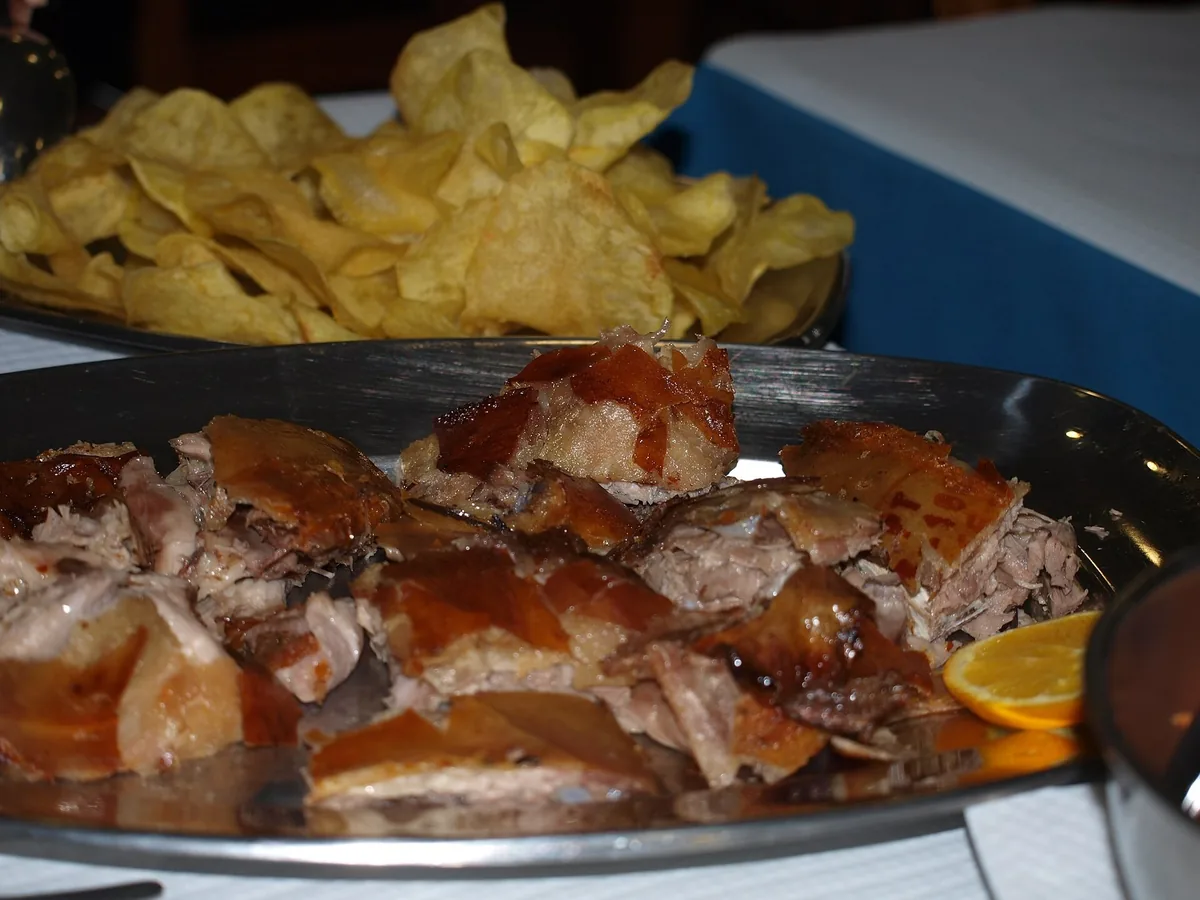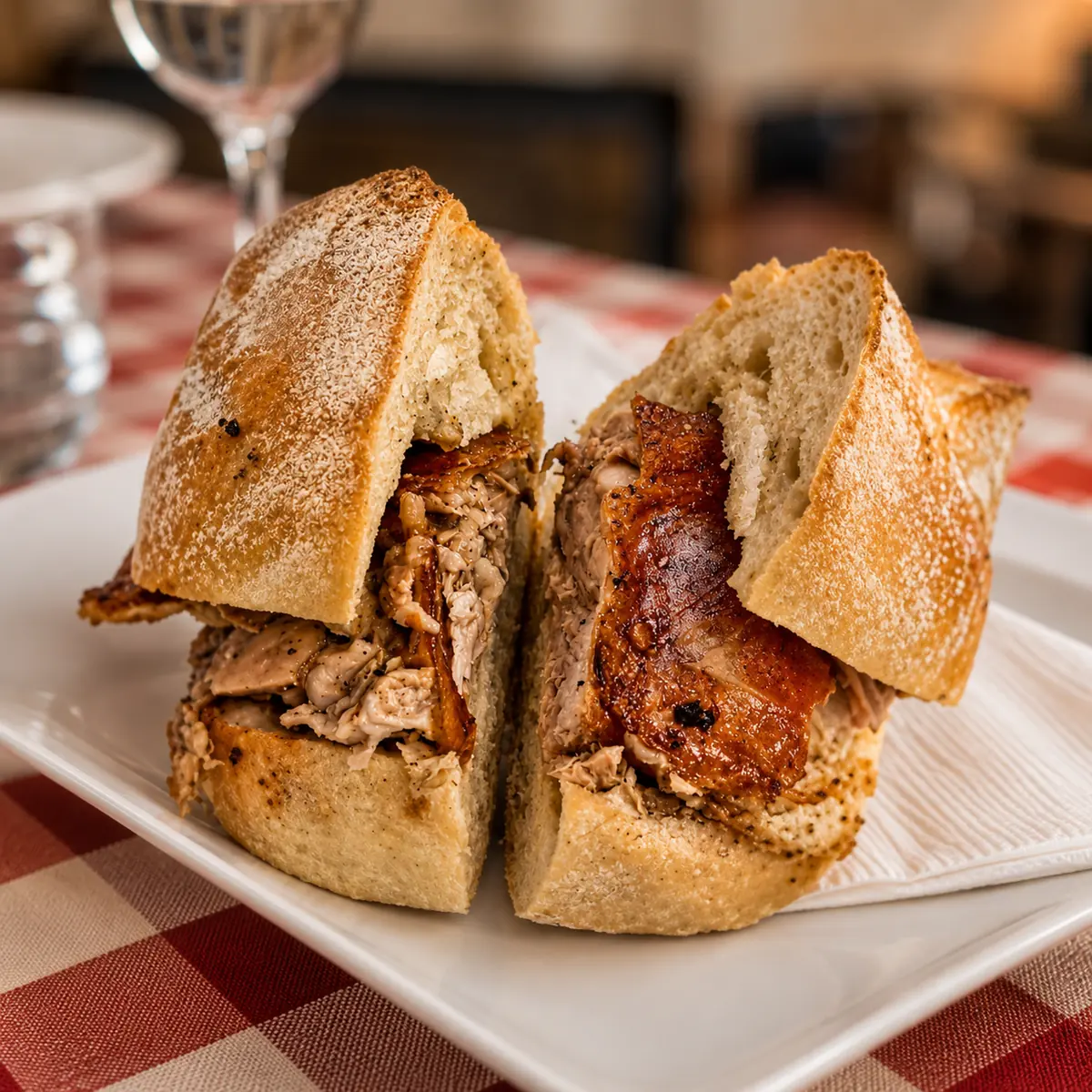

The best thing about a suckling pig is the sound. Skin lacquered to the colour of a chestnut and thin as glass, and when the knife goes in it cracks rather than cuts. Underneath is meat so young it has barely any character of its own, which is the point: it carries garlic, pepper, lard and salt, and it is cut into slabs and eaten with a shrug rather than with reverence.
João dos Leitões serves it on Rua da Gala in Coimbra, banded € by the travel writer Ola Daniela, who also records leitão sandwiches. Before you go, one thing needs saying clearly, because most Coimbra guides do not say it: leitão da Bairrada is not a Coimbra dish. It belongs to the Bairrada, centred on Mealhada, about twenty kilometres north and largely in the neighbouring district of Aveiro. Coimbra serves it. Coimbra did not originate it.
Why this is not a Coimbra dish
The distinction matters because the whole value of a city guide is knowing which claims to believe.
Leitão da Bairrada is the signature dish of the Bairrada, a demarcated stretch of country between Coimbra and Aveiro whose capital for this purpose is Mealhada. The old national road through Mealhada is lined with roasting houses, some of them eighty years old, and that is where the dish is a local institution rather than a menu item.
A certification process for the name has been running, with the Associação Rota da Bairrada as qualifying body and the Mealhada municipality publishing on it. Whether IGP registration has completed is not confirmed, so you will not see us print “IGP” next to this dish the way many sites do. When a protected designation is genuinely in force we say so — as with the pastel de Tentúgal, which is registered.
None of that is an argument against eating leitão in Coimbra. It is an argument against a guide that lists it alongside arrufadas and pastéis de Santa Clara as though the three came from the same place. Two of those three are the city’s. This one is a guest.
It is a guest with very old residency rights, mind. The Bairrada begins less than half an hour up the road, the dish has been on Coimbra tables for generations, and no resident would blink at eating it here. The objection is only to the labelling.
What the Bairrada houses charge
No menu price is published for João dos Leitões, so we cannot tell you what a plate costs here. What we can give you, from the named Spanish and Portuguese guide Guia Repsol, is the pricing at the three best-known houses in Mealhada, as a calibration.
Pedro dos Leitões, founded 1941, on the old EN1: roast leitão at 52 EUR per kilo, and iscas de leitão at 18 EUR. Rei dos Leitões, founded 1947, which moved to fine dining in 2010 and keeps a wine list of 4,200 references: a leitão dose at 25.50 EUR. Churrasqueira Rocha, founded 1979: leitão sandwiches at 7.50 EUR.
Those are snapshots from a named guide, not promises, and they are Mealhada prices rather than Coimbra ones. What they tell you is the shape of the thing: a sandwich is a single-figure lunch, a proper plate is in the mid-twenties, and buying the animal by weight is how the serious houses sell it.
Given the € band here, expect this address to sit at the sandwich-and-plate end rather than the by-the-kilo end. Ask before ordering; nothing is published.
The other thing those three houses tell you is how old the trade is. Founded in 1941, 1947 and 1979, all on or beside the same road, all still roasting. That is not a tourist phenomenon; it is an industry that grew up feeding people driving between Lisbon and Porto before the motorway existed.
How leitão is actually eaten
Two ways, and they are different meals.
The sandwich is street food: pork and crackling in a soft roll, eaten standing or in the car, no cutlery. It is the version most people in this region actually consume most often and it is one of the great cheap lunches in Portugal.
The plate is a sit-down affair: slabs of pig with crisp skin, orange slices, chips or plain boiled potato, and a peppery garlic sauce made from the roasting juices. It is rich and it is not subtle, and half a dose between two people is plenty unless you have walked up from the river.
The traditional drink alongside it is Bairrada sparkling wine, from the same region as the pig. The acidity and the bubbles cut the fat, which is the entire logic of the pairing. If the house has it, order it; if not, a cold light red will do the same job.
Do not plan anything strenuous afterwards. This is a meal that ends with a long sit down, and the climb to the Alta is unkind to anyone who has just eaten a quarter of a pig.
A word on the skin, since it is the whole trick. The pig is basted and turned so the fat under the skin renders out and the surface dries and blisters. If the crackling on your plate is soft or chewy, the roast was rushed or it has been sitting. It should shatter.
Getting there, and what is missing
The address is Rua da Gala 45, from Ola Daniela. That is the extent of the location information: no source we read placed the street inside a named quarter, so this restaurant is filed under no neighbourhood here rather than being assigned to one on a guess.
Also missing: opening hours, closing day, telephone number, official website, menu and individual prices. No rating we are prepared to reprint, either.
Map the street before you set out, allow generous walking time, and be aware that Coimbra’s topography turns short map distances into long walks — the practicalities are in getting around Coimbra.
If the trip matters more than the convenience, the honest recommendation is to go to the source. Mealhada is about twenty kilometres north on the old road, the roasting houses are on it, and eating leitão where it is a local argument rather than an import is a different experience entirely.
The verdict
A cheap, straightforward way to eat one of central Portugal’s great dishes without leaving the city. That is a real convenience and we are not sniffy about it.
Go if you want leitão, have one day in Coimbra, and are not going to get to Mealhada. Go especially for the sandwich, which is the everyday version and the one that suffers least from being served away from home.
Do not go believing you are eating a Coimbra speciality, because you are not. And do not build a food itinerary out of dishes that belong to other towns — what to eat in Coimbra sorts the genuinely local from the regional, and the genuinely local list is short: arrufadas and pastéis de Santa Clara.
Bring cash as well as a card. Nothing about payment is published, and inexpensive Portuguese roasting houses are inconsistent about terminals.
And if the door is shut when you arrive, do not treat the trip as wasted. Nothing about this restaurant is published, which means a closed door is information rather than bad luck, and the lower town’s dozen kitchens are a short walk away.